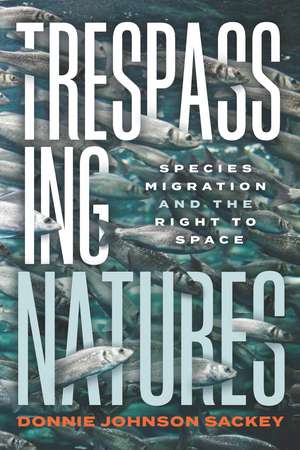
Trespassing Natures: Species Migration and the Right to Space
Autor Donnie Johnson Sackeyen Limba Engleză Paperback – aug 2024
Honorable Mention, 2025 Association for the Rhetoric of Science, Technology, and Medicine Book Award
As old worlds become hostile and new spaces become hospitable, many species are shifting their ranges to live in locations where they have never previously existed. Biological and sociocultural realms collide and boundaries blur, making it increasingly difficult to mark definitively who belongs and who is a trespasser. In Trespassing Natures, Donnie Johnson Sackey troubles the idea of biological “invasion,” turning our attention away from scientific considerations and toward the discursive and rhetorical dimensions of this term—offering a new paradigm that recasts this issue as a question of what it means to live in multi-species communities. Presenting case studies on bed bugs, bighead carp, feral cats, and mackerel, Sackey argues that the identification of a species as an invader is not merely a scientific act, but a cultural and political one. By questioning issues around space, identity, and the institutions that make human participation apparent, Sackey redirects focus away from the belief that a single species threatens space. Ultimately, Trespassing Natures asks us to expand our idea of community and question who has the right to space.
As old worlds become hostile and new spaces become hospitable, many species are shifting their ranges to live in locations where they have never previously existed. Biological and sociocultural realms collide and boundaries blur, making it increasingly difficult to mark definitively who belongs and who is a trespasser. In Trespassing Natures, Donnie Johnson Sackey troubles the idea of biological “invasion,” turning our attention away from scientific considerations and toward the discursive and rhetorical dimensions of this term—offering a new paradigm that recasts this issue as a question of what it means to live in multi-species communities. Presenting case studies on bed bugs, bighead carp, feral cats, and mackerel, Sackey argues that the identification of a species as an invader is not merely a scientific act, but a cultural and political one. By questioning issues around space, identity, and the institutions that make human participation apparent, Sackey redirects focus away from the belief that a single species threatens space. Ultimately, Trespassing Natures asks us to expand our idea of community and question who has the right to space.
| Toate formatele și edițiile | Preț | Express |
|---|---|---|
| Paperback (1) | 244.67 lei 6-8 săpt. | |
| Ohio State University Press – aug 2024 | 244.67 lei 6-8 săpt. | |
| Hardback (1) | 562.39 lei 6-8 săpt. | |
| Ohio State University Press – aug 2024 | 562.39 lei 6-8 săpt. |
Preț: 244.67 lei
Puncte Express: 367
Preț estimativ în valută:
43.27€ • 50.59$ • 37.62£
43.27€ • 50.59$ • 37.62£
Carte tipărită la comandă
Livrare economică 07-21 martie
Specificații
ISBN-13: 9780814259160
ISBN-10: 0814259162
Pagini: 180
Dimensiuni: 152 x 229 x 15 mm
Greutate: 0.27 kg
Editura: Ohio State University Press
Colecția Ohio State University Press
ISBN-10: 0814259162
Pagini: 180
Dimensiuni: 152 x 229 x 15 mm
Greutate: 0.27 kg
Editura: Ohio State University Press
Colecția Ohio State University Press
Recenzii
“In this timely and important contribution to conversations on environmental rhetoric, Sackey offers methodologies for studying complex sociobiotic ecologies and for reimagining our collective response to multispecies climate precarity.” —Candice Rai, author of Democracy’s Lot: Rhetoric, Publics, and the Places of Invention
“Sackey argues for a new paradigm for invasiveness that encourages us to rethink species belonging—our own and that of nonhuman others. Configuring space, identity, and institutions as the social actors that frame invasive species, Sackey thoughtfully expands notions of community to include those we often want to exclude from consideration.” —Jennifer Clary-Lemon, author of Nestwork: New Material Rhetorics for Precarious Species
“An important book that persuasively pushes us to rethink how we talk about nonhuman species range shifting in a global context of concurrent growth in climate-induced ecosystem stress and xenophobic hostility to migrants.” —Tarquin Holmes, H-Net Reviews
“Particularly timely....Trespassing Natures contributes to discussions in rhetoric and writing studies that engage with ecology, multiplicity, and pluriversality.” —Bridie McGreavy, ISLE: Interdisciplinary Studies in Literature and Environment
“Trespassing Natures is useful especially for communication scholars interested in further scrutinizing what ‘animal’ means in contemporary society, as well as for anyone interested in expanding societal boundaries to accommodate a more inclusive environment....At a time when the right to a particular space is such a controversial topic, this book provides a potential framework for cooler heads to prevail and for an alternative understanding of all things ‘invasive,’ human or otherwise.” —Teo Rogers Mendizabal, International Journal of Communication
Notă biografică
Donnie Johnson Sackey is Assistant Professor in the Department of Rhetoric and Writing at the University of Texas at Austin. His work has appeared in Communication Design Quarterly,Rhetoric Review,Journal of Technical Writing and Communication, and Technical Communication Quarterly, among others.
Extras
The murder hornet (Vespa mandarinia), feral pig (Sus scrofa), and black locust (Robinia pseudoacacia) are just a handful of other species deemed nuisance or invasive species within the popular media and public imagination. Some of these species came here through accidental introduction; some were intentionally introduced; and others simply expanded their range to live in locations where they have never existed before. Is it a problem for these species to exist outside their perceived ranges? It is becoming increasingly difficult to answer that question. Some species, like the southern pine beetle (Dendroctonus frontalis), have cost nearly a billion dollars in economic loss in the agroforestry industry. By contrast, many pollinators have come to rely on Japanese honeysuckle (Lonicera japonica) as their savior during increasingly warmer weather accompanied by extended periods of drought. At the same time, while Japanese honeysuckle is naturalized in parts of Hawai‘i, it is considered a noxious weed in Texas, and prohibited for sale or propagation in New Zealand. In other words, its acceptance across borders depends on how humans are willing to tolerate it within space as a citizen, a temporary resident, or an undocumented immigrant.
Before I can dismantle the idea of biological invasion, I first need to explain how we arrived at such an idea. Beliefs about species’ movement in space are the result of early ecologists using naturalizing human social processes to understand nonhuman animal behavior. For just over half a century, the native versus alien dichotomy has been the leading paradigm that has guided not only our understanding of species’ belongingness in space but also conservation efforts around the world. In 1957 Charles S. Elton, a British animal biologist and principal founder of invasion ecology (a subdiscipline of ecology that studies the nature of biological invasions), gave a series of three presentations on BBC radio entitled Balance and Barrier. These recorded broadcasts were Elton’s attempt to share with the public his ideas about introduced species and the risks they present to communities. The British public was less than enthusiastic toward Elton’s ideas at the time. The BBC’s extant audience research records indicate that surveyed listeners rated his presentations with “slightly above average [interest] . . . [and] appreciated Elton’s wit; but it is not recorded that any responded as if they had been called to action.” A year later, Elton published The Ecology of Invasions by Animals and Plants based on his BBC series, which sounded the alarm of the impact of nonnative species establishing populations on local ecosystems around the world. In The Ecology of Invasions, Elton writes of “two rather different kinds of outbreaks in populations: those that occur because a foreign species successfully invades another country; and those that happen in native or long-established populations.” Elton called on ecologists to understand the cause of biological invasions in order to halt or prevent them. Elton creates a few problems in his articulation of the relationship between foreign and native species. First, he focuses on the former—the invaders—while ignoring the biological successions of established species. His writing ignores the relationship between place and time in that it encourages audiences to believe the flora and fauna are static to the point that we can establish an idea of nativity. This belies the fact that environments are dynamic and are always changing regardless of a human presence. Second, Elton’s use of words such as outbreaks, invades, foreign, and native frames a matter of science within the realm of the political, and quite irresponsibly so. Nonexpert audiences who lack scientific frames can only understand species’ movements through ideas of nationalism and contagion. This frame encourages audiences to oscillate between two extreme polls, which rouse them to either welcome species as biological citizens or reject them as uninvited foreigners.
Before I can dismantle the idea of biological invasion, I first need to explain how we arrived at such an idea. Beliefs about species’ movement in space are the result of early ecologists using naturalizing human social processes to understand nonhuman animal behavior. For just over half a century, the native versus alien dichotomy has been the leading paradigm that has guided not only our understanding of species’ belongingness in space but also conservation efforts around the world. In 1957 Charles S. Elton, a British animal biologist and principal founder of invasion ecology (a subdiscipline of ecology that studies the nature of biological invasions), gave a series of three presentations on BBC radio entitled Balance and Barrier. These recorded broadcasts were Elton’s attempt to share with the public his ideas about introduced species and the risks they present to communities. The British public was less than enthusiastic toward Elton’s ideas at the time. The BBC’s extant audience research records indicate that surveyed listeners rated his presentations with “slightly above average [interest] . . . [and] appreciated Elton’s wit; but it is not recorded that any responded as if they had been called to action.” A year later, Elton published The Ecology of Invasions by Animals and Plants based on his BBC series, which sounded the alarm of the impact of nonnative species establishing populations on local ecosystems around the world. In The Ecology of Invasions, Elton writes of “two rather different kinds of outbreaks in populations: those that occur because a foreign species successfully invades another country; and those that happen in native or long-established populations.” Elton called on ecologists to understand the cause of biological invasions in order to halt or prevent them. Elton creates a few problems in his articulation of the relationship between foreign and native species. First, he focuses on the former—the invaders—while ignoring the biological successions of established species. His writing ignores the relationship between place and time in that it encourages audiences to believe the flora and fauna are static to the point that we can establish an idea of nativity. This belies the fact that environments are dynamic and are always changing regardless of a human presence. Second, Elton’s use of words such as outbreaks, invades, foreign, and native frames a matter of science within the realm of the political, and quite irresponsibly so. Nonexpert audiences who lack scientific frames can only understand species’ movements through ideas of nationalism and contagion. This frame encourages audiences to oscillate between two extreme polls, which rouse them to either welcome species as biological citizens or reject them as uninvited foreigners.
Cuprins
Introduction Rhetoric and the Placing of (Invasive) Species
Chapter 1 Bugs without Borders: Spatializing Invasion’s Rhetorical Ecology
Chapter 2 Unruly Fish: Regulating Identity within and across Borders
Chapter 3 Cat’s Cradle: Rendering Life Disposable through Institutions
Chapter 4 Holy Mackerel! Reconsidering Invasion Ecology in the Anthropocene
Conclusion H. Sapiens
Chapter 1 Bugs without Borders: Spatializing Invasion’s Rhetorical Ecology
Chapter 2 Unruly Fish: Regulating Identity within and across Borders
Chapter 3 Cat’s Cradle: Rendering Life Disposable through Institutions
Chapter 4 Holy Mackerel! Reconsidering Invasion Ecology in the Anthropocene
Conclusion H. Sapiens
Descriere
Forwards a discursive and rhetorical definition of invasion, offering a new paradigm that reconsiders what it means to live in multi-species communities.