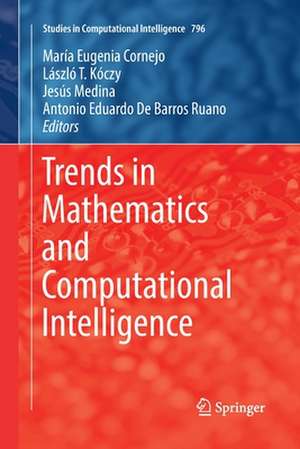
Trends in Mathematics and Computational Intelligence
Editat de María Eugenia Cornejo, László T. Kóczy, Jesús Medina, Antonio Eduardo de Barros Ruanoen Limba Engleză Paperback – 10 dec 2019
Many areas of knowledge call for hybrid solutions that combine traditional mathematical techniques and computational intelligence based on subsymbolic knowledge representation. Important research topics are focused on developing the interaction between computational intelligence and mathematics, in order to address various challenges of the current technological age.
Written by influential, leading researchers, this book discusses the latest trends in hybridising mathematics and computational intelligence.
Preț: 644.47 lei
Preț vechi: 805.58 lei
-20%
Puncte Express: 967
Carte tipărită la comandă
Livrare economică 13-27 noiembrie
Livrare prin curier în România Termenul estimat este afișat lângă disponibilitate.
Transport gratuit pentru acest produs Plată online sau ramburs, în funcție de opțiunile comenzii.
Retur gratuit în 14 zile Comandă securizată și suport în română.
Specificații
ISBN-13: 9783030131173
ISBN-10: 3030131173
Pagini: 216
Ilustrații: XI, 204 p. 32 illus., 14 illus. in color.
Dimensiuni: 155 x 235 x 12 mm
Greutate: 0.34 kg
Ediția:Softcover reprint of the original 1st ed. 2019
Editura: Springer
Locul publicării:Cham, Switzerland
ISBN-10: 3030131173
Pagini: 216
Ilustrații: XI, 204 p. 32 illus., 14 illus. in color.
Dimensiuni: 155 x 235 x 12 mm
Greutate: 0.34 kg
Ediția:Softcover reprint of the original 1st ed. 2019
Editura: Springer
Locul publicării:Cham, Switzerland
Cuprins
Chapter 1. Application of the Flower Pollination Algorithm in the Analysis of Micro-CT Scans (Piotr Kowalski).- Chapter 2. Enhancing the analysis of video time series by means of a multi-agent architecture (Luis Rodriguez-Benitez).- Chapter 3. On the Antecedent Sets for Fuzzy Classification of Colorectal Polyps with Stabilized KH Interpolation (Szilvia Nagy).- Chapter 4. How to predict consistently? (Evgenii Vityaev).- Chapter 5. Symbolic Unfolding of Multi-adjoint Logic Programs (Gines Moreno) etc.
Textul de pe ultima copertă
This book presents appealing contributions on computational intelligence and mathematics, connecting both areas and offering solutions to a number of interesting, real-world problems. Such problems often require novel solutions, as complexity exceeds the tractable size. At the same time, the need for good-quality realistic solutions results in models and algorithms with a good balance of resource intensiveness and model quality (accuracy).
Many areas of knowledge call for hybrid solutions that combine traditional mathematical techniques and computational intelligence based on subsymbolic knowledge representation. Important research topics are focused on developing the interaction between computational intelligence and mathematics, in order to address various challenges of the current technological age.
Written by influential, leading researchers, this book discusses the latest trends in hybridising mathematics and computational intelligence.
Many areas of knowledge call for hybrid solutions that combine traditional mathematical techniques and computational intelligence based on subsymbolic knowledge representation. Important research topics are focused on developing the interaction between computational intelligence and mathematics, in order to address various challenges of the current technological age.
Written by influential, leading researchers, this book discusses the latest trends in hybridising mathematics and computational intelligence.
Caracteristici
Presents recent trends in computational intelligence and mathematics Includes the best papers presented at the 9th European Symposium on Computational Intelligence and Mathematics, held in Faro (Portugal) on 4–7 October 2017 Written by experts in the field