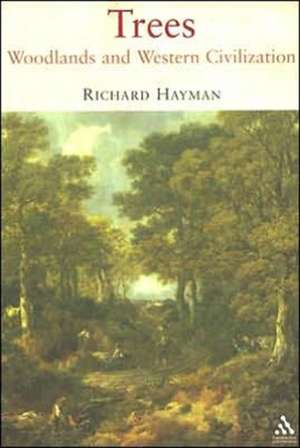
Trees: Woodlands and Western Civilization
Autor Richard Haymanen Limba Engleză Paperback – 30 iun 2007
Preț: 179.20 lei
Preț vechi: 322.34 lei
-44%
Carte tipărită la comandă
Livrare economică 01-15 decembrie
Specificații
ISBN-10: 1847250513
Pagini: 280
Ilustrații: 12
Dimensiuni: 156 x 234 x 15 mm
Greutate: 0.38 kg
Ediția:New ed
Editura: Bloomsbury Publishing
Colecția Hambledon Continuum
Locul publicării:London, United Kingdom
V-ar putea interesa
-
 Preț: 335.32 lei
 -
 Preț: 142.14 lei
 -
 The Mirror: A HistorySabine Melchoir-BonnetPreț: 339.98 lei
 -
 The Story of WritingAndrew Robinson-16%Preț: 106.48 lei126.23 lei
 -
 Lost LanguagesAndrew Robinson-21%Preț: 158.27 lei199.92 lei
 -
 The Lost Spirit of CapitalismBernard StieglerPreț: 154.33 lei
 -
 States of ShockBernard StieglerPreț: 228.70 lei
 -
 Wrought IronRichard Hayman-32%Preț: 36.23 lei53.40 lei
 -
 Isambard Kingdom BrunelRichard Tames-31%Preț: 37.04 lei53.87 lei
 -
 The Green ManRichard Hayman-31%Preț: 42.31 lei61.56 lei
 -
 The Tudor ReformationRichard Hayman-37%Preț: 53.98 lei85.08 lei
 -
 Ironbridge: History and GuideRichard HaymanPreț: 181.22 lei
 -
 Acting OutBernard StieglerPreț: 140.43 lei
 -
 -11%Preț: 329.29 lei371.67 lei
 -
 How to Live in the CityThe School Of LifePreț: 46.11 lei
 -
 The Forgotten Genius: Biography of Leroy James LeishmanDorothy J. VarneyPreț: 38.67 lei
 -
 Churches and Churchyards of England and WalesRichard Hayman-30%Preț: 70.55 lei101.15 lei
 -
 Timber-framed BuildingsRichard Hayman-25%Preț: 48.22 lei64.47 lei
 -
 ChinoiserieRichard Hayman-27%Preț: 46.79 lei63.70 lei
 -
 Riddles in Stone: Myths, Archaeology and the Ancient BritonsRichard Hayman-38%Preț: 427.39 lei686.90 lei
Descriere
Trees are special, being bigger than us both physically and metaphorically. Trees: Woodlands and Western Civilization is an account of our relationship with them. Adam and Eve were expelled from Eden for eating from the Tree of Knowledge and the great tree Yggdrasil was central to Norse mythology. Tacitus, followed by German nationalists and historians of liberty, located freedom in the German forests. Medieval forests were both protected hunting parks and the refuge of Robin Hood. Shakespeare contrasted the simplicity of life in the Forest of Arden with the artificial manners of the court, and indeed poets from Virgil to Hardy have drawn inspiration from trees. While eighteenth-century aristocrats controlled trees in plantations around their houses, Romantics delighted in vast untamed forests, and the American Henry Thoreau withdrew into the woods to reintegrate himself with nature. Throughout history, our views of trees have been affected by the changing use of woodland and the effects of deforestation and urbanisation. How we see trees today will dictate how trees are treated in the future.