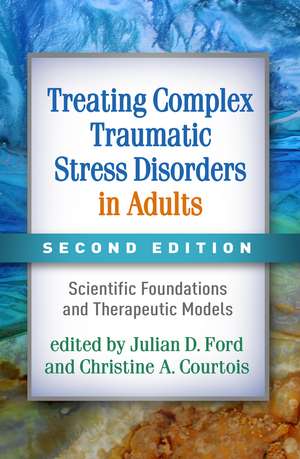
Treating Complex Traumatic Stress Disorders in Adults, Second Edition: Scientific Foundations and Therapeutic Models
Editat de Julian D. Ford, Christine A. Courtoisen Limba Engleză Paperback – 5 mai 2020
Adresat specialiștilor în sănătate mintală și cercetătorilor, Treating Complex Traumatic Stress Disorders in Adults, Second Edition reprezintă o resursă clinică fundamentală pentru gestionarea tulburărilor de stres traumatic complex (CTSD). Reținem că această a doua ediție nu este doar o actualizare, ci o reconstrucție substanțială, peste 75% din material fiind nou pentru a integra progresele teoretice și empirice din ultimul deceniu. Descoperim aici o explorare riguroasă a modului în care traumele cronice modelează neurobiologia dezvoltării și cum simptomatologia pacienților adulți depășește adesea criteriile standard pentru PTSD.
Structura volumului este organizată metodologic, pornind de la fundamentele științifice și evaluarea psihologică, avansând spre modalități de tratament individual, de grup și de familie. Merită menționat că editorii Julian D. Ford și Christine A. Courtois au inclus capitole dedicate unor abordări variate, de la terapia prin expunere prelungită și EMDR, până la modele emergente precum somatoterapia și terapiile bazate pe mindfulness. Clinicienii care folosesc Evidence Based Treatments for Trauma-Related Psychological Disorders ca referință vor găsi aici o aprofundare specifică a complexității traumatice, completând protocoalele standard cu strategii pentru disocierea structurală și umilința culturală.
Această lucrare se plasează central în opera autorilor, făcând punte între abordarea lor teoretică din Treatment of Complex Trauma și perspectivele clinice din Treating Complex Traumatic Stress Disorders in Children and Adolescents. Este un instrument esențial pentru practicienii care doresc să navigheze controversele de diagnostic și să implementeze tratamente adaptate cultural, menținând în același timp un standard ridicat de profesionalism și prevenție a traumatizării vicariante.
Preț: 504.16 lei
Preț vechi: 530.69 lei
-5%
Carte disponibilă
Livrare economică 11-25 noiembrie
Livrare express 28 octombrie-03 noiembrie pentru 53.86 lei
Specificații
ISBN-10: 1462543626
Pagini: 646
Dimensiuni: 156 x 234 x 32 mm
Greutate: 0.93 kg
Ediția:2 ed
Editura: Guilford Publications
Colecția Guilford Press
V-ar putea interesa
-
 -21%Preț: 416.21 lei523.99 lei
 -
 The Encyclopedia of Psychological TraumaGilbert Reyes-9%Preț: 1611.05 lei1770.39 lei
 -
 Father-Daughter IncestJudith Lewis HermanPreț: 215.47 lei
 -
 EthnopharmacologyMichael Heinrich-5%Preț: 746.77 lei786.08 lei
 -
 Treatment of Complex Trauma: A Sequenced, Relationship-Based ApproachChristine A. Courtois-5%Preț: 320.89 lei337.77 lei
 -
 -5%Preț: 325.23 lei342.35 lei
 -
 -5%Preț: 788.80 lei830.31 lei
 -
 -5%Preț: 425.85 lei448.26 lei
 -
 Group Trauma Treatment in Early Recovery: Promoting Safety and Self-CareJudith Lewis Herman-5%Preț: 302.33 lei318.24 lei
 -
 Treating Adolescents with Substance Use DisordersOscar G. Bukstein-5%Preț: 299.21 lei314.96 lei
 -
 ACT for Anorexia Nervosa: A Guide for CliniciansLisa K. Honeycutt-5%Preț: 329.71 lei347.06 lei
 -
 Treating Addiction, Second Edition: A Guide for ProfessionalsWilliam R. Miller-5%Preț: 518.27 lei545.54 lei
 -
 Law and Mental Health, Second Edition: A Case-Based ApproachRobert G. Meyer-15%Preț: 441.36 lei519.25 lei
 -
 The UnconsciousJoel Weinberger-8%Preț: 544.61 lei591.96 lei
 -
 KnieDieter Kohn-5%Preț: 885.45 lei932.04 lei
 -
 -5%Preț: 376.05 lei395.84 lei
 -
 Kindliche AussprachestörungenAnnette V. Fox-BoyerPreț: 341.49 lei
 -
 Les syndromes tardifs secondaires aux neuroleptiquesMouna Ben Djebara-5%Preț: 434.48 lei457.34 lei
Public țintă
Professional Practice & DevelopmentDe ce să citești această carte
Această ediție este indispensabilă psihoterapeuților și psihiatrilor care lucrează cu supraviețuitori ai traumelor interpersonale cronice. Cititorul câștigă acces la un spectru larg de intervenții validate științific, de la cognitiv-comportamentale la cele experiențiale. Este o investiție în expertiza clinică, oferind soluții practice pentru cazurile unde simptomele depășesc tabloul clinic clasic al stresului posttraumatic, asigurând o înțelegere profundă a mecanismelor de disociere și recuperare.
Despre autor
Julian D. Ford și Christine A. Courtois sunt figuri de autoritate în domeniul traumatologiei psihologice. Julian D. Ford este profesor de psihiatrie și drept la Universitatea din Connecticut, specializat în neurobiologia stresului traumatic. Christine A. Courtois este psiholog clinician cu o experiență de peste 35 de ani, fiind recunoscută la nivel internațional pentru contribuțiile sale în tratamentul abuzului și al traumei complexe. Împreună, au coordonat numeroase volume de referință care au definit standardele de îngrijire pentru pacienții cu istorice traumatice severe, punând accent pe integrarea cercetării cu practica clinică.
Cuprins
I. Overview
1. Defining and Understanding Complex Trauma and Complex Traumatic Stress Disorders, Julian D. Ford & Christine A. Courtois
2. Developmental Neurobiology, Julian D. Ford
3. Best Practices in Psychotherapy for Adults, Christine A. Courtois, Julian D. Ford, Marylene Cloitre, & Ulrich Schnyder
4. Therapeutic Alliance and Risk Management, Christine A. Courtois
5. Evidence-Based Psychological Assessment of the Sequelae of Complex Trauma, Joseph Spinazzola & John Briere
6. Assessing and Treating Complex Dissociative Disorders, Kathy Steele & Onno van der Hart
7. Cultural Humility and Spiritual Awareness, Laura S. Brown
8. New Perspectives on Vicarious Traumatization and Complex Trauma, Laurie Anne Pearlman, James Caringi, & Ashley R. Trautman
II. Evidence-Supported Individual Treatment Modalities and Models
9. Prolonged Exposure Therapy, Elizabeth Hembree & Edna B. Foa
10. Cognitive Therapy, Anke Ehlers & Hannah Murray
11. Cognitive Processing Therapy, Kathleen M. Chard, Ellen T. Healy, & Colleen E. Martin
12. Brief Eclectic Psychotherapy, Berthold Gersons, Mirjam J. Nijdam, Geert E. Smid, & Ulrich Schnyder
13. Eye Movement Desensitization and Reprocessing Therapy, Deborah L. Korn & Francine Shapiro
14. Narrative Exposure Therapy, Maggie Schauer, Katy Robjant, Thomas Elbert, & Frank Neuner
15. Emotion-Focused Therapy, Sandra C. Paivio & Lynne E. Angus
16. Interpersonal Psychotherapy, Ari Lowell, Andrea Lopez-Yianilos, & John C. Markowitz
17. Cognitive-Behavioral Therapy, Christie Jackson, Kore Nissenson, & Marylene Cloitre
18. Trauma Affect Regulation: Guide for Education and Therapy, Julian D. Ford
III. Group/Conjoint Therapy Models
19. Group Therapy, Julian D. Ford
20. Dual-Trauma Attachment-Based Couple Therapy, Pamela C. Alexander
21. Family Systems Therapy, Julian D. Ford
22. Complex Trauma and Addiction Treatment, Denise Hien, Lisa Caren Litt, Teresa López-Castro, & Lesia M. Ruglass
IV. Emerging Psychotherapy Models
23. Sensorimotor Psychotherapy, Pat Ogden
24. Experiential Approaches, Janina Fisher
25. Mindfulness Approaches, Barbara L. Niles, Sarah Krill Williston, & DeAnna L. Mori
26. Complementary Healing Therapies, Stefanie F. Smith & Julian D. Ford
Epilogue: Overview and Future Directions in Treatment for Complex Traumatic Stress Disorders, Julian D. Ford & Christine A. Courtois
Afterword, Bessel A. van der Kolk
Author Index
Subject Index
Notă biografică
Christine A. Courtois, PhD, ABPP, a counseling psychologist, is retired from clinical practice and now serves as a consultant/trainer on trauma psychology and treatment. She is a Fellow of the American Psychological Association (APA) and the International Society for the Study of Trauma and Dissociation. Dr. Courtois is a past president of APA Division 56 (Trauma Psychology) and served as Chair of the APA’s Clinical Practice Guideline for the Treatment of Posttraumatic Stress Disorder in Adults. She has received the Award for Distinguished Contributions to Independent Practice from the APA, the Sarah Haley Award for Clinical Excellence from the International Society for Traumatic Stress Studies, the Award for Distinguished Service and Contributions to the Profession of Psychology from the American Board of Professional Psychology, and the APA Division 56 Lifetime Achievement Award. She is coeditor of Treating Complex Traumatic Stress Disorders in Adults, Second Edition, and Treating Complex Traumatic Stress Disorders in Children and Adolescents, and coauthor of Treatment of Complex Trauma: A Sequenced, Relationship-Based Approach.
Recenzii
"Essential reading for practitioners in all disciplines who work with trauma-affected populations. Edited and written by international leaders in the area, the volume provides deep insight into the nature and phenomenology of CTSDs and details an array of expert approaches to intervention. This work--combining the current best science and practice--is an outstanding reference for any clinician working to improve the lives of those experiencing CTSDs."--David Forbes, PhD, Department of Psychiatry, University of Melbourne; Director, Phoenix Australia Centre for Posttraumatic Mental Health
"This comprehensive work delves into the assessment and treatment of the wide symptom array associated with developmental trauma. The book provides incredible depth, breadth, and cutting-edge research on CTSDs. This fully revised second edition will be the leading text for years to come. A 'must read' for all clinicians, trainees, and researchers working in the area of complex traumatic stress."--Ruth A. Lanius, MD, PhD, Professor and Harris–Woodman Chair in Mind–Body Medicine, Department of Psychiatry, Western University, Canada
"Ford and Courtois are among the most knowledgeable authorities in the complex trauma field today. This volume provides a thorough update on the clinical and scientific controversies surrounding CTSDs in adults, as well as the rapidly expanding evidence base. Exciting theoretical and research developments on the neurobiology of the survival brain, complex PTSD, self-regulation, developmental trauma, vicarious trauma, and posttraumatic resilience are highlighted and translated into practical guidelines for culturally responsive clinical practice. I highly recommend this second edition as a valuable resource, both for students learning about complex trauma for the first time and for practitioners who wish to stay up to date on knowledge and treatment approaches."--David L. Corwin, MD, Professor and Director of Forensic Services, Department of Pediatrics, University of Utah School of Medicine
"The definitive international handbook on CTSDs. This superb book yields wonderful insights into the therapeutic treatment of an important but difficult-to-treat group of patients. Every reader from a health care profession can learn something from it. Experts who have been working in the field of complex trauma for decades are complemented by highly respected scholars on classic PTSD. The case studies and therapy dialogues in the various treatment chapters are highly practical."--Andreas Maercker, PhD, MD, Department of Psychology, University of Zurich, Switzerland; Chair, ICD-11 working group on trauma-associated disorders-
Descriere scurtă
New to This Edition
- Incorporates major advances in research and clinical practice.
- Chapters on additional evidence-based individual treatments: prolonged exposure therapy, cognitive therapy, cognitive processing therapy, brief eclectic psychotherapy, eye movement desensitization and reprocessing therapy, narrative exposure therapy, interpersonal psychotherapy, emotion-focused therapy, and the TARGET recovery model.
- Chapters on additional evidence-based group and conjoint family therapy models: attachment-based couple therapy and integrated treatment of co-occurring CTSDs and substance use disorders.
- Chapters on promising treatments: treatment for structural dissociation, experiential/somatotherapy approaches, mindfulness approaches, and complementary healing therapies.