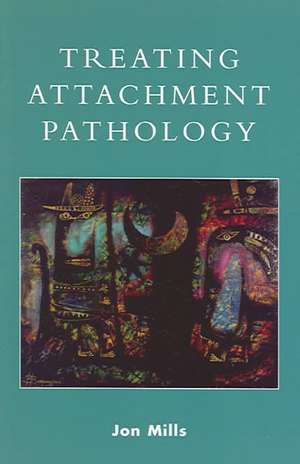
Treating Attachment Pathology
Autor Jon Millsen Limba Engleză Paperback – 25 mar 2005
Offering the first comprehensive paradigm on the psychoanalytic treatment of adult and adolescent attachment disorders, Jon Mills argues that attachment pathology is a disorder of the self based on developmental trauma that predisposes patients toward a future trajectory marked by structural deficits, character pathology, and interpersonal discord that fuel and sustain myriad forms of clinical symptomatology. This pivotal work constitutes a treatise on the governing psychic processes of attachment on self-organization, adaptation, and conflicted intersubjective dynamics in non-childhood populations, and on the intervening relational parameters in treating their emergent clinical pathologies.
Through conceptually astute technical strategies grounded in sold clinical practice, the author offers one of the most extensive and original frameworks in the psychoanalytic treatment of attachment disorders.
Preț: 370.95 lei
Preț vechi: 554.22 lei
-33%
Puncte Express: 556
Carte tipărită la comandă
Livrare economică 25 noiembrie-09 decembrie
Livrare prin curier în România Termenul estimat este afișat lângă disponibilitate.
Transport gratuit de la 400.00 lei Plată online sau ramburs, în funcție de opțiunile comenzii.
Retur gratuit în 14 zile Comandă securizată și suport în română.
Specificații
ISBN-13: 9780765701329
ISBN-10: 0765701324
Pagini: 388
Dimensiuni: 160 x 227 x 21 mm
Greutate: 0.49 kg
Ediția:New.
Editura: Bloomsbury Publishing
Colecția Jason Aronson Inc
Locul publicării:New York, United States
ISBN-10: 0765701324
Pagini: 388
Dimensiuni: 160 x 227 x 21 mm
Greutate: 0.49 kg
Ediția:New.
Editura: Bloomsbury Publishing
Colecția Jason Aronson Inc
Locul publicării:New York, United States
V-ar putea interesa
-
 Treatment-Resistant Mood DisordersAndré F Carvalho-20%Preț: 282.36 lei351.33 lei
 -
 -21%Preț: 539.40 lei685.82 lei
 -
 -26%Preț: 666.80 lei903.61 lei
 -
 Oxford Textbook of Correctional PsychiatryRobert Trestman-26%Preț: 1129.60 lei1519.38 lei
 -
 Medical PsychotherapyJessica Yakeley-26%Preț: 515.98 lei694.70 lei
 -
 Psychological Assessment and Therapy with Older AdultsBob G. Knight-17%Preț: 541.26 lei651.34 lei
 -
 Preț: 464.20 lei
 -
 Attention-Deficit Hyperactivity Disorder in Adults and Children`Lenard A. Adler-5%Preț: 914.78 lei962.94 lei
 -
 Once a Warrior--Always a WarriorCharles Hoge-5%Preț: 114.11 lei120.11 lei
 -
 The Psychopathic Mind: Origins, Dynamics, and TreatmentReid J. Meloy-11%Preț: 465.20 lei522.70 lei
 -
 Psychiatry ReconsideredH. Middleton-5%Preț: 383.33 lei403.51 lei
 -
 Preț: 267.18 lei
 -
 Posttraumatic and Acute Stress DisordersMatthew J. Friedman-5%Preț: 648.56 lei682.69 lei
 -
 An Outline of Psychiatry in Clinical LecturesOnzm Miller-5%Preț: 1162.13 lei1223.29 lei
 -
 Bipolar DisorderKostas N. Fountoulakis-5%Preț: 769.34 lei809.83 lei
Cuprins
Part 1 Part I: Theoretical and Diagnostic Considerations
Chapter 2 1 Conceptualizing Attachment Pathology
Chapter 3 2 The Attachment Disordered Self
Chapter 4 3 Borderline Organization, Trauma, and Attachment
Part 5 Part II: Treatment Perspectives
Chapter 6 4 Beginning the Treatment
Chapter 7 5 The Fragile Nature of Therapeutic Alliance
Chapter 8 6 Managing Primitive Defenses
Chapter 9 7 Embracing Countertransference
Chapter 10 8 Reaching the Affect
Part 11 Part III: Extended Case Studies
Chapter 12 Engaging Alexithymia in a Depressed, Eating Disordered, Body Dysmorphic Adolescent Female
Chapter 13 Feeling Closeted: Der Todestrieb, Guilt, and Self-Punishment in a Bipolar Gay Man
Chapter 14 Homo Homini Lupus: Treating a Case of Systemic Ritualistic Abuse
Chapter 15 Postscript from the Unconscious
Chapter 2 1 Conceptualizing Attachment Pathology
Chapter 3 2 The Attachment Disordered Self
Chapter 4 3 Borderline Organization, Trauma, and Attachment
Part 5 Part II: Treatment Perspectives
Chapter 6 4 Beginning the Treatment
Chapter 7 5 The Fragile Nature of Therapeutic Alliance
Chapter 8 6 Managing Primitive Defenses
Chapter 9 7 Embracing Countertransference
Chapter 10 8 Reaching the Affect
Part 11 Part III: Extended Case Studies
Chapter 12 Engaging Alexithymia in a Depressed, Eating Disordered, Body Dysmorphic Adolescent Female
Chapter 13 Feeling Closeted: Der Todestrieb, Guilt, and Self-Punishment in a Bipolar Gay Man
Chapter 14 Homo Homini Lupus: Treating a Case of Systemic Ritualistic Abuse
Chapter 15 Postscript from the Unconscious
Recenzii
It is a rare treat indeed and one that is increasingly uncommon to have the richest, most detailed clinical material presented alongside tightly organized and coherent clinical theory. This book is of immense practical value. In teaching simple but effective therapeutic techniques, the book succeeds in identifying a previously frequently overlooked set of clinical problems and in meeting these in the most powerful way that modern analytic technique is able to muster. This book is an absolute gem!
Mills' work is a welcome addition to the literature. It goes beyond simply linking adult psychopathology to early attachment difficulties. Mills' work provides a theoretical framework for understanding attachment from a psychodynamic/psychoanalytic perspective and then uses this theoretical framework to discuss the aetiology and treatment of adult disorders. Although Mills is working from a psychoanalytic/psychodynamic perspective, this book offers much to clinicians from all perspectives. Mills is clearly passionate about his work, and it is hard not to feel the same excitement when reading his work...
The theoretical discussions and treatment considerations are rich, nuanced, and informative.
Under the author's highly knowledgeable and skillful guidance, attachment theory once the pariah of psychoanalysis, is demonstrated by him to be central to understanding human development, and errors in attachment to be central to the development of psychopathology. Thus, attachment has now become a major player in psychoanalytic theory and clinical application. Dr. Mills ably demonstrates the role of attachment disorder in adult dysfunctional ways of being. It is the immediacy of the importance of attachment in the clinical situation which clearly distinguishes this worthy book. Attachment is no longer simply a feature of infancy in childhood. It is a matter for a lifetime and is a major player in adult psychopathology. I urge all mental health workers to read it.
Mills' work is a welcome addition to the literature. It goes beyond simply linking adult psychopathology to early attachment difficulties. Mills' work provides a theoretical framework for understanding attachment from a psychodynamic/psychoanalytic perspective and then uses this theoretical framework to discuss the aetiology and treatment of adult disorders. Although Mills is working from a psychoanalytic/psychodynamic perspective, this book offers much to clinicians from all perspectives. Mills is clearly passionate about his work, and it is hard not to feel the same excitement when reading his work...
The theoretical discussions and treatment considerations are rich, nuanced, and informative.
Under the author's highly knowledgeable and skillful guidance, attachment theory once the pariah of psychoanalysis, is demonstrated by him to be central to understanding human development, and errors in attachment to be central to the development of psychopathology. Thus, attachment has now become a major player in psychoanalytic theory and clinical application. Dr. Mills ably demonstrates the role of attachment disorder in adult dysfunctional ways of being. It is the immediacy of the importance of attachment in the clinical situation which clearly distinguishes this worthy book. Attachment is no longer simply a feature of infancy in childhood. It is a matter for a lifetime and is a major player in adult psychopathology. I urge all mental health workers to read it.