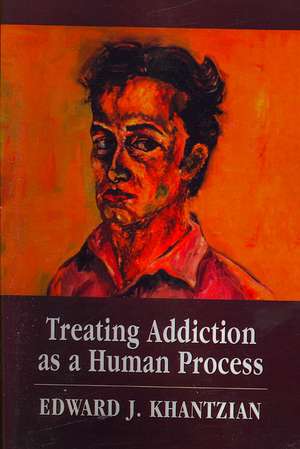
Treating Addiction as a Human Process
Autor Edward J. Khantzianen Limba Engleză Paperback – mai 2007
His insights into the dynamics of substance abuse have changed the ways that clinicians understand their addicted patients, significantly raising the likelihood of successful treatment. Shifting the focus from a pleasure-seeking to a pain-relieving approach to their patients' substance use enables clinicians to engage in a more positive, compassionate psychotherapeutic relationship, unhampered by countertransference feelings of contempt and condemnation.
Passionate, professional, and unfailingly astute, Dr. Khantzian examines his patients' internal worlds, revealing vulnerabilities while uncovering resiliency and strength. This book, comprehensive in scope, abundant in clinical material, and written with clarity and intelligence, provides a depth of understanding of substance use disorders and an increased hope for recovery.
A Jason Aronson Book
Preț: 512.79 lei
Preț vechi: 743.34 lei
-31%
Puncte Express: 769
Carte tipărită la comandă
Livrare economică 30 noiembrie-14 decembrie
Livrare prin curier în România Termenul estimat este afișat lângă disponibilitate.
Transport gratuit pentru acest produs Plată online sau ramburs, în funcție de opțiunile comenzii.
Retur gratuit în 14 zile Comandă securizată și suport în română.
Specificații
ISBN-13: 9780765705457
ISBN-10: 0765705451
Pagini: 687
Dimensiuni: 155 x 229 x 40 mm
Greutate: 1.11 kg
Editura: Bloomsbury Publishing
Colecția Jason Aronson Inc
Locul publicării:New York, United States
ISBN-10: 0765705451
Pagini: 687
Dimensiuni: 155 x 229 x 40 mm
Greutate: 1.11 kg
Editura: Bloomsbury Publishing
Colecția Jason Aronson Inc
Locul publicării:New York, United States
V-ar putea interesa
-
 Surviving Schizophrenia, 6th Edition: A Family ManualE. Fuller TorreyPreț: 97.37 lei
 -
 CreativityMihaly CsikszentmihalyiPreț: 114.62 lei
 -
 -32%Preț: 715.69 lei1057.15 lei
 -
 Evolution's Empress: Darwinian Perspectives on the Nature of WomenMaryanne L. Fisher-32%Preț: 811.31 lei1199.75 lei
 -
 SubliminalLeonard Mlodinow-31%Preț: 63.56 lei92.69 lei
 -
 Knowledge in Context: Representations, Community and CultureSandra JovchelovitchPreț: 475.76 lei
 -
 Alfred Adler: Problems of Neurosis: A Book of Case-HistoriesPhilippe Mairet-15%Preț: 430.08 lei505.97 lei
 -
 The Social Psychology of StigmaTodd F. HeathertonPreț: 406.28 lei
 -
 Preț: 455.11 lei
Recenzii
Over the course of three decades, Dr. Khantzian has generated a deep understanding of why addicts self-medicate, why their self-care becomes compromised, and how they can be supported in their attempts to achieve recovery. The substance abuse field is now most fortunate to be given this compendium of Khantzian's work in such a well-organized and coherent form. This volume will be a most valuable resource for experienced practitioners and students alike.
This is a landmark collection that more than fulfills the promise of its title. The reader gets an evolutionary review of Khantzian's thinking, and the huge bonus of his reflections about his own developmental process. This book is a treasure: clinically rich, theoretically creative, and comprehensive. It is particularly valuable as a model of therapist openness and self-disclosure. We see the author's adherence to psychoanalytic thought and his questions about the limits of this model. With his enlightened theories and his attitude of openness, Khantzian provides an expansive and integrated perspective of addictions treatment with great contemporary relevance.
As a novelist who is also working in the field of addiction medicine, I am in the unique position to comment on the clarity of Dr. Khantzian's writing, as well as its usefulness to practitioners. This book brings together the theoretical and the practical in one highly intelligent volume that can be read with pleasure and awe from beginning to end. It is the cornerstone on which the next generation of knowledge in addiction medicine will be built.
Addiction is the most devastating mental disorder of the twentieth century and the one most neglected by psychodynamically oriented mental health professionals. Against this background, Edward Khantzian's book the work of a lifetime is an extraordinary achievement. Here is a master psychodynamic clinician exploring the internal world of the addicted person and demonstrating convincingly his self-medication hypothesis. There is no magic cure for addiction, but Khantzian's marvelously written book will give even the most experienced clinician useful new ideas about how to understand and help patients.
This is a landmark collection that more than fulfills the promise of its title. The reader gets an evolutionary review of Khantzian's thinking, and the huge bonus of his reflections about his own developmental process. This book is a treasure: clinically rich, theoretically creative, and comprehensive. It is particularly valuable as a model of therapist openness and self-disclosure. We see the author's adherence to psychoanalytic thought and his questions about the limits of this model. With his enlightened theories and his attitude of openness, Khantzian provides an expansive and integrated perspective of addictions treatment with great contemporary relevance.
As a novelist who is also working in the field of addiction medicine, I am in the unique position to comment on the clarity of Dr. Khantzian's writing, as well as its usefulness to practitioners. This book brings together the theoretical and the practical in one highly intelligent volume that can be read with pleasure and awe from beginning to end. It is the cornerstone on which the next generation of knowledge in addiction medicine will be built.
Addiction is the most devastating mental disorder of the twentieth century and the one most neglected by psychodynamically oriented mental health professionals. Against this background, Edward Khantzian's book the work of a lifetime is an extraordinary achievement. Here is a master psychodynamic clinician exploring the internal world of the addicted person and demonstrating convincingly his self-medication hypothesis. There is no magic cure for addiction, but Khantzian's marvelously written book will give even the most experienced clinician useful new ideas about how to understand and help patients.