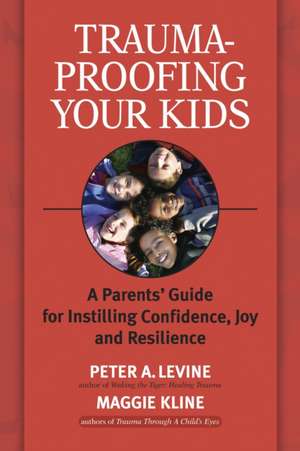
Trauma-Proofing Your Kids
Autor Maggie Kline, Peter A. Levineen Limba Engleză Paperback – 4 mar 2008
Considerăm că Trauma-Proofing Your Kids reprezintă o resursă vitală pentru dezvoltarea inteligenței emoționale și a mecanismelor de adaptare ale copiilor, oferindu-le acestora capacitatea de a-și recăpăta echilibrul după experiențe copleșitoare. Ne-a atras atenția modul în care Peter A. Levine și Maggie Kline reușesc să demistifice un subiect complex, transformând teoria traumei într-un set de instrumente accesibile oricărui părinte. Spre deosebire de alte lucrări pur teoretice, acest volum se concentrează pe corpul copilului, utilizând conștientizarea senzorială ca ancoră pentru siguranță. Structura cărții este gândită progresiv: primele capitole definesc 'rețeta' rezilienței, în timp ce secțiunile următoare sunt dedicate practicii intense prin exerciții precum explorarea ritmului pendulării sau crearea unei „cutii de comori senzoriale”. Părinții care au citit cu plăcere Raising Our Children to Be Resilient de Linda Goldman vor aprecia și această carte pentru accentul pus pe tehnici concrete de „stress-busting” și pentru ghidul pas cu pas de prim ajutor în prevenirea traumei. Această lucrare completează viziunea autorilor începută în Trauma Through a Child's Eyes, însă aduce un plus de pragmatism pentru viața de zi cu zi. Dacă în lucrările anterioare accentul cădea pe recunoașterea traumei, aici accentul se mută pe acțiune: cum putem folosi arta, rimele și jocurile de rol pentru a ajuta copiii să nu mai fie victime pasive ale circumstanțelor, ci mici supraviețuitori încrezători. Este o lectură care oferă speranță, demonstrând că reziliența poate fi învățată și consolidată prin prezență și exercițiu.
Preț: 98.78 lei
Preț vechi: 142.15 lei
-31%
Carte disponibilă
Livrare economică 20-27 octombrie
Livrare express 06-10 octombrie pentru 72.55 lei
Specificații
ISBN-10: 1556436998
Pagini: 248
Ilustrații: COLOR ILLUS.
Dimensiuni: 154 x 230 x 19 mm
Greutate: 0.42 kg
Ediția:1
Editura: North Atlantic Books,U.S.
V-ar putea interesa
-
 The Body Keeps the Score: Mind, Brain and Body in the Transformation of TraumaBessel van der Kolk-28%Preț: 77.03 lei107.58 leiRecomandat
 -
 -31%Preț: 680.16 lei985.32 lei
 -
 Patch Land Adventures Book two "Camping at Mimi's Ranch"Carmen D. SwickPreț: 70.41 lei
 -
 Crash CourseDiane Poole Heller-5%Preț: 93.50 lei98.41 lei
 -
 Presence MeditationJens-Erik RisomPreț: 108.90 lei
 -
 Preț: 132.13 lei
 -
 Preț: 89.58 lei
 -
 -9%Preț: 153.65 lei168.69 lei
 -
 Why Can't We Just Play?Pam LobleyPreț: 102.73 lei
 -
 Verwundete Kinderseelen heilenPeter A. Levine-5%Preț: 180.63 lei190.13 lei
 -
 Kinder vor seelischen Verletzungen schützenPeter A. LevinePreț: 151.78 lei
De ce să citești această carte
Recomandăm această carte părinților care doresc să își protejeze copiii într-o lume imprevizibilă. Veți câștiga instrumente practice pentru a gestiona momentele de anxietate ale celor mici, fie că trec printr-un divorț, o procedură medicală sau bullying. Este un ghid esențial pentru a crește copii joyoși și siguri pe ei, capabili să proceseze stresul la nivel fizic și emoțional înainte ca acesta să devină o traumă pe termen lung.
Despre autor
Peter A. Levine este un renumit doctor în biofizică medicală și psihologie, fiind creatorul Somatic Experiencing®, o abordare terapeutică axată pe eliberarea tensiunii fizice din corp. Împreună cu Maggie Kline, terapeut de familie și școlar cu o vastă experiență clinică, a format o echipă de referință în literatura de specialitate dedicată psihologiei infantile. Împreună, au semnat lucrări fundamentale precum Trauma Through a Child's Eyes, dedicându-și cariera educării părinților și profesioniștilor despre modul în care sistemul nervos al copiilor poate fi recalibrat după evenimente stresante.
Notă biografică
Extras
People (especially young people), however, need not lose their resilience through wear and tear. On the contrary, we have the capacity to actually build and increase our resilience as we encounter the stresses and strains of life. Resilient children tend to be courageous. This doesn’t mean that they are attracted to dangerous situations, but rather that they are open and curious as they explore their world with gusto and exuberance. And, in their explorations, they inevitably have their share of rumbles and tumbles, collisions and conflicts.
When resilient kids meet these forces of nature, they are open rather than shut down. Openness, indeed, is the characteristic that most typifies resilient kids. They are open to other children and enjoy sharing with them. At the same time, they are able to set boundaries of their own personal space and their possessions. They are in touch with their feelings, expressing and communicating them in age-appropriate ways. And, most of all, when bad things happen, they have a wondrous capacity (when supported) to breeze through them. They are the happy, lively children we wish we were. Their biggest challenges occur from events that could be potentially traumatic. Let’s delve into what types of life’s circumstances might cause such overwhelming reactions in our kids.
Trauma can result from events that are clearly extraordinary such as violence and molestation, but it can also result from everyday “ordinary” events. In fact, common occurrences such as accidents, falls, medical procedures and divorce can cause children to withdraw, lose confidence, or develop anxiety and phobias. Traumatized children may also display behavioral problems including aggression, hyperactivity and, as they grow older, addictions of various sorts. The good news is that with the guidance of attuned parents and other caregivers who are willing to learn the necessary skills, children at risk can be identified and spared from being scarred for life, regardless of how devastating the events might be or seem.
Parents are, at times, conflicted between protecting their children and permitting them to take the risks that build confidence and competence. It’s a tricky balancing act because as they master their world, children can also be traumatized when the unexpected inevitably happens. As much as you may try to “child-proof” your home, ultimately children—driven by their curiosity—will explore and get hurt. That is how they learn and they will have their share of falls, burns, electrical shocks, animal bites and other encounters with the non-forgiving forces of nature. No matter how hard we try, we cannot close our children off in an impenetrable (and inescapable) bubble of safety.
Our children are frequently exposed to potentially traumatic events. But parents need not despair. It is possible to minimize the effects of the “ordinary” situations mentioned above, as well as those from extraordinary events such as natural and man-made disasters, including violence, war, terrorism and molestation. Are we being ridiculous by proposing that adults can “traumaproof” kids? We don’t believe so. Remember, although pain can’t be avoided . . . trauma is a fact of life . . . but so is resilience, the capacity to spring back.
In this book you will learn practical tools to maximize your child’s resilience so that their equilibrium can be restored when they are stressed to their breaking point. Armed with this “recipe for resilience,” parents and other responsible adults can help to trauma-proof their kids while also generally increasing their tolerance to everyday stress. In this way they can truly become stronger, more caring, joyful and compassionate human beings. The word “trauma” pops up in the headlines of magazines and newspapers regularly. Popular TV shows such as The Oprah Winfrey Show bring understanding to millions of viewers regarding trauma’s gripping effect on body and soul. Trauma’s devastating impact on children’s emotional and physical well-being, mental development and behavior is finally getting the recognition it deserves. Since September 11, 2001, there has been an information blitz on how to cope with catastrophe.
Despite this focus, however, precious little has been written regarding the common causes or the prevention and the non-drug treatment of trauma. Focus instead has been on the diagnosis and the medication of its various symptoms. “Trauma is perhaps the most avoided, ignored, belittled, denied, misunderstood, and untreated cause of human suffering.” (1) Fortunately, you—the parents, aunts, uncles and grandparents who nurture and protect children—are in a position to prevent, or at least mitigate, the damaging effects of trauma.
In order to do the most good for the children in your care, first you need to recognize the roots of trauma. Next, we take a closer look at trauma—its myths and realities. In this way you will understand what may cause a child to remain overwhelmed even though the actual danger has passed.
This book will teach you how to help children notice and move through painful sensations and feelings without undue distress...
1. Peter A. Levine, Waking the Tiger: Healing Trauma (Berkeley, CA: North Atlantic Books, 1997).
Descriere scurtă
In addition to arming parents with priceless protective strategies, best-selling authors Dr. Peter A. Levine and Maggie Kline offer an antidote to trauma and a recipe for creating resilient kids no matter what misfortune has besieged them. Trauma-Proofing Your Kids is a treasure trove of simple-to-follow “stress-busting,” boundary-setting, sensory/motor-awareness activities that counteract trauma’s effect on a child’s body, mind and spirit. Including a chapter on how to navigate the inevitable difficulties that arise during the various ages and stages of development, this ground-breaking book simplifies an often mystifying and complex subject, empowering parents to raise truly confident and joyful kids despite stressful and turbulent times.
Recenzii
—Violet Oaklander, PhD, author of Windows to Our Children: A Gestalt Therapy Approach to Children and Adolescents and Hidden Treasure: A Map to the Child’s Inner Self
“If you’ve ever wondered how to help children navigate the rough and tumble vicissitudes of life, this book is a godsend.”
—Sandra Blakeslee, co-author of The Body Has a Mind of Its Own
“This book is a must for every parent, teacher, coach and scout leader. It helps us to understand the stages of childhood development and supports parents in dealing with each stage more appropriately and sensitively. It is a pioneering work, a pioneering insight and a pioneering triumph. It is visionary common sense, pure and simple.”
—From the foreword by Mira Rothenberg
“Trauma-Proofing Your Kids is an important tool to help parents and all adults deal with children that have experienced trauma. Understanding that trauma is a part of life should signal all of us to prepare ourselves for the inevitable.”
—Ron Scruggs, athletic coach, parent and grandparent
Cuprins
Foreword by Mira Rothenberg
CHAPTER I
Trauma Is a Fact of Life
Real-Life Examples of Children We Have Known
Trauma Is Not Only in the Event
The Recipe for Trauma
The Recipe for Resilience
CHAPTER II
Building Resilience by Building Sensory Skills through Practice, Practice and More Practice
Giving Appropriate Support to an Overwhelmed Child
Simple Steps to Build Resilience
Developing a Calming Presence
Getting Acquainted with Your Own Sensations
Exercise: Noticing Sensations
Exercise: Exploring Sensations and the Rhythm of Pendulation
Exercise: Tracking Sensations with a Partner
Exercise: Making a Sensation Treasure Chest
First Aid for Trauma Prevention: A Step-by-Step Guide
CHAPTER III
Tricks of the Trade: Restoring Resilience through Play, Art and Rhymes
The Story of Sammy
Four Principles to Guide Children’s Play Toward Resolution
More Help for Kids through “Make-Believe” Play
Art Activities: Clay, Play Dough, Painting and Drawing
Nature and Animal Rhymes Combined with Drawings That Build Resources
CHAPTER IV
Remedies for Specific Situations: Amusement Park Rides to Zebra Bites
First Aid for Accidents and Falls
The Purpose of Touch When Helping a Child in Shock
The Power of Language to Soothe and Heal
Exercise: Experiencing the Power of Words
More Animal Rhymes to Help Your Child Regain Self-Confidence
A Guide to Constructing a Healing Story
Prevention of Medical Trauma
What Parents Can Do to Prepare Children for Surgery or Other Medical Procedures
When the Medical Procedure Is an Emergency
Elective Surgeries
Sensitivity to Your Child’s Pain
A Timely Word about Bullies and School Shootings
CHAPTER V
Ages & Stages: Building Confidence by Fostering Healthy Development
Responding to Your Infant: Issues of Safety and Trust
Your Toddler’s Needs: “Me Do It Myself”
“Tug of War” with Your Three- to Four-Year-Old
Your Flirtatious Four- to Six-Year-Old Boy or Girl
Adolescent Development: Who Am I?
CHAPTER VI
Sexual Violation: Reducing the Risk and Early Detection
Sexual Trauma Symptoms
Reducing the Risk of Sexual Wounds
What Is Sexual Violation?
Steps Caregivers Can Take to Decrease Children’s Susceptibility
Games for Kids to Practice Making Boundaries
Why Most Children Don’t Tell: Making It Safe for Them to Tell You
Date Rape and Other Teen Issues
CHAPTER VII
Separation, Divorce and Death: Helping Your Child Move through the Grieving Process
Symptoms of Grief versus Symptoms of Trauma
Two Views of Divorce: Rosy or Dark?
Surviving Divorce: A Guide to Preserving Your Child’s Wholeness
Helping Your Child Grieve
Dealing with the Death of a Pet
Steps That Help Children Resolve Their Grief
Exercise: Grief Recovery
CHAPTER VIII
Guerrilla Warfare in Our Neighborhoods: The Real Battle to Protect Kids from Terror
Models for Change in Hospitals and Medical Centers
A Peek at a Model Family-Centered Children’s Hospital
Community Crisis Intervention
A New Model for Crisis Debriefing at School
Notes
Bibliography
Additional Resources
About the Authors
Foundation for Human Enrichment