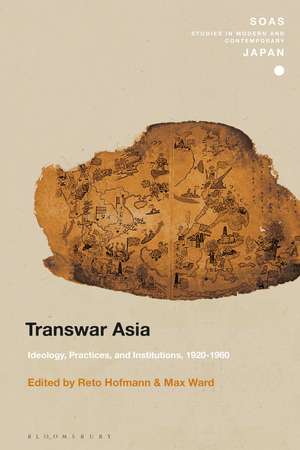
Transwar Asia: Ideology, Practices, and Institutions, 1920-1960: SOAS Studies in Modern and Contemporary Japan
Editat de Dr Reto Hofmann, Associate Professor Max Warden Limba Engleză Paperback – 27 iul 2023
With contributions covering the transwar histories of China, Indonesia, Korea, Japan, the Philippines and Taiwan, the book addresses key themes such as authoritarianism, militarization, criminal rehabilitation, market controls, labor-regimes, and anti-communism. A transwar angle, the authors argue, sheds new light on the continuing problems that undergirded the formation of postwar nation-states and illuminates the political legacies that still shape the various regions in Asia up to the present.
Din seria SOAS Studies in Modern and Contemporary Japan
- 27%
 Preț: 243.01 lei
 - 26%
 Preț: 214.50 lei
 - 25%
 Preț: 247.34 lei
 - 23%
 Preț: 235.70 lei
 - 15%
 Preț: 250.53 lei
 - 25%
 Preț: 277.20 lei
 - 33%
 Preț: 613.23 lei
 - 25%
 Preț: 247.15 lei
 - 36%
 Preț: 583.95 lei
 -
 Preț: 349.84 lei
 - 25%
 Preț: 243.70 lei
 - 23%
 Preț: 236.74 lei
 - 25%
 Preț: 277.58 lei
 - 16%
 Preț: 278.68 lei
 - 23%
 Preț: 235.51 lei
 - 25%
 Preț: 277.48 lei
 - 32%
 Preț: 584.30 lei
 - 26%
 Preț: 260.53 lei
 - 15%
 Preț: 279.86 lei
 - 16%
 Preț: 271.07 lei
 - 27%
 Preț: 251.10 lei
 - 23%
 Preț: 236.30 lei
 - 24%
 Preț: 254.08 lei
 - 33%
 Preț: 645.41 lei
 - 25%
 Preț: 278.77 lei
 - 23%
 Preț: 236.30 lei
 - 33%
 Preț: 583.08 lei
 - 33%
 Preț: 838.13 lei
Preț: 206.77 lei
Preț vechi: 288.34 lei
-28%
Puncte Express: 310
Carte tipărită la comandă
Livrare economică 13-27 noiembrie
Livrare prin curier în România Termenul estimat este afișat lângă disponibilitate.
Transport gratuit de la 400.00 lei Plată online sau ramburs, în funcție de opțiunile comenzii.
Retur gratuit în 14 zile Comandă securizată și suport în română.
Specificații
ISBN-13: 9781350281127
ISBN-10: 1350281123
Pagini: 240
Dimensiuni: 152 x 232 x 12 mm
Greutate: 0.34 kg
Editura: Bloomsbury Publishing
Colecția Bloomsbury Academic
Seria SOAS Studies in Modern and Contemporary Japan
Locul publicării:London, United Kingdom
ISBN-10: 1350281123
Pagini: 240
Dimensiuni: 152 x 232 x 12 mm
Greutate: 0.34 kg
Editura: Bloomsbury Publishing
Colecția Bloomsbury Academic
Seria SOAS Studies in Modern and Contemporary Japan
Locul publicării:London, United Kingdom
Cuprins
Introduction: The Long Transwar Asia, Reto Hofmann (University of Western Australia, Australia) and Max Ward (Middlebury College, USA)
Part I. Institutional Transwar Regimes
1. Imperial Shift: Rice and Revolution in Transwar Korea, 1939-1949, Yumi Moon (Stanford University, USA)
2. Colonial Militarism in the Transwar East Asia: Indigenous Forces and the Three Waves of Militarizaition, Victor Louzon (Sorbonne University, France)
3. Occupational Hazards in the Transwar Pacific: Imperialism, the US Military, and Filipino Labor, Colleen Woods (University of Maryland, USA)
4. University, Landed Class, and Land Reform: Transwar Origins of Private Universities in South Korea, 1920-1960, Do Young Oh (Lingnan University, Hong Kong)
Part II. Ideological Transwar Regimes
5. Resetting China's Conservative Revolution: 'People's Livelihood' in 1950s Taiwan, Brian Tsui (The Hong Kong Polytechnic University, Hong Kong)
6. 'Volksgeist-ism': Ideational Flows between Europe, Japan, and Indonesia, 1920s-1960s, David Bourchier (University of Western Australia, Australia)
7. Reproducing the "Emperor System Within": Transwar Criminal Rehabilitation and Imperial Benevolence in Japan, 1920-1960, Max Ward (Middlebury College, USA)
Afterword: Transwar as Method, Takashi Fujitani (University of Toronto, Canada)
Bibliography
Index
Part I. Institutional Transwar Regimes
1. Imperial Shift: Rice and Revolution in Transwar Korea, 1939-1949, Yumi Moon (Stanford University, USA)
2. Colonial Militarism in the Transwar East Asia: Indigenous Forces and the Three Waves of Militarizaition, Victor Louzon (Sorbonne University, France)
3. Occupational Hazards in the Transwar Pacific: Imperialism, the US Military, and Filipino Labor, Colleen Woods (University of Maryland, USA)
4. University, Landed Class, and Land Reform: Transwar Origins of Private Universities in South Korea, 1920-1960, Do Young Oh (Lingnan University, Hong Kong)
Part II. Ideological Transwar Regimes
5. Resetting China's Conservative Revolution: 'People's Livelihood' in 1950s Taiwan, Brian Tsui (The Hong Kong Polytechnic University, Hong Kong)
6. 'Volksgeist-ism': Ideational Flows between Europe, Japan, and Indonesia, 1920s-1960s, David Bourchier (University of Western Australia, Australia)
7. Reproducing the "Emperor System Within": Transwar Criminal Rehabilitation and Imperial Benevolence in Japan, 1920-1960, Max Ward (Middlebury College, USA)
Afterword: Transwar as Method, Takashi Fujitani (University of Toronto, Canada)
Bibliography
Index
Recenzii
Pursuing a transwar perspective, both as analytic method and alternative history, these essays cross the alleged rupture of 1945 to show the connections across time from the 1920s to the 1960s and across space in the entangled nations and empires in Asia and beyond. Their fascinating topics and compelling arguments bring new depth to the term "transwar".
This volume injects us with an effective dose of reformulation, recalibration and resetting in our understanding of twentieth-century global Asia. The spaciotemporality of 'transwar Asia' as method provides a long durée perspective on knowledge-, practice- and institution-formation within competing imperialisms. It is a welcome and timely volume that all students of modern global history would benefit from reading.
Rather than thinking in terms of legacies, the editors highlight the postwar afterlives in a refreshing way that takes into consideration the connections across time... [T]he book will be of interest to scholars and graduate students interested in alternative and postcolonial conceptions of 'Trans-Asia', as a way to rescue research on the continent from area studies.
Transwar Asia is highly recommended to scholars of Asian history and Asian studies more broadly, but equally so to historians who deal with methodological questions of historiography and the conceptualization of history in general. Hofmann and Ward's volume offers new critical insights into four decades of Asian history, during which the experiences of the Second World War were not a temporal interruption but rather must be understood as links of continuity between the region's pre- and post-war periods.
This volume injects us with an effective dose of reformulation, recalibration and resetting in our understanding of twentieth-century global Asia. The spaciotemporality of 'transwar Asia' as method provides a long durée perspective on knowledge-, practice- and institution-formation within competing imperialisms. It is a welcome and timely volume that all students of modern global history would benefit from reading.
Rather than thinking in terms of legacies, the editors highlight the postwar afterlives in a refreshing way that takes into consideration the connections across time... [T]he book will be of interest to scholars and graduate students interested in alternative and postcolonial conceptions of 'Trans-Asia', as a way to rescue research on the continent from area studies.
Transwar Asia is highly recommended to scholars of Asian history and Asian studies more broadly, but equally so to historians who deal with methodological questions of historiography and the conceptualization of history in general. Hofmann and Ward's volume offers new critical insights into four decades of Asian history, during which the experiences of the Second World War were not a temporal interruption but rather must be understood as links of continuity between the region's pre- and post-war periods.