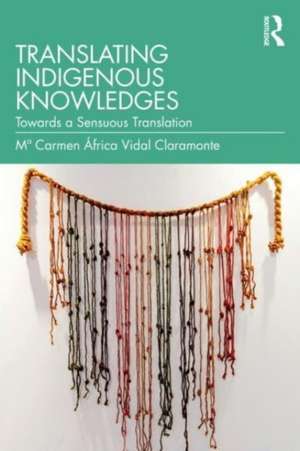
Translating Indigenous Knowledges: Toward a Sensuous Translation
Autor Mª Carmen África Vidal Claramonteen Limba Engleză Paperback – 30 dec 2024
In recent decades, there has been a steadily growing interest in dialogical epistemologies. Disciplines ranging from historiography and philosophy to anthropology are calling for this universalist idea of knowledge to be modified. Thanks to this change of perspective, other forms of knowledge, which until now have been ignored, are gradually coming to light. Indigenous knowledges are not constructed with the scientific, binary, static, Cartesian, or univocal logic characteristic of Western societies. Non-Western types of knowledge incorporate senses, emotions, body, objects, and matter. It is impossible to reduce indigenous knowledges to Western conceptualizations. The types of translation covered in this book assume that knowledge is not transmitted only in the Western way and that there are world views that take into account the emotions and body, as well as the intellect. This includes all types of beings: human, non-human, and extrahuman. In the face of this plurality of epistemologies, this book affirms that the static Western conceptual traditions characterized by a binary logic are not useful and that there is a need to translate outside the scope of these traditions.
The examples given in this book show that translation is not only a process involving Western and non-Western languages. Translation is not a mere substitution of one word for another because knowledge is not only transmitted through words. It also involves non-verbal elements. Knowledge is transmitted through objects, songs, sensations, and emotions, as well as through words. Moreover, many non-Western traditions do not translate with language systems but rather with other semiotic systems, such as knots, threads, colors, and bodies in movement. This is a timely, topical, and transdisciplinary reading, of interest to advanced students and researchers in translation studies, anthropology, and beyond.
Preț: 354.87 lei
Puncte Express: 532
Carte disponibilă
Livrare economică 03-17 noiembrie
Livrare express 20-24 octombrie pentru 30.100 lei
Livrare prin curier în România Termenul estimat este afișat lângă disponibilitate.
Transport gratuit de la 400.00 lei Plată online sau ramburs, în funcție de opțiunile comenzii.
Retur gratuit în 14 zile Comandă securizată și suport în română.
Specificații
ISBN-13: 9781032866987
ISBN-10: 1032866985
Pagini: 222
Dimensiuni: 156 x 234 x 15 mm
Greutate: 0.36 kg
Ediția:1
Editura: Taylor & Francis
Colecția Routledge
Locul publicării:Oxford, United Kingdom
ISBN-10: 1032866985
Pagini: 222
Dimensiuni: 156 x 234 x 15 mm
Greutate: 0.36 kg
Ediția:1
Editura: Taylor & Francis
Colecția Routledge
Locul publicării:Oxford, United Kingdom
Public țintă
PostgraduateCuprins
Preface, by Karen Bennett
Introduction
1. Translating knowledges
2. Whose knowledge?
1. A knowledge of many knowledges
1.1 The disdain of the West
1.2 Beyond one-world world
1.3 From KNOWLEDGE to conocimiento: Gloria Anzaldúa’s proposal
1.4 Examples of indigenous knowledges: the teachings of the shaman
1.4.1 Don Juan
1.4.2 Davi Kopenawa
1.5 Indigenous knowledge and the (more than five) senses: the “sensory turn”
2. Expanding translation
2.1 New approaches to translation
2.2 Shamanic translations
2.3 Viveiros de Castro’s translations as equivocations
2.4 The intercultural translation of Boaventura de Sousa Santos
2.5 Jerome Rothenberg’s total translation
3. Translating through the senses: Cecilia Vicuña
3.1 Words as living beings
3.2 Translating through weaving
3.3 The quipu as an example of inter-epistemic translation
4. Towards a sensuous translation
4.1 Translating sensuous knowledge, translating knowledge sensuously
4.2 Situated knowledges
4.3 The right to opacity
4.4 Sensuous translation as slow becoming
4.5 Sensuous translation as somatic translationality
4.6 The wasp and the orchid
4.7 New avenues
Introduction
1. Translating knowledges
2. Whose knowledge?
1. A knowledge of many knowledges
1.1 The disdain of the West
1.2 Beyond one-world world
1.3 From KNOWLEDGE to conocimiento: Gloria Anzaldúa’s proposal
1.4 Examples of indigenous knowledges: the teachings of the shaman
1.4.1 Don Juan
1.4.2 Davi Kopenawa
1.5 Indigenous knowledge and the (more than five) senses: the “sensory turn”
2. Expanding translation
2.1 New approaches to translation
2.2 Shamanic translations
2.3 Viveiros de Castro’s translations as equivocations
2.4 The intercultural translation of Boaventura de Sousa Santos
2.5 Jerome Rothenberg’s total translation
3. Translating through the senses: Cecilia Vicuña
3.1 Words as living beings
3.2 Translating through weaving
3.3 The quipu as an example of inter-epistemic translation
4. Towards a sensuous translation
4.1 Translating sensuous knowledge, translating knowledge sensuously
4.2 Situated knowledges
4.3 The right to opacity
4.4 Sensuous translation as slow becoming
4.5 Sensuous translation as somatic translationality
4.6 The wasp and the orchid
4.7 New avenues
Notă biografică
Mª Carmen África Vidal Claramonte is Full Professor of Translation at the University of Salamanca, Spain. She has co-edited anthologies, including The Routledge Handbook of Spanish Translation Studies (co-edited with Roberto Valdeón, 2018) and Translation/Power/Subversion (co-edited with Román Álvarez, 1996), and authored 22 books, including Translation and Objects (2024), Translation and Repetition (2023), Translating Borrowed Tongues: The Verbal Quest of Ilan Stavans (2023), and Translation and Contemporary Art: Transdisciplinary Encounters (2022), all published by Routledge.
Recenzii
Translating Indigenous Knowledges highlights non-Western Indigenous epistemology, including emotions, body, and intellect. It facilitates access to research fields receiving scant academic attention, in particular in relation to the reconstruction of non-Western epistemologies and multidimensional conceptualizations of sensuous translation. […] Therefore, this work constitutes an indispensable resource for students and scholars interested in the field of translation studies and anthropology.
Zheng Zhang (17 Jul 2025): Perspectives, DOI: 10.1080/0907676X.2025.2528472
Zheng Zhang (17 Jul 2025): Perspectives, DOI: 10.1080/0907676X.2025.2528472
Descriere
In this book, Vidal presents a new way of translating indigenous epistemologies. For centuries, the Western world has ordained what knowledge is, what it should be and has also been responsible for transmitting that knowledge. This ‘universal’ knowledge has traveled to the four corners of the globe,