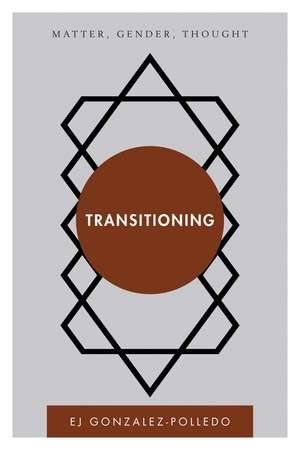
Transitioning: Matter, Gender, Thought
Autor EJ Gonzalez-Polledoen Limba Engleză Paperback – 24 mai 2017
Preț: 327.44 lei
Preț vechi: 425.36 lei
-23%
Puncte Express: 491
Carte tipărită la comandă
Livrare economică 30 noiembrie-14 decembrie
Livrare prin curier în România Termenul estimat este afișat lângă disponibilitate.
Transport gratuit de la 400.00 lei Plată online sau ramburs, în funcție de opțiunile comenzii.
Retur gratuit în 14 zile Comandă securizată și suport în română.
Specificații
ISBN-13: 9781783488452
ISBN-10: 178348845X
Pagini: 224
Ilustrații: 4 colour photos;
Dimensiuni: 143 x 212 x 15 mm
Greutate: 0.27 kg
Editura: Bloomsbury Publishing
Colecția Rowman & Littlefield
Locul publicării:New York, United States
ISBN-10: 178348845X
Pagini: 224
Ilustrații: 4 colour photos;
Dimensiuni: 143 x 212 x 15 mm
Greutate: 0.27 kg
Editura: Bloomsbury Publishing
Colecția Rowman & Littlefield
Locul publicării:New York, United States
Cuprins
1. Transition Inside Out / 2. T: Informed Material / 3. Counternarrative / 4. Thresholds: Gender In The Wild / 5. Assembling Transition / Bibliography / Index
Recenzii
In this conceptually and ethnographically rich exercise in thinking "with" transgender rather than thinking "about" transgender, EJ Gonzalez-Polledo explores how "transitioning" is not something only trans people do in the process of moving away from their birth-assigned sex. It is something that all materiality does--perpetually, inexorably, unavoidably--in the ever-unfolding dynamic processes of being. Gonzalez-Polledo superbly demonstrates in Transitioning how manifesting this ontological flux can be a danger trans people face when they destablize gender for others, as well as a gift they give that can open the world in profound and unexpected ways. Read this book if you've ever wondered how deep the transgender rabbit-hole can go.
This dance of concepts weaves it way through several narratives of transitioning FTM men to create a terrain that resists any simple cartography. Neither map nor guide, this book takes equally seriously the gender of those for whom re-embodiment is a resting place and of those for whom everything is still open.
Transitioning: Matter, Gender, Thought, by EJ Gonzalez-Polledo, is an important and provocative book. Drawing on several years of research in the London trans community, the book is in part a review and critique of the existing theoretical literature on gender and sexuality, biology and culture, and models and lived in worlds, and in part a sensitive and vivid ethnographic account of experiences of transition. Theoretically both very imaginative and solidly grounded, the discussion moves through personhood and agency, the imagined worlds that encompass many transitions, and the biomedical and social models which try to categorise and regulate these. This provides insight to the social, political and ideological considerations which provide the frame for much of the discussion and debate around transsexual transition. Transition, Gonzalez-Polledo argues, is not a lineal and finite process, but a way of being and becoming which is always potentially transient. It is a powerful argument, and one that could be used fruitfully in considering all kinds of transitions, not only transsexual ones. The beauty of this book lies in the author's engagement with both theory and ethnography. The space between its broad and impressive theoretical sweep and its focus on the miniscule detail of personal life stories and narratives could be insurmountable, and yet Gonzalez-Polledo makes them speak to each other. There have been many arguments about whether anthropology should be theory driven or ethnographically led. This book achieves a brilliant balance between the two domains, always insisting on the relation between the two. In the end, of course, the reader realizes that both ethnography and theory are themselves objects of intellectual scrutiny; in a sense, they become the processes they describe. Transitioning should be read by everyone interested in gender, sexuality and the body, by all those teaching courses on gender and the body, and by everyone trying to navigate their way through what is often the minefield of contemporary social theory.
This dance of concepts weaves it way through several narratives of transitioning FTM men to create a terrain that resists any simple cartography. Neither map nor guide, this book takes equally seriously the gender of those for whom re-embodiment is a resting place and of those for whom everything is still open.
Transitioning: Matter, Gender, Thought, by EJ Gonzalez-Polledo, is an important and provocative book. Drawing on several years of research in the London trans community, the book is in part a review and critique of the existing theoretical literature on gender and sexuality, biology and culture, and models and lived in worlds, and in part a sensitive and vivid ethnographic account of experiences of transition. Theoretically both very imaginative and solidly grounded, the discussion moves through personhood and agency, the imagined worlds that encompass many transitions, and the biomedical and social models which try to categorise and regulate these. This provides insight to the social, political and ideological considerations which provide the frame for much of the discussion and debate around transsexual transition. Transition, Gonzalez-Polledo argues, is not a lineal and finite process, but a way of being and becoming which is always potentially transient. It is a powerful argument, and one that could be used fruitfully in considering all kinds of transitions, not only transsexual ones. The beauty of this book lies in the author's engagement with both theory and ethnography. The space between its broad and impressive theoretical sweep and its focus on the miniscule detail of personal life stories and narratives could be insurmountable, and yet Gonzalez-Polledo makes them speak to each other. There have been many arguments about whether anthropology should be theory driven or ethnographically led. This book achieves a brilliant balance between the two domains, always insisting on the relation between the two. In the end, of course, the reader realizes that both ethnography and theory are themselves objects of intellectual scrutiny; in a sense, they become the processes they describe. Transitioning should be read by everyone interested in gender, sexuality and the body, by all those teaching courses on gender and the body, and by everyone trying to navigate their way through what is often the minefield of contemporary social theory.