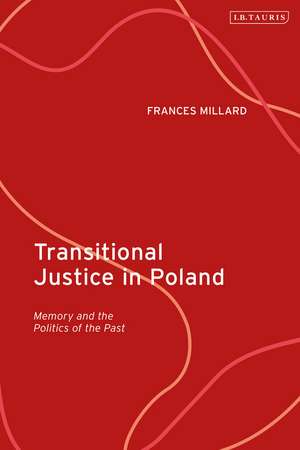
Transitional Justice in Poland: Memory and the Politics of the Past
Autor Professor Frances Millarden Limba Engleză Hardback – 28 ian 2021
Through the specific case of Poland, Millard provides a comprehensive assessment of the mechanisms and institutions used to achieve this, such as lustration, law enforcement through a Constitutional Tribunal and institutions dedicated to dealing with the past such as the Institute of National Remembrance. Crucially, these processes have assumed new significance in recent years after the Law and Justice Party came to power in 2015, using transitional justice as a tool of political control which has enabled the restructuring of Polish democracy.
Preț: 589.57 lei
Preț vechi: 910.09 lei
-35%
Puncte Express: 884
Carte tipărită la comandă
Livrare economică 02-16 decembrie
Livrare express 27-31 octombrie pentru 136.47 lei
Livrare prin curier în România Termenul estimat este afișat lângă disponibilitate.
Transport gratuit pentru acest produs Plată online sau ramburs, în funcție de opțiunile comenzii.
Retur gratuit în 14 zile Comandă securizată și suport în română.
Specificații
ISBN-13: 9780755601332
ISBN-10: 0755601335
Pagini: 272
Dimensiuni: 156 x 234 x 23 mm
Greutate: 0.56 kg
Editura: Bloomsbury Publishing
Colecția I.B.Tauris
Locul publicării:London, United Kingdom
ISBN-10: 0755601335
Pagini: 272
Dimensiuni: 156 x 234 x 23 mm
Greutate: 0.56 kg
Editura: Bloomsbury Publishing
Colecția I.B.Tauris
Locul publicării:London, United Kingdom
Cuprins
1. Introduction: Approaches to the Study of Transitional Justice
2. The Politics of Transitional Justice in Poland
3. The Prosecution of Past Crimes
4. Reparation through Rehabilitation and Compensation
5. The Restitution of Property
6. Lustration 1989-2005
7. Lustration after the fall of the SLD: The Return of the Right
8. Transitional Justice and the Role of the Constitutional Tribunal
9. The Role of the Institute of National Remembrance: The Politics of History and Memory
10. PiS: The End of Transitional Justice and the New Project of Social Transformation
Index
2. The Politics of Transitional Justice in Poland
3. The Prosecution of Past Crimes
4. Reparation through Rehabilitation and Compensation
5. The Restitution of Property
6. Lustration 1989-2005
7. Lustration after the fall of the SLD: The Return of the Right
8. Transitional Justice and the Role of the Constitutional Tribunal
9. The Role of the Institute of National Remembrance: The Politics of History and Memory
10. PiS: The End of Transitional Justice and the New Project of Social Transformation
Index
Recenzii
In this insightful and detailed account Frances Millard deftly charts and explains the twists and turns of Poland's three decades of debates about transitional justice. The book deserves to be on the shelves of all scholars and students concerned with how states and societies deal with difficult pasts, but also those interested in the consequences that decisions to punish, prosecute or draw lines have on the health and fate of democracy.
This is an extremely detailed and wide-ranging account of attempts to achieve transitional justice since the collapse of the Polish communist regime in 1989. It is a meticulously-researched piece of history writing, which explains the chequered progress of transitional justice with reference to developing political circumstances and without recourse to simplistic, one-sided explanations. Millard provides a thorough analysis of the legislation regarding each separate strand of transitional justice.
This is an extremely detailed and wide-ranging account of attempts to achieve transitional justice since the collapse of the Polish communist regime in 1989. It is a meticulously-researched piece of history writing, which explains the chequered progress of transitional justice with reference to developing political circumstances and without recourse to simplistic, one-sided explanations. Millard provides a thorough analysis of the legislation regarding each separate strand of transitional justice.