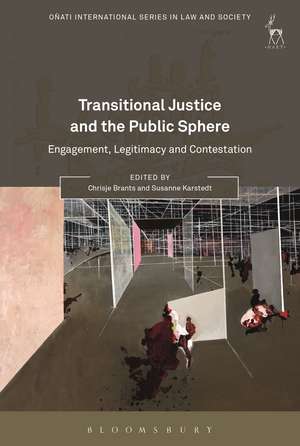
Transitional Justice and the Public Sphere: Engagement, Legitimacy and Contestation: Oñati International Series in Law and Society
Editat de Chrisje Brants, Professor Susanne Karstedten Limba Engleză Paperback – 19 mar 2020
Din seria Oñati International Series in Law and Society
- 32%
 Preț: 628.91 lei
 - 22%
 Preț: 244.93 lei
 - 25%
 Preț: 288.64 lei
 - 24%
 Preț: 286.21 lei
 - 25%
 Preț: 291.36 lei
 - 26%
 Preț: 293.30 lei
 - 29%
 Preț: 555.28 lei
 - 31%
 Preț: 639.98 lei
 - 34%
 Preț: 588.07 lei
 - 21%
 Preț: 352.66 lei
 - 14%
 Preț: 970.24 lei
 - 24%
 Preț: 215.86 lei
 - 25%
 Preț: 277.20 lei
 - 27%
 Preț: 284.79 lei
 - 33%
 Preț: 613.50 lei
 - 22%
 Preț: 340.63 lei
 - 32%
 Preț: 565.30 lei
 - 20%
 Preț: 334.83 lei
 - 32%
 Preț: 619.21 lei
 - 14%
 Preț: 637.11 lei
 - 14%
 Preț: 626.32 lei
 - 32%
 Preț: 636.67 lei
 - 21%
 Preț: 340.71 lei
 - 32%
 Preț: 630.62 lei
 - 20%
 Preț: 336.47 lei
 - 14%
 Preț: 303.33 lei
 - 26%
 Preț: 290.27 lei
 - 25%
 Preț: 282.65 lei
 - 26%
 Preț: 286.38 lei
 - 30%
 Preț: 542.35 lei
 - 34%
 Preț: 857.18 lei
 -
 Preț: 339.80 lei
 - 31%
 Preț: 482.23 lei
 - 25%
 Preț: 277.29 lei
 - 24%
 Preț: 295.12 lei
 - 33%
 Preț: 588.63 lei
 - 32%
 Preț: 598.37 lei
Preț: 300.41 lei
Preț vechi: 396.54 lei
-24%
Puncte Express: 451
Carte tipărită la comandă
Livrare economică 05-19 decembrie
Livrare prin curier în România Termenul estimat este afișat lângă disponibilitate.
Transport gratuit de la 400.00 lei Plată online sau ramburs, în funcție de opțiunile comenzii.
Retur gratuit în 14 zile Comandă securizată și suport în română.
Specificații
ISBN-13: 9781509936892
ISBN-10: 1509936890
Pagini: 360
Dimensiuni: 156 x 234 mm
Greutate: 0.51 kg
Editura: Bloomsbury Publishing
Colecția Hart Publishing
Seria Oñati International Series in Law and Society
Locul publicării:London, United Kingdom
ISBN-10: 1509936890
Pagini: 360
Dimensiuni: 156 x 234 mm
Greutate: 0.51 kg
Editura: Bloomsbury Publishing
Colecția Hart Publishing
Seria Oñati International Series in Law and Society
Locul publicării:London, United Kingdom
V-ar putea interesa
-
 -15%Preț: 419.64 lei493.69 lei
 -
 -32%Preț: 798.30 lei1172.49 lei
 -
 Cases, Materials and Text on European Law and Private LawArthur Hartkamp-25%Preț: 374.58 lei497.90 lei
 -
 Europe’s Justice Deficit?Professor Dr Dimitry Kochenov-22%Preț: 289.32 lei371.77 lei
 -
 Uniform Rules for European Contract Law?: A Critical AssessmentFrancisco de Elizalde-32%Preț: 634.71 lei931.59 lei
 -
 -32%Preț: 635.62 lei928.83 lei
 -
 -23%Preț: 404.20 lei524.93 lei
 -
 Preț: 363.64 lei
 -
 -27%Preț: 981.68 lei1344.78 lei
Cuprins
1. Introduction: The Rational and the Emotional: Issues of Transparency and Legitimacy in Transitional Justice
Chrisje Brants and Susanne Karstedt
Part I: Transitional Justice and its Public Spheres: Principles of Justice
2. Justice as the Art of Muddling through: The Importance of Nyaya in the Aftermath of International Crimes
Antony Pemberton and Rianne Letschert
3. Emotional Discourse in a Rational Public Sphere: The Victim and the International Criminal Trial
Chrisje Brants
4. Credible Justice and Incredible Crimes
Susanne Karstedt
5. Globalisation, Crime and Governance: Transparency, Accountability and Participation as Principles for Global Criminal Law
Paul De Hert
Part II: Justice Seen to Be Done: Courts and the Public
6. International Judicial Institutions: (Re)Defining 'Public' Proceedings?
Olga Kavran
7. The Contestation of Complementarity in Uganda: The Case of Thomas Kwoyelo
Lauren Gould
8. Discursive Proceedings and the Transitional Trial: A View from the Extraordinary Chambers in the Courts of Cambodia
Cheryl White
9. Unmet Expectations and the Legitimacy of Transitional Justice Institutions: The International Criminal Tribunal for the Former Yugoslavia and the Extraordinary Chambers in the Courts of Cambodia
Ray Nickson
Part III: Beyond the Courts: Creating Public Spheres of Testimony
10. Witness Testimony and the Incommensurability of Truth in Argentina
Antonius CGM Robben
11. Faces of Truth: Journalism, Justice and War
Kees Brants and Chrisje Brants
12. Memory Laws: Regulating Memory and the Policing of Acknowledgement and Denial
Marloes van Noorloos
13. Challenges to the Movement to Exhume the Missing Victims of the Spanish Civil War and Francoist Dictatorship
Natalia Maystorovich Chulio
14. Portraits of the Dead and the Living: Bosnia and Rwanda 20 Years on
Olivera Simic
Chrisje Brants and Susanne Karstedt
Part I: Transitional Justice and its Public Spheres: Principles of Justice
2. Justice as the Art of Muddling through: The Importance of Nyaya in the Aftermath of International Crimes
Antony Pemberton and Rianne Letschert
3. Emotional Discourse in a Rational Public Sphere: The Victim and the International Criminal Trial
Chrisje Brants
4. Credible Justice and Incredible Crimes
Susanne Karstedt
5. Globalisation, Crime and Governance: Transparency, Accountability and Participation as Principles for Global Criminal Law
Paul De Hert
Part II: Justice Seen to Be Done: Courts and the Public
6. International Judicial Institutions: (Re)Defining 'Public' Proceedings?
Olga Kavran
7. The Contestation of Complementarity in Uganda: The Case of Thomas Kwoyelo
Lauren Gould
8. Discursive Proceedings and the Transitional Trial: A View from the Extraordinary Chambers in the Courts of Cambodia
Cheryl White
9. Unmet Expectations and the Legitimacy of Transitional Justice Institutions: The International Criminal Tribunal for the Former Yugoslavia and the Extraordinary Chambers in the Courts of Cambodia
Ray Nickson
Part III: Beyond the Courts: Creating Public Spheres of Testimony
10. Witness Testimony and the Incommensurability of Truth in Argentina
Antonius CGM Robben
11. Faces of Truth: Journalism, Justice and War
Kees Brants and Chrisje Brants
12. Memory Laws: Regulating Memory and the Policing of Acknowledgement and Denial
Marloes van Noorloos
13. Challenges to the Movement to Exhume the Missing Victims of the Spanish Civil War and Francoist Dictatorship
Natalia Maystorovich Chulio
14. Portraits of the Dead and the Living: Bosnia and Rwanda 20 Years on
Olivera Simic
Recenzii
... the multitude of perspectives and experiences that scholars and practitioners brought to this book make is outstanding. Legal scholars of criminal law and procedure, criminologists, political scientists, anthropologists, victimologists, communications specialists - they all add to this book their unique perspectives, emphasising once again that transitional justice is an interdisciplinary field.
This collection brings together an impressive range of scholars from different geographical contexts and career stages to explore the role of the public sphere in understanding 'justice' within a transitional justice framework, with a particular focus on legal justice. It will be of use to legal scholars, and to those interested in the role of the public sphere who would like a more nuanced understanding of the role of criminal courts within transitional justice frameworks.
This collection brings together an impressive range of scholars from different geographical contexts and career stages to explore the role of the public sphere in understanding 'justice' within a transitional justice framework, with a particular focus on legal justice. It will be of use to legal scholars, and to those interested in the role of the public sphere who would like a more nuanced understanding of the role of criminal courts within transitional justice frameworks.