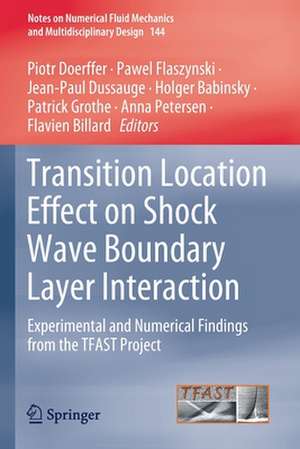
Transition Location Effect on Shock Wave Boundary Layer Interaction: Notes on Numerical Fluid Mechanics and Multidisciplinary Design, cartea 144
Editat de Piotr Doerffer, Pawel Flaszynski, Jean-Paul Dussauge, Holger Babinsky, Patrick Grothe, Anna Petersen, Flavien Billarden Limba Engleză Paperback – aug 2021
The book shares findings obtained using advanced flow measurement methods and concerning e.g. the transition location, boundary layer characteristics, and the detection of shock wave configurations. It includes a number of experimental case studies and CFD simulations that offer valuable insights into the flow structure. It covers RANS/URANS methods for the experimental test section design, as well as more advanced techniques, such as LES, hybrid methods and DNS for studying the transition and shock wave interaction in detail. The experimental and numerical investigations presented here were conducted by sixteen different partners in the context of the TFAST Project. The general focus is on determining if and how it is possible to improve flow performance in comparison to laminar interaction. The book mainly addresses academics and professionals whose work involves the aerodynamics of internal and external flows, as well as experimentalists working with compressible flows. It will also be of benefit for CFD developers and users, and for students of aviation and propulsion systems alike.
Din seria Notes on Numerical Fluid Mechanics and Multidisciplinary Design
- 18%
 Preț: 1176.72 lei
 - 18%
 Preț: 1904.76 lei
 - 18%
 Preț: 1156.02 lei
 -
 Preț: 402.77 lei
 -
 Preț: 402.20 lei
 -
 Preț: 402.94 lei
 - 18%
 Preț: 1279.56 lei
 - 18%
 Preț: 1172.94 lei
 - 18%
 Preț: 1178.29 lei
 - 18%
 Preț: 1191.49 lei
 - 18%
 Preț: 1182.04 lei
 - 18%
 Preț: 1270.46 lei
 - 18%
 Preț: 1260.93 lei
 - 18%
 Preț: 1271.73 lei
 - 18%
 Preț: 1223.23 lei
 - 18%
 Preț: 1189.90 lei
 - 18%
 Preț: 1190.11 lei
 -
 Preț: 401.00 lei
 - 18%
 Preț: 1781.22 lei
 - 18%
 Preț: 1774.70 lei
 - 18%
 Preț: 1275.30 lei
 - 18%
 Preț: 1177.68 lei
 - 18%
 Preț: 1188.82 lei
 - 18%
 Preț: 922.89 lei
 -
 Preț: 375.57 lei
 - 18%
 Preț: 1179.74 lei
 - 18%
 Preț: 1194.92 lei
 - 18%
 Preț: 987.83 lei
 - 18%
 Preț: 985.05 lei
 - 18%
 Preț: 1006.23 lei
Preț: 930.76 lei
Preț vechi: 1135.06 lei
-18%
Puncte Express: 1396
Carte tipărită la comandă
Livrare economică 07-21 decembrie
Livrare prin curier în România Termenul estimat este afișat lângă disponibilitate.
Transport gratuit pentru acest produs Plată online sau ramburs, în funcție de opțiunile comenzii.
Retur gratuit în 14 zile Comandă securizată și suport în română.
Specificații
ISBN-13: 9783030474638
ISBN-10: 3030474631
Pagini: 548
Ilustrații: VIII, 540 p. 518 illus., 424 illus. in color.
Dimensiuni: 155 x 235 x 30 mm
Greutate: 0.82 kg
Ediția:1st ed. 2021
Editura: Springer
Colecția Notes on Numerical Fluid Mechanics and Multidisciplinary Design
Seria Notes on Numerical Fluid Mechanics and Multidisciplinary Design
Locul publicării:Cham, Switzerland
ISBN-10: 3030474631
Pagini: 548
Ilustrații: VIII, 540 p. 518 illus., 424 illus. in color.
Dimensiuni: 155 x 235 x 30 mm
Greutate: 0.82 kg
Ediția:1st ed. 2021
Editura: Springer
Colecția Notes on Numerical Fluid Mechanics and Multidisciplinary Design
Seria Notes on Numerical Fluid Mechanics and Multidisciplinary Design
Locul publicării:Cham, Switzerland
Cuprins
Introduction – TFAST Overview.- WP-1 Reference Cases of Laminar and Turbulent Interactions.- WP-2 Basic Investigation of Transition Effect.- WP-3 Internal Flows – Compressors.- WP-4 Internal Flows – Turbine.- WP-5 External Flows – Wing.- Closing Remarks.
Textul de pe ultima copertă
This book presents experimental and numerical findings on reducing shock-induced separation by applying transition upstream the shock wave. The purpose is to find out how close to the shock wave the transition should be located in order to obtain favorable turbulent boundary layer interaction.
The book shares findings obtained using advanced flow measurement methods and concerning e.g. the transition location, boundary layer characteristics, and the detection of shock wave configurations. It includes a number of experimental case studies and CFD simulations that offer valuable insights into the flow structure. It covers RANS/URANS methods for the experimental test section design, as well as more advanced techniques, such as LES, hybrid methods and DNS for studying the transition and shock wave interaction in detail. The experimental and numerical investigations presented here were conducted by sixteen different partners in the context of the TFAST Project. The general focus is on determining if and how it is possible to improve flow performance in comparison to laminar interaction. The book mainly addresses academics and professionals whose work involves the aerodynamics of internal and external flows, as well as experimentalists working with compressible flows. It will also be of benefit for CFD developers and users, and for students of aviation and propulsion systems alike.
The book shares findings obtained using advanced flow measurement methods and concerning e.g. the transition location, boundary layer characteristics, and the detection of shock wave configurations. It includes a number of experimental case studies and CFD simulations that offer valuable insights into the flow structure. It covers RANS/URANS methods for the experimental test section design, as well as more advanced techniques, such as LES, hybrid methods and DNS for studying the transition and shock wave interaction in detail. The experimental and numerical investigations presented here were conducted by sixteen different partners in the context of the TFAST Project. The general focus is on determining if and how it is possible to improve flow performance in comparison to laminar interaction. The book mainly addresses academics and professionals whose work involves the aerodynamics of internal and external flows, as well as experimentalists working with compressible flows. It will also be of benefit for CFD developers and users, and for students of aviation and propulsion systems alike.
Caracteristici
Presents advanced methods for improving flow performance Fosters a better understanding the consequences of laminar interactions Shows how CFD can be used to predict complex flow phenomena