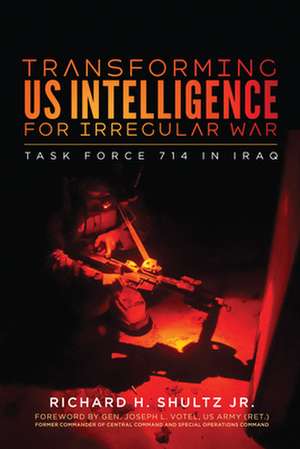
Transforming US Intelligence for Irregular War
Autor Jr. Shultzen Limba Engleză Hardback – apr 2020
In Transforming US Intelligence for Irregular War, Richard H. Shultz Jr. provides a broad discussion of the role of intelligence in combatting nonstate militants and revisits this moment of innovation during the Iraq War, showing how the defense and intelligence communities can adapt to new and evolving foes. Shultz tells the story of how TF 714 partnered with US intelligence agencies to dismantle AQI's secret networks by eliminating many of its key leaders. He also reveals how TF 714 altered its methods and practices of intelligence collection, intelligence analysis, and covert paramilitary operations to suppress AQI's growing insurgency and, ultimately, destroy its networked infrastructure.
TF 714 remains an exemplar of successful organizational learning and adaptation in the midst of modern warfare. By examining its innovations, Shultz makes a compelling case for intelligence leading the way in future campaigns against nonstate armed groups.
--John Arquilla, distinguished professor of defense analysis, US Naval Postgraduate School "Proceedings"
Preț: 679.41 lei
Preț vechi: 882.35 lei
-23%
Puncte Express: 1019
Carte tipărită la comandă
Livrare economică 27 noiembrie-11 decembrie
Livrare prin curier în România Termenul estimat este afișat lângă disponibilitate.
Transport gratuit pentru acest produs Plată online sau ramburs, în funcție de opțiunile comenzii.
Retur gratuit în 14 zile Comandă securizată și suport în română.
Specificații
ISBN-13: 9781626167643
ISBN-10: 1626167648
Pagini: 312
Dimensiuni: 152 x 229 x 21 mm
Greutate: 0.63 kg
Editura: Georgetown University Press
ISBN-10: 1626167648
Pagini: 312
Dimensiuni: 152 x 229 x 21 mm
Greutate: 0.63 kg
Editura: Georgetown University Press
Notă biografică
Richard H. Shultz Jr. is the Lee E. Dirks Professor of International Politics and the director of the International Security Studies Program at the Fletcher School of Law and Diplomacy at Tufts University. He is the author of several books, including The Marines Take Anbar: The Four-Year Fight Against Al Qaeda and, with Andrea J. Dew, Insurgents, Terrorists, and Militias: The Warriors of Contemporary Combat.
Descriere
In Transforming US Intelligence for Irregular War, Richard H. Shultz Jr. provides a broad discussion of intelligence in combatting nonstate militants. He revisits the innovation of TF 714 during the Iraq War, showing how the defense and intelligence communities can adapt to new and evolving foes.