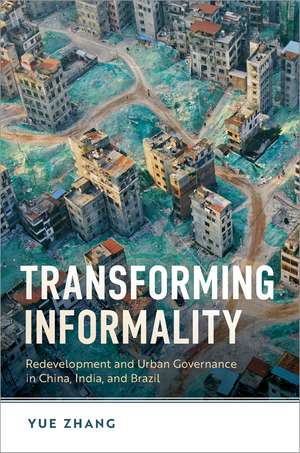
Transforming Informality: Redevelopment and Urban Governance in China, India, and Brazil
Autor Yue Zhangen Limba Engleză Paperback – 8 mar 2027
Preț: 172.23 lei
Preț vechi: 227.23 lei
-24% Precomandă
Puncte Express: 258
Carte nepublicată încă
Livrare prin curier în România Precomanda se expediază când titlul devine disponibil.
Transport gratuit de la 400.00 lei Plată online sau ramburs, în funcție de opțiunile comenzii.
Retur gratuit în 14 zile Comandă securizată și suport în română.
Doresc să fiu notificat când acest titlu va fi disponibil:
Se trimite...
Specificații
ISBN-13: 9780197850992
ISBN-10: 0197850995
Pagini: 328
Dimensiuni: 156 x 235 mm
Editura: Oxford University Press
Colecția OUP USA
Locul publicării:New York, United States
ISBN-10: 0197850995
Pagini: 328
Dimensiuni: 156 x 235 mm
Editura: Oxford University Press
Colecția OUP USA
Locul publicării:New York, United States
Recenzii
Transforming Informality is comparative urban politics at its best. Drawing on extraordinarily ambitious research in Guangzhou, Mumbai, Rio de Janeiro, and São Paulo, Yue Zhang shows that redevelopment transforms informality through distinct arrangements of state power and social participation. Her lucid framework of effective and inclusive governance moves beyond familiar contrasts between democracy and authoritarianism to explain why cities produce different policy outcomes. By tracing struggles over land, housing, and recognition, Zhang reveals how redevelopment remakes urban citizenship itself. This conceptually incisive and empirically rich book will become essential reading on cities, governance, and the Global South.
Combining bold cross-regional breadth with impressive empirical depth, Transforming Informality proposes a novel theoretical framework that explains how cities are governed across the Global South. The book's key findings about contrasting patterns of redevelopment among informal settlements have profound implications for the dignity and well-being of the more than one billion people around the globe who live in precarious urban areas. A major agenda-setting achievement that exemplifies how careful comparative research can shed new light on important human problems.
Combining bold cross-regional breadth with impressive empirical depth, Transforming Informality proposes a novel theoretical framework that explains how cities are governed across the Global South. The book's key findings about contrasting patterns of redevelopment among informal settlements have profound implications for the dignity and well-being of the more than one billion people around the globe who live in precarious urban areas. A major agenda-setting achievement that exemplifies how careful comparative research can shed new light on important human problems.
Notă biografică
Yue Zhang is Associate Professor of Political Science and Global Asian Studies at the University of Illinois Chicago. She is the author of The Fragmented Politics of Urban Preservation: Beijing, Chicago, and Paris. She is Co-Editor of Urban Affairs Review and was a Fellow at the Woodrow Wilson International Center for Scholars in Washington, D.C.