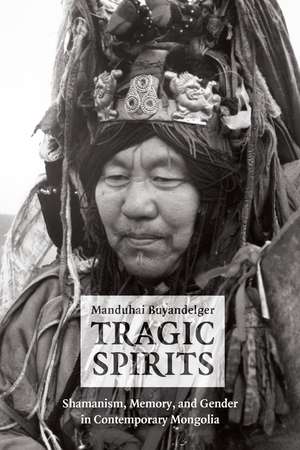
Tragic Spirits: Shamanism, Memory, and Gender in Contemporary Mongolia
Autor Manduhai Buyandelgeren Limba Engleză Paperback – noi 2013
The collapse of socialism at the end of the twentieth century brought devastating changes to Mongolia. Economic shock therapy—an immediate liberalization of trade and privatization of publicly owned assets—quickly led to impoverishment, especially in rural parts of the country, where Tragic Spirits takes place. Following the travels of the nomadic Buryats, Manduhai Buyandelger tells a story not only of economic devastation but also a remarkable Buryat response to it—the revival of shamanic practices after decades of socialist suppression.
Attributing their current misfortunes to returning ancestral spirits who are vengeful over being abandoned under socialism, the Buryats are now at once trying to appease their ancestors and recover the history of their people through shamanic practice. Thoroughly documenting this process, Buyandelger situates it as part of a global phenomenon, comparing the rise of shamanism in liberalized Mongolia to its similar rise in Africa and Indonesia. In doing so, she offers a sophisticated analysis of the way economics, politics, gender, and other factors influence the spirit world and the crucial workings of cultural memory.
Preț: 328.84 lei
Puncte Express: 493
Carte tipărită la comandă
Livrare economică 24 noiembrie-08 decembrie
Livrare prin curier în România Termenul estimat este afișat lângă disponibilitate.
Transport gratuit de la 400.00 lei Plată online sau ramburs, în funcție de opțiunile comenzii.
Retur gratuit în 14 zile Comandă securizată și suport în română.
Specificații
ISBN-13: 9780226086569
ISBN-10: 0226086569
Pagini: 336
Ilustrații: 24 halftones, 3 maps, 2 line drawings
Dimensiuni: 152 x 229 x 20 mm
Greutate: 0.47 kg
Editura: University of Chicago Press
Colecția University of Chicago Press
ISBN-10: 0226086569
Pagini: 336
Ilustrații: 24 halftones, 3 maps, 2 line drawings
Dimensiuni: 152 x 229 x 20 mm
Greutate: 0.47 kg
Editura: University of Chicago Press
Colecția University of Chicago Press
V-ar putea interesa
-
 Imperatives and CommandsAlexandra Y. Aikhenvald-22%Preț: 479.00 lei613.85 lei
 -
 Intangible Cultural Heritage in International LawLucas Lixinski-31%Preț: 679.40 lei988.51 lei
 -
 The Mormon Quest for Glory: The Religious World of the Latter-Day SaintsMelvyn Hammarberg-19%Preț: 380.14 lei466.97 lei
 -
 -13%Preț: 279.30 lei320.96 lei
 -
 Preț: 221.88 lei
 -
 A History of AnthropologyThomas Hylland EriksenPreț: 229.99 lei
 -
 When God Comes to TownRik PinxtenPreț: 199.69 lei
 -
 The GiftLewis HydePreț: 93.81 lei
 -
 Biosocial BecomingsTim Ingold-11%Preț: 643.30 lei722.81 lei
 -
 Crossing OverRubén MartínezPreț: 146.42 lei
 -
 Cultures and CrisesMary Douglas-15%Preț: 448.20 lei527.29 lei
 -
 Power, Culture, and Violence in the AndesChristine HunefeldtPreț: 373.53 lei
 -
 An Anthropology of ArchitectureVictor BuchliPreț: 389.18 lei
Notă biografică
Manduhai Buyandelger is associate professor of anthropology at the Massachusetts Institute of Technology.
Recenzii
“Packed with interwoven personal narratives which the author ties together to show the fragility and molding of Buryat memory and Buryat shamanism’s purpose during the transition from state socialism to neoliberal capitalism in Mongolia. . . . Buyandelger has created an emotive, accessible, and well-researched ethnography sure to arouse sympathy and interest in readers.”
“As this work poignantly captures, what the Buryats want from the shamans are stories and rituals that both make sense of their past and ongoing trials and tribulations. By capturing in fascinating detail the long, complicated, and negotiated process of this shamanic narrativization and its ritualization, Buyandelger not only reveals how the shamans create meaning, but also
how the clients of these religious specialists engage these new traditions precisely in order to make sense of their current lives. Thus by moving beyond the by-now fetishized shaman, and both their venality within the capitalist system and their clients’ supposed gullibility, the author reveals the ongoing process whereby memory is reclaimed in new ways in order to rebuild a shattered community.”
how the clients of these religious specialists engage these new traditions precisely in order to make sense of their current lives. Thus by moving beyond the by-now fetishized shaman, and both their venality within the capitalist system and their clients’ supposed gullibility, the author reveals the ongoing process whereby memory is reclaimed in new ways in order to rebuild a shattered community.”
“Tragic Spirits is a rich, enviably nuanced ethnography filled with details about Mongolian history and the impact of Mongolian history on Buryat shamanistic practices. The author’s capacities as a ‘native anthropologist’ have enabled her to comprehend a myriad of complex and multilayered interactions, but perhaps more impressive is how she derives her analysis through the interpretation of narratives. We learn about the twists and turns of Buryat experience through the trenchant stories of people, many of whom are either shamans or the clients of shamans. This strategy is admirable, for it foregrounds experience and renders the text a memorable evocation of the human condition as well as a powerful exercise in social analysis. Such a synthesis is a rare achievement.”
“Manduhai Buyandelger’s accounts of Mongolians’ anxious attempts to enlist the help of new shamans to find their lost dead, against a background of deep disruption by socialist terror followed by a failed neoliberal ‘shock therapy,’ are deeply moving. They also raise challenging questions of a more general purport: the ‘reality’ of spirits that seem to be out of contact, the expertise of specialists who have to start from lost knowledge, and the tricks memory can play offering relief nonetheless. A powerful analysis of common sense, the supernatural, and innovative creativity.”
“Tragic Spirits, by the Harvard trained Buryat-Mongolian scholar Buyandelger, is based on the author’s immersion into the social and spiritual relations in the rural district of Bayan-Uul in eastern Mongolia between 1996 and 2000. Her ethnography reflects the author’s unique ability to successfully merge her insiders’ familiarity with postsocialist ruptures with estrangement by anthropological analysis. Her representation provides a complex account intertwining fieldwork experiences with historical narratives and theoretical concepts. By relating her discussion to theories not only on shamanism and magic but also on neoliberal capitalism, gender, and postsocialism, the author creates a dense, multilayered analysis with inspiring new insights.”