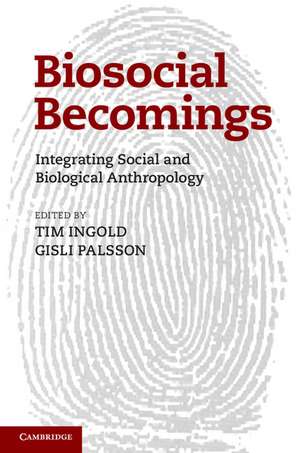
Biosocial Becomings
Editat de Tim Ingold, Gisli Pálssonen Limba Engleză Hardback – 13 iun 2013
Ne-a atras atenția Biosocial Becomings prin rigoarea cu care chestionează fundamentele antropologiei contemporane. Coordonat de Tim Ingold și Gisli Pálsson, volumul reunește o echipă de cercetători din centre academice de prestigiu, propunând o perspectivă integrată asupra condiției umane. Subliniem faptul că autorii nu se limitează la o analiză teoretică, ci ancorează dezbaterea în date clinice și etnografice solide, investigând modul în care viața se forjează în procesul trăirii, dincolo de determinismele genetice sau culturale. Considerăm că structura volumului este esențială pentru înțelegerea progresiei de la teorie la practică. După un „Prospect” semnat de Tim Ingold, textul explorează relațiile biosociale prin prisma epigeneticii și a mediilor bioculturale, culminând cu studii de caz fascinante despre biologiile mediate în talasemie sau managementul resurselor în Africa Subsahariană. Această abordare completează excelent lucrarea Nature, Culture, and Society de Gisli Pálsson, adăugând o dimensiune profund fenomenologică și o metodologie bazată pe „devenire”. În contextul operei lui Tim Ingold, acest titlu reprezintă o evoluție firească de la Companion Encyclopedia of Anthropology. Dacă enciclopedia stabilea interconexiunile între ramurile antropologiei, Biosocial Becomings trece la o etapă superioară, demonstrând cum descoperirile din științele biologice pot avansa mână în mână cu cercetarea socială. Tonul este unul clinic și analitic, evitând dihotomiile clasice și oferind o viziune unitară asupra ființei ca organism-persoană în mediul său.
Preț: 672.01 lei
Preț vechi: 707.37 lei
-5%
Carte tipărită la comandă
Livrare economică 11-25 iulie
Specificații
ISBN-10: 110702563X
Pagini: 288
Ilustrații: 16 b/w illus. 1 table
Dimensiuni: 156 x 236 x 20 mm
Greutate: 0.6 kg
Ediția:New.
Editura: Cambridge University Press
Locul publicării:New York, United States
V-ar putea interesa
-
 PROGRESS HBSamuel Miller McDonaldPreț: 153.75 lei
 -
![Sapiens [Tenth Anniversary Edition]](https://i0.books-express.ro/bt/9780063422001/sapiens-tenth-anniversary-edition.jpg) Sapiens [Tenth Anniversary Edition]Yuval Noah HarariPreț: 173.09 lei
Sapiens [Tenth Anniversary Edition]Yuval Noah HarariPreț: 173.09 lei -
 -18%Preț: 129.29 lei157.24 lei
 -
 Human PeoplesLluis Quintana-MurciPreț: 188.81 lei
 -
 Preț: 150.55 lei
 -
 Against IdentityAlexander DouglasPreț: 141.46 lei
 -
 -9%Preț: 746.52 lei820.35 lei
 -
 AdaptableHerman PontzerPreț: 182.93 lei
 -
 Life in SyncPhilippa GanderPreț: 119.55 lei
 -
 Metamorphosis: A Natural and Human HistoryOren Harman-31%Preț: 131.42 lei191.14 lei
 -
 The Rise and Fall of Generation NowTim IngoldPreț: 112.72 lei
 -
 How to Inhabit the EarthBruno LatourPreț: 75.19 lei
 -
 Becoming a WomanMegan BurkePreț: 122.51 lei
 -
 Lineages of ModernityEmmanuel ToddPreț: 160.64 lei
 -
 We Are Not NumbersAhmed AlnaouqPreț: 108.42 lei
 -
 InheritanceHarvey WhitehousePreț: 85.18 lei
 -
 ProcessedLucie Morris-MarrPreț: 115.91 lei
 -
 The Other Side of ChangeMaya ShankarPreț: 120.16 lei
 -
 Agency and Organisation: The Dialectics of Nature and LifeRasmus Sandnes Haukedal-18%Preț: 705.98 lei860.95 lei
De ce să citești această carte
Recomandăm această carte profesioniștilor din antropologie, sociologie medicală și biologie care caută un cadru teoretic unificat. Cititorul câștigă o înțelegere profundă a modului în care factorii biologici și sociali se întrepătrund în procese precum epigenetica. Este o resursă esențială pentru a înțelege de ce umanitatea nu este un dat genetic, ci un proces continuu de construcție în raport cu mediul și tehnologia.
Despre autor
Tim Ingold este profesor de antropologie socială la Universitatea din Aberdeen și unul dintre cei mai influenți gânditori contemporani în domeniul relațiilor om-mediu. Cercetările sale interdisciplinare acoperă teoria evoluționistă, percepția mediului și practicile calificate. Recunoscut la nivel internațional, a fost distins cu Medalia de Aur Anders Retzius în 2004. Opera sa este marcată de un efort constant de a depăși fragmentarea dintre științele naturii și cele umaniste, promovând o antropologie a vieții care integrează biologia, arheologia și psihologia într-o viziune holistică asupra devenirii umane.
Descriere scurtă
Cuprins
Recenzii
'Biosocial Becomings is a thought-provoking collection of essays on the current re-negotiation of the boundaries between the biological and the social in the study of humans. The subtitle of the book promises a new integration of social and biological anthropology after a long century of divorce. It does more: it explores a conceptual space that is no longer dominated by the dichotomy between nature and culture.' Hans-Jörg Rheinberger, Max Planck Institute for the History of Science
'The essays included in the book are highly informative and inspiring. I am pleased that the authors actually build upon an interdisciplinary approach. The texts are based not only on findings and theories of social and biological anthropology, but the authors also benefit from various concepts of philosophy, psychology, and other scientific fields. Biosocial Becomings is a highly original volume including inspiriting texts. I personally find [it] groundbreaking, because it is really an effort to restore connection of social and biological anthropology.' Martin Soukup, Anthropos
'… an interesting and thought-provoking read for those of us ready to engage in debate with our colleagues in social anthropology.' Siân Waters, Primate Eye