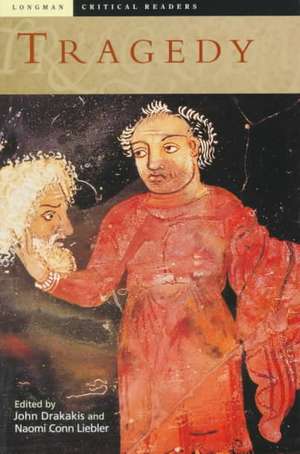
Tragedy: Longman Critical Readers
Autor John Drakakis, Naomi Conn Liebleren Limba Engleză Paperback – 9 apr 1998
With the explosion of interest in the areas of post-structuralism, sociology of culture, social anthropology, feminism, deconstruction, and the study of ritual, new questions are being asked about this persistent artistic exploration of human experience. This book seeks to represent a full selection of these divergent interests, in a series of substantial extracts which display the continuing richness of the debate about a genre which has provoked, and challenged categorical discussion since the appearance of Aristotle's Poetics.
Din seria Longman Critical Readers
- 11%
 Preț: 407.87 lei
 - 15%
 Preț: 426.80 lei
 - 18%
 Preț: 1303.58 lei
 -
 Preț: 367.55 lei
 - 15%
 Preț: 449.21 lei
 - 18%
 Preț: 1112.48 lei
 - 15%
 Preț: 425.36 lei
 - 15%
 Preț: 439.90 lei
 - 18%
 Preț: 1112.48 lei
 - 15%
 Preț: 452.71 lei
 -
 Preț: 360.86 lei
 - 15%
 Preț: 440.15 lei
 - 18%
 Preț: 1112.48 lei
 - 15%
 Preț: 452.71 lei
 - 18%
 Preț: 1249.78 lei
 -
 Preț: 475.05 lei
 - 15%
 Preț: 480.87 lei
 - 18%
 Preț: 1112.48 lei
 - 15%
 Preț: 433.03 lei
 - 18%
 Preț: 1112.48 lei
 - 15%
 Preț: 617.44 lei
 - 18%
 Preț: 1112.48 lei
 - 18%
 Preț: 1112.48 lei
 - 15%
 Preț: 567.83 lei
 - 18%
 Preț: 1112.48 lei
 - 15%
 Preț: 474.49 lei
 - 18%
 Preț: 1150.52 lei
 - 18%
 Preț: 1303.58 lei
 - 15%
 Preț: 438.72 lei
 - 15%
 Preț: 422.09 lei
 -
 Preț: 343.86 lei
 - 18%
 Preț: 1112.48 lei
 - 15%
 Preț: 442.04 lei
 - 15%
 Preț: 562.64 lei
 - 18%
 Preț: 1112.48 lei
 - 15%
 Preț: 434.62 lei
 - 15%
 Preț: 443.05 lei
Preț: 496.17 lei
Preț vechi: 583.73 lei
-15%
Puncte Express: 744
Carte tipărită la comandă
Livrare economică 04-18 decembrie
Livrare prin curier în România Termenul estimat este afișat lângă disponibilitate.
Transport gratuit pentru acest produs Plată online sau ramburs, în funcție de opțiunile comenzii.
Retur gratuit în 14 zile Comandă securizată și suport în română.
Specificații
ISBN-13: 9780582209978
ISBN-10: 0582209978
Pagini: 376
Dimensiuni: 156 x 234 x 22 mm
Greutate: 0.7 kg
Ediția:1
Editura: Taylor & Francis
Colecția Routledge
Seria Longman Critical Readers
Locul publicării:Oxford, United Kingdom
ISBN-10: 0582209978
Pagini: 376
Dimensiuni: 156 x 234 x 22 mm
Greutate: 0.7 kg
Ediția:1
Editura: Taylor & Francis
Colecția Routledge
Seria Longman Critical Readers
Locul publicării:Oxford, United Kingdom
V-ar putea interesa
-
 Antony and CleopatraProfessor John DrakakisPreț: 215.20 lei
 -
 Dramatic MonologueGlennis ByronPreț: 220.70 lei
 -
 Alternative ShakespearesJohn DrakakisPreț: 288.86 lei
 -
 Gothic ShakespearesJohn DrakakisPreț: 402.32 lei
 -
 British Radio DramaJohn DrakakisPreț: 300.28 lei
 -
 Shakespearean TragedyJohn Drakakis-15%Preț: 501.01 lei589.42 lei
 -
 A Study Guide for Tom Stoppard's "Travesties"Cengage Learning GalePreț: 67.20 lei
 -
 Les Petites Âmes Pressées (Éd.1898)Gustave KahnPreț: 199.48 lei
 -
 Les Petites Comédies Du Vice (Éd.1890)Eugène ChavettePreț: 182.45 lei
 -
 Les Petits Vagabonds (Éd.1867)Jeanne MarcelPreț: 166.69 lei
 -
 Les Petits-Paris. Paris-En-Voyage (Éd.1854-1855)Taxile DelordPreț: 94.66 lei
 -
 Preț: 183.07 lei
 -
 Les Premières Oeuvres de M. Régnier . Au Roy (Éd.1608)Mathurin RégnierPreț: 104.65 lei
 -
 Preț: 285.10 lei
 -
 Les Premières Représentations Célèbres (Nouvelle Édition) (Éd.1875)Charles MonseletPreț: 175.78 lei
 -
 Les Princes d'Ébène, (Éd.1852)Guillaume-Joseph-Gabriel De La LandellePreț: 183.07 lei
 -
 Les Princesses d'Amour (Courtisanes Japonaises) (Éd.1900)Judith GautierPreț: 174.95 lei
 -
 Preț: 151.37 lei
 -
 Les Quatre Fils Aymon (Éd.1497)CollectifPreț: 151.16 lei
 -
 Les Quatre Poëtiques. T. 1 (Éd.1771)AristotePreț: 207.79 lei
 -
 Les Robinsons de la Guyane (Éd.1893)Louis BoussenardPreț: 287.01 lei
 -
 Les romans de la Table rondeCollectifPreț: 199.64 lei
 -
 Les Romantiques (Éd.1878)Marc De MontifaudPreț: 166.69 lei
 -
 Les Roueries de Trialph: Notre Contemporain Avant Son Suicide (Éd.1833)Charles LassaillyPreț: 185.20 lei
 -
 Performing the Renaissance BodyJohn Drakakis-23%Preț: 1070.35 lei1390.06 lei
Cuprins
General Editor's Preface Acknowledgements 1. Introduction 2. The Philosophy of Tragedy G.W.F. Hegel, Tragedy as a dramatic art; A. C. Bradley, Hegel's Theory of Tragedy; Friedrich Nietzsche from The Birth of Tragedy; Soren Kierkegaard, The Tragic in Ancient Drama; Georg Lukacs, The Metaphysics of Tragedy 3. Historical Materialism and Tragedy Lucien Goldman, The Tragic Vision: Man; World Visions and Social Classes; Bertold Breght from A Short Organum for the Theatre; George Thomson, Tragedy; Walter Benjamin, Trauerspiel and Tragedy; Alain Robbe-Grillet, Nature, Humanism and Tragedy; Augusto Boal, Aristotle's Coercive System of Tragedy 4. Tradition and Innovation Arthur Miller, Tragedy and the Common Man ; Arthur Miller, The Nature of Tragedy; George Steiner from The Death of Tragedy; Raymond Williams from Modern Tragedy 5. Psychoanalysis and Tragedy Sigmund Freud from Character and Culture; Jacques Lacan, The Splendor of Antigone; Andre Greend, The Psychoanalytic Reading of Tragedy 6. Feminism and Tragedy Elisabeth Bronten from Omphalos to Phallus: Cultural Representations of Femininity and Death; Sarah B. Pomeroy, Images of Women in the Literature of Classical Athens; Nicole Loraux, The Rope and the Sword 7. Ritual and Tragedy Jan Kott, The Eating of the Gods, or the Bacchae; Rene Girard, The Sacrificial Crisis; Wole Soyinka, Morality and Aesthetics and the Ritual of Archetype; Northrop Frye, The Mythos of Autumn: Tragedy; Susanne K. Langer, The Great Dramatic Forms: The Tragic Rhythm 8. Deconstruction and Tragedy Jacques Derrida, Plato's Pharmacy Bibliography Index
Descriere
This wide-ranging and unique collection of documents on one of the most enduring of literary genres, Tragedy, offers a radical revaluation of its significance in the light of the critical attention that it has received during the past one-hundred and fifty years. With growing interest in the areas of post-structuralism, sociology of culture, social anthropology, feminism, deconstruction, and the study of ritual, new questions are being asked about this persistent artistic exploration of human experience. This book seeks to represent a full selection of these divergent interests, in a series of substantial extracts which display the continuing richness of the debate about a genre which has provoked, and challenged categorical discussion since the appearance of Aristotle's Poetics.