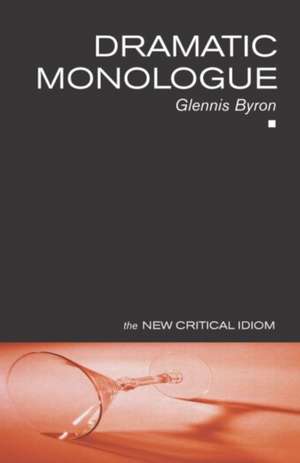
Dramatic Monologue: The New Critical Idiom
Autor Glennis Byronen Limba Engleză Paperback – 24 iul 2003
* explores the origins of the monologue and presents a history of definitions of the term
* considers the monologue as a form of social critique
* explores issues at play in our understanding of the genre, such as subjectivity, gender and politics
* traces the development of the genre through to the present day.
Taking as example the increasingly politicized nature of contemporary poetry, the author clearly and succinctly presents an account of the monologue's growing popularity over the past twenty years.
Din seria The New Critical Idiom
-
 Preț: 187.72 lei
 -
 Preț: 181.31 lei
 - 9%
 Preț: 1347.66 lei
 - 9%
 Preț: 819.32 lei
 -
 Preț: 220.70 lei
 -
 Preț: 305.86 lei
 -
 Preț: 212.53 lei
 -
 Preț: 212.99 lei
 -
 Preț: 187.72 lei
 -
 Preț: 215.68 lei
 -
 Preț: 279.07 lei
 -
 Preț: 213.45 lei
 - 18%
 Preț: 895.35 lei
 - 18%
 Preț: 834.71 lei
 -
 Preț: 217.96 lei
 -
 Preț: 272.05 lei
 -
 Preț: 243.66 lei
 -
 Preț: 273.54 lei
 -
 Preț: 215.10 lei
 -
 Preț: 213.06 lei
 -
 Preț: 276.93 lei
 -
 Preț: 213.93 lei
 -
 Preț: 213.12 lei
 -
 Preț: 238.74 lei
 -
 Preț: 212.02 lei
 -
 Preț: 217.15 lei
 - 18%
 Preț: 835.51 lei
 -
 Preț: 230.90 lei
 -
 Preț: 226.51 lei
 -
 Preț: 188.86 lei
 - 18%
 Preț: 714.03 lei
 -
 Preț: 272.27 lei
 - 18%
 Preț: 713.00 lei
 -
 Preț: 250.69 lei
 -
 Preț: 212.64 lei
 -
 Preț: 217.73 lei
 -
 Preț: 278.22 lei
 -
 Preț: 212.27 lei
 -
 Preț: 300.79 lei
 -
 Preț: 238.88 lei
 - 18%
 Preț: 709.86 lei
 -
 Preț: 218.79 lei
 -
 Preț: 251.75 lei
Preț: 220.70 lei
Puncte Express: 331
Carte tipărită la comandă
Livrare economică 27 noiembrie-11 decembrie
Livrare prin curier în România Termenul estimat este afișat lângă disponibilitate.
Transport gratuit de la 400.00 lei Plată online sau ramburs, în funcție de opțiunile comenzii.
Retur gratuit în 14 zile Comandă securizată și suport în română.
Specificații
ISBN-13: 9780415229371
ISBN-10: 0415229375
Pagini: 176
Ilustrații: glossary, bibliography
Dimensiuni: 129 x 198 x 14 mm
Greutate: 0.18 kg
Ediția:New.
Editura: Taylor & Francis
Colecția Routledge
Seria The New Critical Idiom
Locul publicării:Oxford, United Kingdom
ISBN-10: 0415229375
Pagini: 176
Ilustrații: glossary, bibliography
Dimensiuni: 129 x 198 x 14 mm
Greutate: 0.18 kg
Ediția:New.
Editura: Taylor & Francis
Colecția Routledge
Seria The New Critical Idiom
Locul publicării:Oxford, United Kingdom
V-ar putea interesa
-
 Dracula: Bram StokerGlennis Byron-14%Preț: 553.96 lei644.13 lei
 -
 Preț: 491.35 lei
 -
 Preț: 417.22 lei
 -
 A Short History of English LiteratureHarry BlamiresPreț: 430.86 lei
 -
 -18%Preț: 1454.92 lei1774.29 lei
 -
 Literature About LanguageValerie ShepardPreț: 470.92 lei
 -
 Reading Between the LinesAnnabel PattersonPreț: 487.13 lei
 -
 Preț: 350.94 lei
 -
 The Routledge Reader in Caribbean LiteratureAlison DonnellPreț: 416.45 lei
 -
 Alternative ShakespearesJohn DrakakisPreț: 288.86 lei
 -
 Gothic ShakespearesJohn DrakakisPreț: 402.32 lei
 -
 Autism and RepresentationMark Osteen-18%Preț: 1127.82 lei1375.39 lei
 -
 -18%Preț: 1113.77 lei1358.26 lei
 -
 British Radio DramaJohn DrakakisPreț: 300.28 lei
 -
 The GothicDavid PunterPreț: 300.00 lei
 -
 Weeping for Dido – The Classics in the Medieval ClassroomMarjorie Curry WoodsPreț: 392.34 lei
 -
 Universality and Social Policy in CanadaDaniel BélandPreț: 276.73 lei
 -
 Preț: 63.39 lei
 -
 Preț: 64.32 lei
 -
 Gil Vicente Bibliography (2005-2015)Constantin C. Stathatos-33%Preț: 548.14 lei814.52 lei
 -
 Made Under Pressure: Literary Translation in the Soviet Union, 1960–1991Natalia KamovnikovaPreț: 275.57 lei
 -
 Preț: 287.35 lei
 -
 Books for Idle Hours: Nineteenth-Century Publishing and the Rise of Summer ReadingDonna Harrington-LuekerPreț: 269.16 lei
 -
 Food, Text and Culture in the Anglophone CaribbeanSarah Lawson Welsh-23%Preț: 286.36 lei371.73 lei
 -
 Ngugi – Reflections on his Life of WritingSimon GikandiPreț: 264.17 lei
 -
 -23%Preț: 839.32 lei1090.02 lei
Public țintă
UndergraduateCuprins
Chapter 1 Introduction; Chapter 2 Definitions; Chapter 3 Origins; Chapter 4 Men and Women; Chapter 5 Victorian Developments; Chapter 6 Modernism and Its Aftermath; Chapter 7 Contemporary Dramatic Monologues;
Notă biografică
Glennis Byron is a Reader in English Studies at the University of Stirling. She is the author of Letitia Landon: The Woman behind L.E.L. (1995) and various articles on Victorian literature and the Gothic.
Descriere
Taking as example the increasingly politicised nature of contemporary poetry, the author clearly and succinctly presents an account of the monologue's growing popularity over the past twenty years.