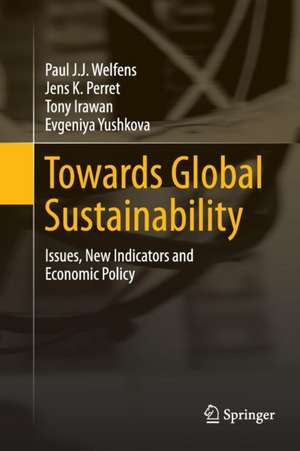
Towards Global Sustainability
Autor Paul J. J. Welfens, Jens K. Perret, Tony Irawan, Evgeniya Yushkovaen Limba Engleză Paperback – 22 oct 2016
Sustainability rhetoric dominates environmental policy. This fresh assessment of key "pillars" of sustainable economic performance and growth is a valuable contribution to greening the economy, the leitmotiv of the latest Rio Earth Summit. The book places the discussion of sustainability on solid data. The rather surprising results of its new sustainability index should make policy makers rethink their environmental and economic strategies.
Prof. Dr. Peter Bartelmus
Columbia University, New York
Many people put the economy first when sustainability concerns are raised, while environmental indicators are often developed without a sense of socio-economic performance. This important new book bridges the gap. It sheds light on crucial indicators such as renewable energies, exporting green goods and services, genuine savings, and water productivity. And it helps to observe the impressive changes at a global scale and in countries such as China. A must read for all experts interested in those issues.
Prof. Dr. Raimund Bleischwitz
University College London
Preț: 369.35 lei
Puncte Express: 554
Carte tipărită la comandă
Livrare economică 23 noiembrie-07 decembrie
Livrare prin curier în România Termenul estimat este afișat lângă disponibilitate.
Transport gratuit de la 400.00 lei Plată online sau ramburs, în funcție de opțiunile comenzii.
Retur gratuit în 14 zile Comandă securizată și suport în română.
Specificații
ISBN-13: 9783319373744
ISBN-10: 3319373749
Pagini: 180
Ilustrații: XV, 164 p. 66 illus., 33 illus. in color.
Dimensiuni: 155 x 235 x 11 mm
Greutate: 0.28 kg
Ediția:Softcover reprint of the original 1st edition 2016
Editura: Springer
Locul publicării:Cham, Switzerland
ISBN-10: 3319373749
Pagini: 180
Ilustrații: XV, 164 p. 66 illus., 33 illus. in color.
Dimensiuni: 155 x 235 x 11 mm
Greutate: 0.28 kg
Ediția:Softcover reprint of the original 1st edition 2016
Editura: Springer
Locul publicării:Cham, Switzerland
V-ar putea interesa
-
 The Economics and Politics of Climate ChangeDieter Helm-10%Preț: 347.41 lei385.69 lei
 -
 Local Climate Change and SocietyM. A. Mohamed Salih-18%Preț: 1254.81 lei1530.26 lei
 -
 Climate Change and Displacement ReaderScott Leckie-15%Preț: 530.97 lei624.67 lei
 -
 The Politics of Climate ChangeAnthony GiddensPreț: 166.37 lei
 -
 A Short Introduction to Climate ChangeTony EggletonPreț: 333.44 lei
 -
 -27%Preț: 78.80 lei107.43 lei
 -
 -15%Preț: 526.40 lei619.29 lei
 -
 -27%Preț: 998.11 lei1361.48 lei
 -
 Emissions of Methane & Nitrous Oxide from Natural SourcesAnderson T Scott-27%Preț: 1598.82 lei2182.66 lei
 -
 Preț: 472.65 lei
 -
 Cold Matters: The State and Fate of Canada's Fresh WaterRobert William Sandford-8%Preț: 213.55 lei232.55 lei
 -
 The Impact of Climate Change and Bioenergy on NutritionBrian Thompson-15%Preț: 611.17 lei719.02 lei
Cuprins
Green Modernization Issues and Sustainability Indicators.- Traditional approaches to Environmental Degradation and Innovation Theory References.- Green Innovation Dynamics.- New Indicator Concept.- The Methodology of the EIIW-vita Indicator.- General Sustainability Trends for Key Countries in the World Economy.- Why the Global Sustainability Perspective is Important for Asian Countries.- Policy Conclusions.
Textul de pe ultima copertă
This study develops a new indicator for national and global sustainability. The main components of the EIIW-vita indicator are: the share of renewable energy, the genuine savings rate, and the relative "green export" position of the respective countries; it is in line with OECD requirements on composite indicators. As green exports are related to technological progress and environmental-friendly products, there is also a Schumpeterian perspective of this indicator. An extended version furthermore looks at water productivity. The analysis highlights the BRIICS countries as well as the US, Germany, France, Spain, Italy, the UK, and Japan. Moreover the special challenges and dynamics of ASEAN countries and Asia are discussed. The book derives key implications for economic and environmental policy and shows that the new global sustainability indicator is not only relevant for green progress, but also useful as a signal for international investors. The construction of the EIIW-vita global sustainability indicator is such that investors, citizens, and governments can easily interpret the results. Correlation analysis of the new sustainability indicator with the human development index indicates complementarity, so that a new hybrid superindicator can be constructed.
Sustainability rhetoric dominates environmental policy. This fresh assessment of key "pillars" of sustainable economic performance and growth is a valuable contribution to greening the economy, the leitmotiv of the latest Rio Earth Summit. The book places the discussion of sustainability on solid data. The rather surprising results of its new sustainability index should make policy makers rethink their environmental and economic strategies.
Prof. Dr. Peter Bartelmus
Columbia University, New York
Many people put the economy first when sustainability concerns are raised, while environmental indicators are often developed without a sense of socio-economic performance. This importantnew book bridges the gap. It sheds light on crucial indicators such as renewable energies, exporting green goods and services, genuine savings, and water productivity. And it helps to observe the impressive changes at a global scale and in countries such as China. A must read for all experts interested in those issues.
Prof. Dr. Raimund Bleischwitz
University College London
Sustainability rhetoric dominates environmental policy. This fresh assessment of key "pillars" of sustainable economic performance and growth is a valuable contribution to greening the economy, the leitmotiv of the latest Rio Earth Summit. The book places the discussion of sustainability on solid data. The rather surprising results of its new sustainability index should make policy makers rethink their environmental and economic strategies.
Prof. Dr. Peter Bartelmus
Columbia University, New York
Many people put the economy first when sustainability concerns are raised, while environmental indicators are often developed without a sense of socio-economic performance. This importantnew book bridges the gap. It sheds light on crucial indicators such as renewable energies, exporting green goods and services, genuine savings, and water productivity. And it helps to observe the impressive changes at a global scale and in countries such as China. A must read for all experts interested in those issues.
Prof. Dr. Raimund Bleischwitz
University College London
Caracteristici
Introduces and innovative indicator for national and global sustainability in line with OECD requirement Presents new findings for measuring sustainability in BRIICS countries, the US, the UK, Germany, Japan and other major OECD countries Analyzes correlations between the human development index and the new sustainability index