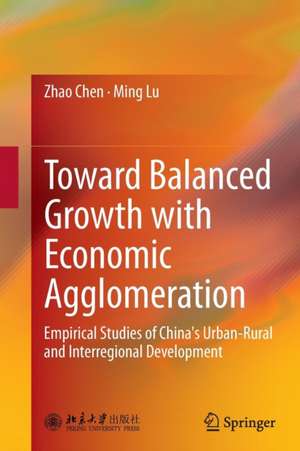
Toward Balanced Growth with Economic Agglomeration: Empirical Studies of China's Urban-Rural and Interregional Development
Autor Zhao Chen, Ming Luen Limba Engleză Paperback – 18 oct 2016
Preț: 365.29 lei
Puncte Express: 548
Carte tipărită la comandă
Livrare economică 21 noiembrie-05 decembrie
Livrare prin curier în România Termenul estimat este afișat lângă disponibilitate.
Transport gratuit de la 400.00 lei Plată online sau ramburs, în funcție de opțiunile comenzii.
Retur gratuit în 14 zile Comandă securizată și suport în română.
Specificații
ISBN-13: 9783662516751
ISBN-10: 3662516756
Pagini: 145
Ilustrații: VII, 138 p. 21 illus.
Dimensiuni: 155 x 235 x 8 mm
Greutate: 0.22 kg
Ediția:Softcover reprint of the original 1st ed. 2016
Editura: Springer Berlin, Heidelberg
Colecția Springer
Locul publicării:Berlin, Heidelberg, Germany
ISBN-10: 3662516756
Pagini: 145
Ilustrații: VII, 138 p. 21 illus.
Dimensiuni: 155 x 235 x 8 mm
Greutate: 0.22 kg
Ediția:Softcover reprint of the original 1st ed. 2016
Editura: Springer Berlin, Heidelberg
Colecția Springer
Locul publicării:Berlin, Heidelberg, Germany
V-ar putea interesa
-
 Managing the Global EconomyJonathan Michie-25%Preț: 204.11 lei271.46 lei
 -
 -22%Preț: 473.81 lei610.78 lei
 -
 -28%Preț: 363.41 lei503.42 lei
 -
 -14%Preț: 285.47 lei331.29 lei
 -
 -32%Preț: 668.86 lei986.50 lei
 -
 Development Strategy and Management of the Market Economy: Volume 1Edmond Malinvaud-19%Preț: 381.42 lei473.07 lei
 -
 -28%Preț: 411.82 lei575.22 lei
 -
 -28%Preț: 392.52 lei547.62 lei
 -
 -19%Preț: 354.70 lei437.40 lei
 -
 The Politics of Aid: African Strategies for Dealing with DonorsLindsay Whitfield-31%Preț: 651.98 lei941.07 lei
 -
 Development as FreedomAmartya SenPreț: 115.46 lei
 -
 The Mystery of Economic Growth (OISC)Elhanan HelpmanPreț: 238.15 lei
 -
 Crouching Dragon, Hidden TigerPrem Shankar JhaPreț: 116.59 lei
 -
 Preț: 421.08 lei
Cuprins
Introduction.- Urban-rural integration and spatial agglomeration during urbanization in China.- How should China maintain growth while balancing regional development.- Globalization and Regional Income Inequality in China.- Economic Opening and Domestic Market Integration.- Urban-rural Inequality and regional economic growth in China.
Textul de pe ultima copertă
This book explains the relationships between equality and efficiency, as well as between government and market, in urban-rural and regional development by providing theoretical frameworks and empirical evidence. Urban-rural development in China is understood from a regional perspective, while the core issue of urban-rural and regional development is cross-regional resource reallocation driven by the trends of globalization, marketization and urbanization and their influence on growth and inequality. The book puts forward the following arguments: An urban-rural and regional balance should not be achieved by limiting agglomeration effects in eastern regions. For some time now, China has lacked a suitable mechanism to enable residents in underdeveloped and rural areas to share in the achievements of economic agglomeration. As a result, China should not slow down economic agglomeration and development in eastern regions simply by depending on administrative means to balance urban-rural and regional development. In the final analysis, arriving at a regional balance depends on growth in the eastern regions, provided a reasonable mechanism is implemented to enable inland areas to share in the development achievements of eastern regions. In turn, finding an urban-regional balance rests on urban development, as long as more rural workers can move to and prosper in cities.
Caracteristici
Offers key empirical evidence on urban-rural and regional development in China regarding the processes of globalization, marketization and urbanization Provides insights for policymakers, presenting solid research based on an in-depth understanding on China’s institutional background concerning urban-rural and regional development Recommends policies to promote more efficient and equitable urban-rural and regional development in China Includes supplementary material: sn.pub/extras