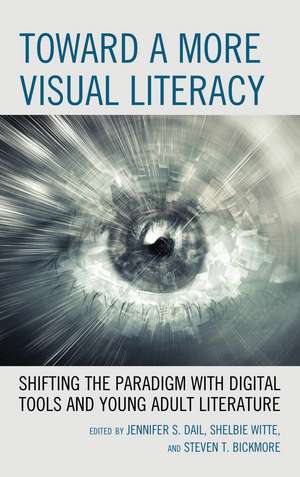
Toward a More Visual Literacy: Shifting the Paradigm with Digital Tools and Young Adult Literature
Editat de Jennifer S. Dail, Shelbie Witte, Steven T. Bickmoreen Limba Engleză Hardback – 7 mai 2018
Preț: 381.41 lei
Preț vechi: 461.72 lei
-17%
Puncte Express: 572
Carte tipărită la comandă
Livrare economică 20 noiembrie-04 decembrie
Livrare prin curier în România Termenul estimat este afișat lângă disponibilitate.
Transport gratuit de la 400.00 lei Plată online sau ramburs, în funcție de opțiunile comenzii.
Retur gratuit în 14 zile Comandă securizată și suport în română.
Specificații
ISBN-13: 9781475835663
ISBN-10: 1475835663
Pagini: 128
Ilustrații: 8 b/w illustrations; 1 b/w photos; 2 tables; 6 textboxes
Dimensiuni: 162 x 232 x 14 mm
Greutate: 0.39 kg
Editura: Bloomsbury Publishing
Colecția Rowman & Littlefield
Locul publicării:New York, United States
ISBN-10: 1475835663
Pagini: 128
Ilustrații: 8 b/w illustrations; 1 b/w photos; 2 tables; 6 textboxes
Dimensiuni: 162 x 232 x 14 mm
Greutate: 0.39 kg
Editura: Bloomsbury Publishing
Colecția Rowman & Littlefield
Locul publicării:New York, United States
Cuprins
Foreword
Lisa Scherff
Introduction: Positioning Students as Creators in the Classroom
Jennifer S. Dail and Shelbie Witte
Part I: Classroom Contexts: Helping Students Visualize Digitally
Chapter 1- "It's about more than words:" Reading All American Boys in a Social Digital Reading Environment
Sara Kajder
Chapter 2- Flipping the Teaching of Young Adult Literature
Amy Piotrowski
Chapter 3- Learning Conversations: Ancient Practice Meets New Technology
Jenny Cameron Paulsen and Matt Copeland
Part II: Social Engagement: Connecting Youth Beyond School
Chapter 4- Responding to Young Adult Literature through Civic Engagement
Kristen Hawley Turner and Dawn Reed
Chapter 5- Social Media, Gaming, and Jay Gatsby: Integrating Youth Motifs with Youth Literacies in High School English
Alison Heron Hruby, Lindsay Ellis Johnson, Dakoda Trenary, and Dallas Cox
Chapter 6- Infusing Young Adult Literature into the Virtual Classroom
Brooke Eisenbach, Paula Greathouse, and Jennifer Farnham
III: Critical Inquiry: Digging Deeper with Young Adult Literature
Chapter 7- Emerging Media, Evolving Engagement: Expanding Teachers' Repertoires of Literary Study and Response
Anna Smith and Robyn Seglem
Chapter 8- Seeing the World Differently: Remixing Young Adult Literature through Critical Lenses
Jennifer S. Dail and Aneté Vasquez
Chapter 9- Song of Myself: A Digital Unit of Study Remixed
Fawn Canady, Kymberly Martin, and Chyllis Scott
About the Editors
About the Contributors
Lisa Scherff
Introduction: Positioning Students as Creators in the Classroom
Jennifer S. Dail and Shelbie Witte
Part I: Classroom Contexts: Helping Students Visualize Digitally
Chapter 1- "It's about more than words:" Reading All American Boys in a Social Digital Reading Environment
Sara Kajder
Chapter 2- Flipping the Teaching of Young Adult Literature
Amy Piotrowski
Chapter 3- Learning Conversations: Ancient Practice Meets New Technology
Jenny Cameron Paulsen and Matt Copeland
Part II: Social Engagement: Connecting Youth Beyond School
Chapter 4- Responding to Young Adult Literature through Civic Engagement
Kristen Hawley Turner and Dawn Reed
Chapter 5- Social Media, Gaming, and Jay Gatsby: Integrating Youth Motifs with Youth Literacies in High School English
Alison Heron Hruby, Lindsay Ellis Johnson, Dakoda Trenary, and Dallas Cox
Chapter 6- Infusing Young Adult Literature into the Virtual Classroom
Brooke Eisenbach, Paula Greathouse, and Jennifer Farnham
III: Critical Inquiry: Digging Deeper with Young Adult Literature
Chapter 7- Emerging Media, Evolving Engagement: Expanding Teachers' Repertoires of Literary Study and Response
Anna Smith and Robyn Seglem
Chapter 8- Seeing the World Differently: Remixing Young Adult Literature through Critical Lenses
Jennifer S. Dail and Aneté Vasquez
Chapter 9- Song of Myself: A Digital Unit of Study Remixed
Fawn Canady, Kymberly Martin, and Chyllis Scott
About the Editors
About the Contributors
Recenzii
The editors of Toward a More Visual Literacy: Shifting the Paradigm with Digital Tools and Young Adult Literature have curated a collection of essays by teachers and teacher educators that examine the possibilities of exploring young adult literature through the lens of digital literacies.The chapters are written with teachers in mind and offer aspirational models of lessons that could be adapted and, to use a term from the collection, "remixed" for learners at any grade level.
Though many teachers strive to "integrate" technology, there are very few who innovate with it. Framed with thoughtful attention to curricular guidelines offered by ISTE and NCTE - and rooted in the scholarship of participatory culture - Dail, Witte, and Bickmore's collection brings together over twenty voices from middle and high school classrooms. Exploring classic and contemporary texts from The Great Gatsby to Monster, from Feed to All American Boys, the authors in this collection share strategies for digital reading, flipping the classroom, rethinking the socratic seminar, and moving students into virtual worlds with tools like Minecraft and social media. Beyond typical school assignments that only aim to layer technology in as an afterthought, Toward a More Visual Literacydemonstrates practical ways for teachers to engage students in YA literature, both in their classrooms and throughout our digital world.
While ELA teachers are constantly being told to integrate technology into their instruction, Toward a More Visual Literacy answers the crucial questions of how and why we should do so - namely, to support young people as not only consumers, but also producers of digital texts that connect them to the world outside the classroom and help them forge transformative futures for themselves and our society. The contributors share innovative classroom literacy practices that foster digital social imagination and offer all educators inspiration for merging literary response, multimodal composing, and civic engagement.
While sharing a wealth of stories from and suggestions for the classroom, Dail, Witte, and Bickmore's Toward a More Visual Literacy: Shifting the Paradigm with Digital Tools and Young Adult Literature will ignite teachers' creativity for enhancing young adult literature with visual literacy practices. Chapters written by an array of impressive authors--classroom teachers and pre-service teacher educators--include new ideas for teaching based on remix, gamification, socratic circles, collaborative writing, physical construction, and other new and traditional technologies. Reluctant readers may be transformed and gifted readers will be challenged by the creative approaches described here.
Youth deserve the right to not just read books that speak to them, but to create, produce, and perform alongside the very texts that they are reading. Toward a More Visual Literacy: Shifting the Paradigm with Digital Tools and Young Adult Literature provides teachers insight into those very literacies that youth uptake in their interest-driven spaces, while providing practical ideas for teaching texts in innovative ways alongside their students rather than at their students. This book is a must read for any teacher looking for innovative ways to inspire their English language arts classroom in the digital era.
We may now be certain that the rise of the Internet did not, as feared, implode the teaching of English. But it has changed things, things that require confident and critical attention. That is precisely what this book offers. Dail, Witte, and Bickmore have assembled a digitally dextrous team of scholars whose chapters will leave readers with a newfound confidence in the creative power of young people's visual literacies.
The issues canvassed in the book are crucial to the adaptation of pedagogies for literacies development so that students growing up into the online digital multimodal communication world are assured of the relevance and importance of this aspect of their formal education to their lives within and beyond their schooling.
Though many teachers strive to "integrate" technology, there are very few who innovate with it. Framed with thoughtful attention to curricular guidelines offered by ISTE and NCTE - and rooted in the scholarship of participatory culture - Dail, Witte, and Bickmore's collection brings together over twenty voices from middle and high school classrooms. Exploring classic and contemporary texts from The Great Gatsby to Monster, from Feed to All American Boys, the authors in this collection share strategies for digital reading, flipping the classroom, rethinking the socratic seminar, and moving students into virtual worlds with tools like Minecraft and social media. Beyond typical school assignments that only aim to layer technology in as an afterthought, Toward a More Visual Literacydemonstrates practical ways for teachers to engage students in YA literature, both in their classrooms and throughout our digital world.
While ELA teachers are constantly being told to integrate technology into their instruction, Toward a More Visual Literacy answers the crucial questions of how and why we should do so - namely, to support young people as not only consumers, but also producers of digital texts that connect them to the world outside the classroom and help them forge transformative futures for themselves and our society. The contributors share innovative classroom literacy practices that foster digital social imagination and offer all educators inspiration for merging literary response, multimodal composing, and civic engagement.
While sharing a wealth of stories from and suggestions for the classroom, Dail, Witte, and Bickmore's Toward a More Visual Literacy: Shifting the Paradigm with Digital Tools and Young Adult Literature will ignite teachers' creativity for enhancing young adult literature with visual literacy practices. Chapters written by an array of impressive authors--classroom teachers and pre-service teacher educators--include new ideas for teaching based on remix, gamification, socratic circles, collaborative writing, physical construction, and other new and traditional technologies. Reluctant readers may be transformed and gifted readers will be challenged by the creative approaches described here.
Youth deserve the right to not just read books that speak to them, but to create, produce, and perform alongside the very texts that they are reading. Toward a More Visual Literacy: Shifting the Paradigm with Digital Tools and Young Adult Literature provides teachers insight into those very literacies that youth uptake in their interest-driven spaces, while providing practical ideas for teaching texts in innovative ways alongside their students rather than at their students. This book is a must read for any teacher looking for innovative ways to inspire their English language arts classroom in the digital era.
We may now be certain that the rise of the Internet did not, as feared, implode the teaching of English. But it has changed things, things that require confident and critical attention. That is precisely what this book offers. Dail, Witte, and Bickmore have assembled a digitally dextrous team of scholars whose chapters will leave readers with a newfound confidence in the creative power of young people's visual literacies.
The issues canvassed in the book are crucial to the adaptation of pedagogies for literacies development so that students growing up into the online digital multimodal communication world are assured of the relevance and importance of this aspect of their formal education to their lives within and beyond their schooling.