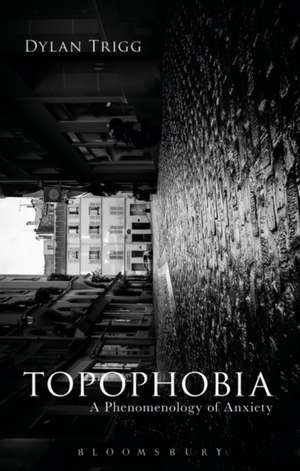
Topophobia: A Phenomenology of Anxiety
Autor Dylan Triggen Limba Engleză Hardback – 15 dec 2016
Bazându-ne pe arhivele Husserl și pe tradiția fenomenologică continentală ca fundament teoretic principal, suntem de părere că Topophobia reprezintă o contribuție esențială la înțelegerea modului în care anxietatea modelează subiectivitatea umană. Dylan Trigg propune o analiză riguroasă la persoana a doua, transformând agorafobia dintr-o simplă patologie clinică într-un instrument de cercetare a relației dintre corp, spațiu și identitate. Cartea extinde cadrul propus de Phenomenology of Anxiety de Stefano Micali prin adăugarea unei dimensiuni auto-etnografice și prin concentrarea pe relația specifică dintre anxietate și conceptul de „acasă”.
Structura volumului reflectă o progresie de la spațiul intim către cel public, începând cu analiza căminului pe timp de noapte și continuând cu explorarea limitelor corporale („Under the Skin”) și a dezorientării spațiale („Lost in place”). Această organizare permite cititorului să urmărească modul în care stările afective, precum frica de spații deschise, nu sunt doar reacții psihologice, ci elemente constitutive ale modului în care locuim lumea. În contextul operei sale anterioare, Topophobia continuă explorarea „horror-ului corporal” începută în The Thing, însă într-un registru academic mai așezat, integrând perspective din filosofia minții contemporană.
Spre deosebire de Phobic Geographies de Joyce Davidson, care se concentrează pe dimensiunea socială și geografică a fobiilor, lucrarea lui Trigg rămâne ancorată în tradiția lui Merleau-Ponty, oferind o perspectivă vie asupra imposibilității de a traversa un pod sau de a intra într-un supermarket. Ritmul este alert pentru un text academic, evitând jargonul excesiv în favoarea unor descrieri fenomenologice vibrante care fac legătura între experiența agorafobului și structura universală a conștiinței umane.
Preț: 769.60 lei
Preț vechi: 894.88 lei
-14%
Carte tipărită la comandă
Livrare economică 16-30 noiembrie
Specificații
ISBN-10: 1474283225
Pagini: 256
Dimensiuni: 160 x 232 x 20 mm
Greutate: 0.36 kg
Editura: Bloomsbury Publishing
Colecția Bloomsbury Academic
Locul publicării:London, United Kingdom
V-ar putea interesa
-
 Piero della Francesca: Artist and ManJames R. Banker-19%Preț: 198.11 lei243.13 lei
 -
 Bernini: His Life and His RomeFranco MormandoPreț: 177.13 lei
 -
 Piranesi′s Lost WordsHeather Hyde Minor-23%Preț: 616.05 lei800.07 lei
 -
 Still Life Before Still LifeDavid EkserdjianPreț: 340.40 lei
 -
 Preț: 243.60 lei
 -
 Preț: 223.94 lei
 -
 The Aesthetics of DecayDylan Trigg-23%Preț: 639.82 lei830.92 lei
 -
 Preț: 242.91 lei
 -
 The Deleuze and Guattari DictionaryEugene B. Young-16%Preț: 195.88 lei232.83 lei
 -
 La JetéeChris MarkerPreț: 304.56 lei
 -
 Maine de Biran's 'Of Immediate Apperception'Maine de Biran-33%Preț: 646.36 lei958.64 lei
 -
 The Nietzsche DictionaryProfessor Douglas Burnham-14%Preț: 237.51 lei274.65 lei
 -
 The New Phenomenology: A Philosophical IntroductionProfessor J. Aaron Simmons-17%Preț: 193.72 lei232.27 lei
 -
 BlackAlain BadiouPreț: 104.00 lei
 -
 The Age of the PoetsAlain BadiouPreț: 167.18 lei
 -
 Thing, The - A Phenomenology of HorrorDylan TriggPreț: 90.79 lei
 -
 Titian's Touch: Art, Magic and PhilosophyMaria H. Loh-11%Preț: 128.46 lei144.95 lei
 -
 Into the WhiteChristopher P. HeuerPreț: 231.88 lei
 -
 Unconsciousness Between Phenomenology and PsychoanalysisDorothée Legrand-18%Preț: 790.51 lei964.04 lei
De ce să citești această carte
Recomandăm această carte studenților și cercetătorilor din domeniul filosofiei și psihologiei care doresc să înțeleagă anxietatea dincolo de manualele de diagnostic. Cititorul câștigă o perspectivă profundă asupra modului în care spațiul și corpul interacționează, primind o explicație fenomenologică pentru stările de agorafobie. Este o lectură esențială pentru cei interesați de intersecția dintre filosofia minții, geografie umană și studiile despre corporalitate.
Despre autor
Dylan Trigg este cercetător senior FWF Lise Meitner în cadrul Departamentului de Filosofie al Universității din Viena și membru de cercetare IRC la University College Dublin. Cu o activitate desfășurată și la Les Archives Husserl (ENS Paris), Trigg s-a specializat în aplicarea fenomenologiei asupra unor teme precum nostalgia, atmosfera și corporalitatea. Opera sa, care include titluri precum The Thing și Atmospheres and Shared Emotions, este recunoscută pentru modul original în care îmbină rigoarea academică cu elemente de estetică și psihanaliză, fiind un nume de referință în fenomenologia contemporană.
Descriere
Calling upon the author's own experience of being agoraphobic, it asks a series of critical questions: How is our experience of the world affected by our bodily experience of others? What role do moods play in shaping our experience of the world? How can we understand the role of conditions such as agoraphobia in relation to our normative understanding of the body and the environment? What is the relation between anxiety and home? The reader will gain an insight into the strange experience of being unable to cross a bridge, get on a bus, and enter a supermarket without tremendous anxiety. At the same time, they will discover aspects of their own bodily experience that are common to both agoraphobes and non-agoraphobes alike.
Integrating phenomenological inquiry with current issues in the philosophy of mind, Trigg arrives at a renewed understanding of identity, which arranges self, other and world as a unified whole. Written with a sense of vividness often lacking in academic discourse, this is living philosophy.
Cuprins
1. The Home at Night
2. Under the Skin
3. Two Ocular Globes
4. Lost in place
5. Through the Mirror
Conclusion
Index
Recenzii
Trigg's ability to bring together the philosophical, the filmic and the literary without trivialising ... makes him a writer of great importance not only to the phenomenological tradition but to contemporary thought more generally.
Readers will be captivated by Dylan Trigg's penetrating insights into and eloquent accounts of his experience of anxiety. They lead him into strikingly new and important ideas for psychology and philosophy.
Dylan Trigg's Topophobia puts you inside the phenomenology of place-related phobias, so that you can explore the modulations of such experiences as they unfold and twist themselves into an anxiety that is without boundaries. This is a true phenomenological study of how places appear cut up and displaced, how they are darkened and blindingly lit, how they overwhelm, grab you and close in, how one's body turns against itself, freezes, and starts to drift, and how others invade and obstruct one's intentions. Trigg also draws from psychiatry and psychoanalysis to map out a detailed landscape of anxiety, delivering a deep analysis of the interweaving of the conscious and the unconscious elements that constitute the phobias related to place. He shows us that anxiety and the self are always more than, and at the same time, less than personal.
Topophilia, our love of place and our embeddedness in it and indebtedness to it, is not the only story to tell about place. In Topophobia, Dylan Trigg brilliantly shows that topophobia is woven through our experience of place, from its most intimate to its most public. He is equal parts Virgil and J. G. Ballard: he is our guide into the anxious, uncanny, nausea-inducing, claustrophobic, and agoraphobic places we are seduced by and condemned to live in, and he is the one who puts into words that which haunts us.
But this is not an account of the macabre, nor is it a tour of the bleak spaces of post-industrial collapse. Trigg gives us a rigorous phenomenology of the gaps and fissures of everyday place, the anxieties and ambiguities of being a body that must at some level be committed to its places, and yet which does not always experience a similar commitment in return. This book should have a rightful place for anyone interested in phenomenology, place, and body.