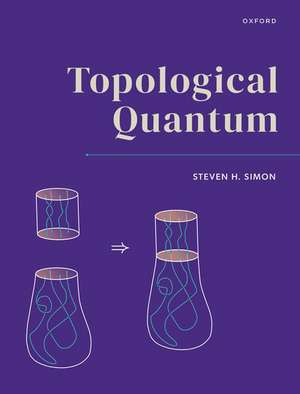
Topological Quantum: Oxford University Press
Autor Steven H. Simonen Limba Engleză Hardback – 29 sep 2023
Subliniem faptul că Topological Quantum este un manual fundamental care reușește să demistifice un domeniu adesea considerat impenetrabil din cauza formalismului matematic excesiv. Considerăm că abordarea autorului Steven H. Simon este una pragmatică; acesta alege să explice nexusul dintre teoria nodurilor, anyoni și computația cuantică evitând abstracțiunile grele ale teoriei categoriilor. Această alegere face ca volumul să fie o resursă rară, capabilă să ghideze cititorul de la nivelul de licență avansat până la cel de cercetător activ.
Structura cărții este riguros organizată în cinci părți principale. Începând cu o introducere istorică și invariantul Kauffman, textul progresează natural către statistica particulelor și efectul Aharonov-Bohm. Secțiunile dedicate anyonilor și diagramaticii acestora sunt susținute de cele peste 400 de ilustrații, esențiale pentru înțelegerea conceptelor de „braiding” și „fusion”. Comparativ cu Introduction to Topological Quantum Computation de Jiannis K. Pachos, care se concentrează pe evoluțiile cuantice imune la erori, lucrarea lui Simon oferă o bază mult mai largă în fizica materiei condensate și topologie, servind drept fundament teoretic înainte de a trece la aplicații specifice de calcul.
În contextul operei autorului, acest volum reprezintă o evoluție naturală de la The Oxford Solid State Basics. Dacă lucrarea anterioară transforma studiul solidelor într-o expunere entuziastă a principiilor fundamentale, Topological Quantum aplică același stil „down-to-earth” unei zone de frontieră a fizicii moderne. Credem că forța acestui text rezidă în capacitatea de a face legătura între rigoarea matematică a topologiei și realitatea experimentală a materialelor cuantice.
Din seria Oxford University Press
- 28%
 Preț: 85.93 lei
- 25%
 Preț: 300.93 lei
- 25%
 Preț: 230.11 lei
-
 Preț: 69.21 lei
- 26%
 Preț: 289.99 lei
- 17%
 Preț: 65.55 lei
- 24%
 Preț: 232.11 lei
-
 Preț: 62.76 lei
- 28%
 Preț: 86.47 lei
- 19%
 Preț: 46.36 lei
- 18%
 Preț: 53.36 lei
- 30%
 Preț: 213.42 lei
- 17%
 Preț: 60.35 lei
- 24%
 Preț: 178.52 lei
- 15%
 Preț: 56.85 lei
- 28%
 Preț: 86.16 lei
- 18%
 Preț: 64.85 lei
-
 Preț: 72.74 lei
- 17%
 Preț: 108.00 lei
- 28%
 Preț: 86.41 lei
- 26%
 Preț: 262.14 lei
- 26%
 Preț: 290.28 lei
- 14%
 Preț: 97.28 lei
-
 Preț: 65.62 lei
- 14%
 Preț: 77.82 lei
- 17%
 Preț: 101.81 lei
- 29%
 Preț: 217.24 lei
-
 Preț: 142.18 lei
-
 Preț: 69.63 lei
- 20%
 Preț: 259.67 lei
- 28%
 Preț: 86.34 lei
- 18%
 Preț: 59.35 lei
- 28%
 Preț: 85.84 lei
- 18%
 Preț: 83.13 lei
- 28%
 Preț: 86.71 lei
- 18%
 Preț: 65.17 lei
-
 Preț: 56.31 lei
- 16%
 Preț: 85.80 lei
- 19%
 Preț: 71.51 lei
- 24%
 Preț: 232.17 lei
-
 Preț: 59.73 lei
- 18%
 Preț: 52.88 lei
- 28%
 Preț: 86.41 lei
- 24%
 Preț: 232.76 lei
- 24%
 Preț: 178.79 lei
- 24%
 Preț: 302.61 lei
-
 Preț: 322.33 lei
- 20%
 Preț: 165.39 lei
- 18%
 Preț: 64.34 lei
-
 Preț: 79.11 lei
Preț: 516.27 lei
Preț vechi: 631.80 lei
-18%
Carte disponibilă
Livrare economică 27 noiembrie-08 decembrie
Livrare express 14-20 noiembrie pentru 140.27 lei
Specificații
ISBN-10: 0198886721
Pagini: 640
Ilustrații: 483 line drawings and halftones
Dimensiuni: 195 x 254 x 37 mm
Greutate: 1.5 kg
Editura: OUP OXFORD
Colecția OUP Oxford
Seria Oxford University Press
Locul publicării:Oxford, United Kingdom
De ce să citești această carte
Recomandăm această carte oricărui student sau cercetător care dorește să înțeleagă fundamentele anyonilor și ale fazelor topologice fără a se pierde în matematici abstracte. Câștigați o perspectivă clară asupra modului în care topologia dictează proprietățile materiei, totul prin intermediul unui stil narativ captivant și al unei diagramatici bogate. Este instrumentul ideal pentru a trece de la mecanica cuantică elementară la cercetarea de vârf în computație cuantică.
Despre autor
Steven H. Simon este un fizician de renume și profesor la Universitatea Oxford, cunoscut pentru capacitatea sa de a preda concepte complexe într-o manieră accesibilă. Expertiza sa în fizica materiei condensate este recunoscută la nivel internațional, fiind autorul volumului de referință 'The Oxford Solid State Basics'. Lucrările sale se concentrează pe intersecția dintre fizica teoretică și fenomenele emergente din starea solidă, Simon fiind un promotor al stilului pedagogic care prioritizează înțelegerea conceptuală și intuiția fizică în fața formalismului matematic arid.
Descriere
Recenzii
This text is nothing short of a triumph.
I recommend the book to everyone who is interested in topological quantum field theories, topological quantum computing and topological materials. I also recommend it to students to get an impression of current hot topics.
Notă biografică
Cuprins
- 1.: Introduction and Ancient History
- 2.: Kauffman Bracket Invariant and Relation to Physics
- I Anyons and Topological Quantum Field Theories
- 3.: Particle Quantum Statistics
- 4.: Aharonov-Bohm Effect and Charge-Flux Composites
- 5.: Chern-Simons Theory Basics
- 6.: Short Digression on Quantum Gravity
- 7.: Defining Topological Quantum Field Theory
- II Anyon Basics
- 8.: Fusion and Structure of Hilbert Space
- 9.: Change of Basis and F-Matrices
- 10.: Exchanging Identical Particles
- 11.: Computing with Anyons
- III Anyon Diagrammatics
- 12.: Planar Diagrams
- 13.: Braiding Diagrams
- 14.: Seeking Isotopy
- 15.: Twists
- 16.: Nice Theories with Planar or Three-Dimensional Isotopy
- 17.: Further Structure
- IV Some Examples: Planar Diagrams and Anyon Theories
- 18.: Some Simple Examples
- 19.: Anyons From Discrete Groups Elements
- 20.: Bosons and Fermions from Group Representati
- 21.: Quantum Groups (In Brief)
- 22.: Temperly-Lieb Algebra and Jones-Kauffman Anyons
- V Applications of TQFT Diagrammatics
- 23.: State Sum TQFTs
- 24.: Formal Construction of "Chern-Simons" TQFT: Surgery and More Complicated Manifolds
- 25.: Anyon Condensation
- VI Toric Code Basics
- 26.: Introducing Quantum Error Correction
- 27.: Introducing the Toric Code
- 28.: The Toric Code as a Phase of Matter and a TQFT
- 29.: Robustness of Topologically-Ordered Matter
- 30.: Abstracting the Toric Code: Introduction to Tube Algebra
- VII More General Loop-Gas and String-Net Models
- 31.: Kitaev Quantum Double Model
- 32.: Doubled-Semion Model
- 33.: Levin-Wen String-Net
- VIII Entanglement and Symmetries
- 34.: Topological Entanglement
- 35.: SPT Phases of Matter
- 36.: Anyon Permuting Symmetry
- IX Further Thoughts
- 37.: 37 Experiments (In Brief)
- 38.: Final Comments
- 39.: Appendix: Kac and Other Resources for TQFTs
- 40.: Appendix: Some Mathematical Basics
- Index
- Free