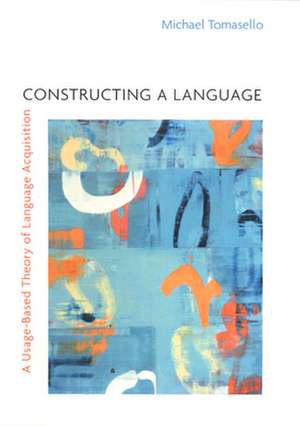
Tomasello, M: Constructing a Language - A Usage-Based Theory
en Limba Engleză Paperback – 31 mar 2005
Tomasello argues that the essence of language is its symbolic dimension, which rests on the uniquely human ability to comprehend intention. Grammar emerges as the speakers of a language create linguistic constructions out of recurring sequences of symbols; children pick up these patterns in the buzz of words they hear around them.
All theories of language acquisition assume these fundamental skills of intention-reading and pattern-finding. Some formal linguistic theories posit a second set of acquisition processes to connect somehow with an innate universal grammar. But these extra processes, Tomasello argues, are completely unnecessary-important to save a theory but not to explain the phenomenon.
For all its empirical weaknesses, Chomskian generative grammar has ruled the linguistic world for forty years. Constructing a Language offers a compellingly argued, psychologically sound new vision for the study of language acquisition.
Preț: 242.14 lei
Puncte Express: 363
Carte indisponibilă temporar
Livrare prin curier în România Termenul estimat este afișat lângă disponibilitate.
Transport gratuit de la 400.00 lei Plată online sau ramburs, în funcție de opțiunile comenzii.
Retur gratuit în 14 zile Comandă securizată și suport în română.
Specificații
ISBN-13: 9780674017641
ISBN-10: 0674017641
Pagini: 408
Ilustrații: 19 line illustrations & 16 tables
Dimensiuni: 153 x 233 x 25 mm
Greutate: 0.66 kg
Ediția:Revised
Editura: Harvard University Press
ISBN-10: 0674017641
Pagini: 408
Ilustrații: 19 line illustrations & 16 tables
Dimensiuni: 153 x 233 x 25 mm
Greutate: 0.66 kg
Ediția:Revised
Editura: Harvard University Press
V-ar putea interesa
-
 23: The Transition to LanguageAlison Wray-26%Preț: 358.40 lei487.32 lei
 -
 -28%Preț: 347.37 lei483.16 lei
 -
 Child Language: The Parametric ApproachWilliam Snyder-19%Preț: 351.77 lei435.86 lei
 -
 Origins of Human CommunicationMichael TomaselloPreț: 323.95 lei
 -
 Language Development and Learning to ReadDiane McguinnessPreț: 325.25 lei
 -
 How Children Learn LanguageWilliam O'GradyPreț: 287.03 lei
 -
 -23%Preț: 431.69 lei560.64 lei
 -
 Second Language SyntaxRoger Hawkins-27%Preț: 938.53 lei1285.65 lei
 -
 Second Language SyntaxHawkins-23%Preț: 534.01 lei693.52 lei
 -
 Second Language AcquisitionArchibald-23%Preț: 459.43 lei596.66 lei
 -
 Tense and Aspect in Second LanugageBardovi-HarligPreț: 509.70 lei
 -
 The Handbook of Second Language AcquisitionCatherine J Doughty-8%Preț: 483.89 lei525.97 lei
 -
 Second Language IdentitiesDavid Block-16%Preț: 180.66 lei215.18 lei
 -
 Multilingual Universities in South AfricaLiesel HibbertPreț: 278.41 lei
 -
 The Multilingual Turn in Languages EducationJean ContehPreț: 390.49 lei
 -
 Cognate Vocabulary in Language Acquisition and UseAgnieszka OtwinowskaPreț: 393.77 lei
Notă biografică
Michael Tomasello is Professor of Psychology and Neuroscience at Duke University. From 1998 to 2018 he was Co-Director of the Max Planck Institute for Evolutionary Anthropology, and in 2017 he was elected to the National Academy of Sciences and the American Academy of Arts and Sciences. His scientific work has been recognized by institutions around the world, including the Guggenheim Foundation, the British Academy, the Royal Academy of Netherlands, and the German National Academy of Sciences.