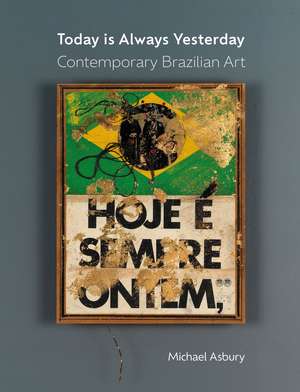
Today Is Always Yesterday
Autor Michael Asburyen Limba Engleză Hardback – 19 dec 2023
Today Is Always Yesterday explores the historical constructs underlying contemporary art in Brazil. Michael Asbury argues that art can activate as well as illustrate history. The colors of the Brazilian flag structure the book’s five chapters as Asbury explores artists’ vital role in unraveling Brazil’s core myths and its projected image as a racial melting pot. Richly illustrated, this book presents a compelling account of contemporary debates in Brazilian art.
Preț: 256.09 lei
Preț vechi: 331.16 lei
-23%
Puncte Express: 384
Carte disponibilă
Livrare economică 29 octombrie-05 noiembrie
Livrare express 15-21 octombrie pentru 142.12 lei
Livrare prin curier în România Termenul estimat este afișat lângă disponibilitate.
Transport gratuit de la 400.00 lei Plată online sau ramburs, în funcție de opțiunile comenzii.
Retur gratuit în 14 zile Comandă securizată și suport în română.
Specificații
ISBN-13: 9781789148008
ISBN-10: 1789148006
Pagini: 312
Ilustrații: 115 color plates, 20 halftones
Dimensiuni: 258 x 200 x 30 mm
Greutate: 1.2 kg
Editura: REAKTION BOOKS
ISBN-10: 1789148006
Pagini: 312
Ilustrații: 115 color plates, 20 halftones
Dimensiuni: 258 x 200 x 30 mm
Greutate: 1.2 kg
Editura: REAKTION BOOKS
V-ar putea interesa
-
 Preț: 403.66 lei
 -
 The Art Isles: A 15,000-Year Story of Art in Britain and IrelandCharlotte MullinsPreț: 197.26 lei
 -
 The Shock of the NewRobert Hughes-17%Preț: 238.67 lei286.84 lei
 -
 The Art of Yoshi Yoshitani: 100 PostcardsYoshi YoshitaniPreț: 140.25 lei
 -
 The Dehumanization of Art and Other Essays on Art, Culture, and LiteratureJosé Ortega Y. GassetPreț: 90.47 lei
 -
 BrazilRodrigo Fernandes da Fonseca-20%Preț: 267.13 lei331.89 lei
 -
 Preț: 116.41 lei
 -
 Form and FeelingAntonio Sergio BessaPreț: 268.69 lei
 -
 ReckoningAaron BryantPreț: 343.41 lei
 -
 -30%Preț: 104.68 lei149.02 lei
 -
 -24%Preț: 94.94 lei125.31 lei
 -
 -24%Preț: 83.98 lei110.63 lei
 -
 Art Since 1980: Charting the ContemporaryPeter R. Kalb-8%Preț: 394.53 lei428.84 lei
 -
 Up in the AirHolly SmithPreț: 151.38 lei
 -
 -19%Preț: 208.87 lei257.15 lei
 -
 Beauty: In Some Recent ArtMichael BracewellPreț: 239.65 leiNou
 -
 The Anomie Review of Contemporary British Painting 3Anneka FrenchPreț: 283.92 lei
 -
 The Endurance of ThingsMartin GrayPreț: 143.80 lei
 -
 -8%Preț: 398.89 lei433.58 lei
 -
 24-HOUR INTERVIEWCharles Moore-18%Preț: 120.73 lei146.39 lei
Notă biografică
Michael Asbury is a reader in the history and theory of art and deputy director of the Research Center for Transnational Art, Identity and Nation at the University of the Arts London. He has worked as a curator and art critic for over two decades.
Recenzii
"Today is Always Yesterday links Modernism to today in a compelling exploration of contemporary Brazilian art . . . a unique and insightful perspective."
"Asbury challenges the cliché of national identity in Brazilian contemporary art by provocatively employing the national colors as metaphors. He provides essential historical context, critically deconstructing the themes and concepts examined within the pages of this compelling book."
"One of the strengths of Today is Always Yesterday lies precisely in showing the role that art plays in the formation and historical and cultural construction of a nation. . . . Its publication allows for important gaps in our historiography to be filled. Today is Always Yesterday has much to add to the debate and to the Brazilian art system overall."