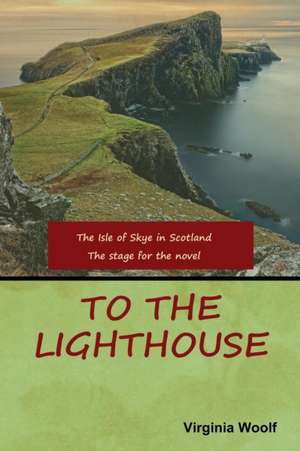
To the Lighthouse
Autor Virginia Woolfen Limba Engleză Paperback – 31 iul 2018
Preț: 99.59 lei
Puncte Express: 149
Carte tipărită la comandă
Livrare economică 26 octombrie-09 noiembrie
Livrare prin curier în România Termenul estimat este afișat lângă disponibilitate.
Transport gratuit de la 400.00 lei Plată online sau ramburs, în funcție de opțiunile comenzii.
Retur gratuit în 14 zile Comandă securizată și suport în română.
Specificații
ISBN-13: 9781618953445
ISBN-10: 1618953443
Pagini: 186
Dimensiuni: 152 x 229 x 10 mm
Greutate: 0.28 kg
Editura: Bibliotech Press
ISBN-10: 1618953443
Pagini: 186
Dimensiuni: 152 x 229 x 10 mm
Greutate: 0.28 kg
Editura: Bibliotech Press
V-ar putea interesa
-
 The Adventures Of Huckleberry FinnMark TwainPreț: 28.01 lei
 -
 CLASSICS HOUND OF BASKERVILLESArthur Conan DoylePreț: 28.01 lei
 -
 The Prince and the PauperMark TwainPreț: 28.01 lei
 -
 A Portrait of the Artist as a Young ManJames JoycePreț: 28.01 lei
 -
 Mrs DallowayVirginia WoolfPreț: 28.01 lei
 -
 AtonementIan McEwan-17%Preț: 59.44 lei72.04 lei
 -
 Flaubert's ParrotJulian Barnes-20%Preț: 56.14 lei70.09 lei
 -
 Song of SolomonToni Morrison-24%Preț: 59.67 lei79.02 lei
 -
 -47%Preț: 42.32 lei79.81 lei
 -
 Preț: 27.62 lei
 -
 Paradise LostJohn MiltonPreț: 91.61 lei
 -
 The StrangerAlbert CamusPreț: 92.45 lei
 -
 Academic Vocabulary in Use Edition with AnswersMichael MccarthyPreț: 196.36 lei
 -
 A Shakespeare Story: The Taming of the ShrewAndrew Matthews-30%Preț: 34.27 lei48.61 lei
 -
 The WavesVirginia WoolfPreț: 35.76 lei
 -
 UlyssesJames JoycePreț: 40.06 lei
 -
 The Picture of Dorian GrayOscar WildePreț: 30.11 lei
 -
 Lord JimJoseph ConradPreț: 28.01 lei
 -
 Sons and LoversD. H. LawrencePreț: 28.01 lei
 -
 The RainbowD. H. LawrencePreț: 28.01 lei
 -
 Much Ado About NothingWilliam ShakespearePreț: 28.01 lei
Descriere
Descriere de la o altă ediție sau format:
'I am making up "To the Lighthouse" - the sea is to be heard all through it' Inspired by the lost bliss of her childhood summers in Cornwall, Virginia Woolf produced one of the masterworks of English literature in To the Lighthouse. It concerns the Ramsay family and their summer guests on the Isle of Skye before and after the First World War. As children play and adults paint, talk, muse and explore, relationships shift and mutate. A captivating fusion of elegy, autobiography, socio-political critique and visionary thrust, it is the most accomplished of all Woolf's novels. On completing it, she thought she had exorcised the ghosts of her imposing parents, but she had also brought form to a book every bit as vivid and intense as the work of Lily Briscoe, the indomitable artist at the centre of the novel. ABOUT THE SERIES: For over 100 years Oxford World's Classics has made available the widest range of literature from around the globe. Each affordable volume reflects Oxford's commitment to scholarship, providing the most accurate text plus a wealth of other valuable features, including expert introductions by leading authorities, helpful notes to clarify the text, up-to-date bibliographies for further study, and much more.
'I am making up "To the Lighthouse" - the sea is to be heard all through it' Inspired by the lost bliss of her childhood summers in Cornwall, Virginia Woolf produced one of the masterworks of English literature in To the Lighthouse. It concerns the Ramsay family and their summer guests on the Isle of Skye before and after the First World War. As children play and adults paint, talk, muse and explore, relationships shift and mutate. A captivating fusion of elegy, autobiography, socio-political critique and visionary thrust, it is the most accomplished of all Woolf's novels. On completing it, she thought she had exorcised the ghosts of her imposing parents, but she had also brought form to a book every bit as vivid and intense as the work of Lily Briscoe, the indomitable artist at the centre of the novel. ABOUT THE SERIES: For over 100 years Oxford World's Classics has made available the widest range of literature from around the globe. Each affordable volume reflects Oxford's commitment to scholarship, providing the most accurate text plus a wealth of other valuable features, including expert introductions by leading authorities, helpful notes to clarify the text, up-to-date bibliographies for further study, and much more.
Notă biografică
Virginia Woolf was born in London in 1882, the daughter of Sir Leslie Stephen, first editor of The Dictionary of National Biography. After his death in 1904 Virginia and her sister, the painter Vanessa Bell, moved to Bloomsbury and became the centre of 'The Bloomsbury Group'. This informal collective of artists and writers which included Lytton Strachey and Roger Fry, exerted a powerful influence over early twentieth-century British culture.
In 1912 Virginia married Leonard Woolf, a writer and social reformer. Three years later, her first novel The Voyage Out was published, followed by Night and Day (1919) and Jacob's Room (1922). These first novels show the development of Virginia Woolf's distinctive and innovative narrative style. It was during this time that she and Leonard Woolf founded The Hogarth Press with the publication of the co-authored Two Stories in 1917, hand-printed in the dining room of their house in Surrey.
Between 1925 and 1931 Virginia Woolf produced what are now regarded as her finest masterpieces, from Mrs Dalloway (1925) to the poetic and highly experimental novel The Waves (1931). She also maintained an astonishing output of literary criticism, short fiction, journalism and biography, including the playfully subversive Orlando (1928) and A Room of One's Own (1929) a passionate feminist essay. This intense creative productivity was often matched by periods of mental illness, from which she had suffered since her mother's death in 1895. On 28 March 1941, a few months before the publication of her final novel, Between the Acts, Virginia Woolf committed suicide.
In 1912 Virginia married Leonard Woolf, a writer and social reformer. Three years later, her first novel The Voyage Out was published, followed by Night and Day (1919) and Jacob's Room (1922). These first novels show the development of Virginia Woolf's distinctive and innovative narrative style. It was during this time that she and Leonard Woolf founded The Hogarth Press with the publication of the co-authored Two Stories in 1917, hand-printed in the dining room of their house in Surrey.
Between 1925 and 1931 Virginia Woolf produced what are now regarded as her finest masterpieces, from Mrs Dalloway (1925) to the poetic and highly experimental novel The Waves (1931). She also maintained an astonishing output of literary criticism, short fiction, journalism and biography, including the playfully subversive Orlando (1928) and A Room of One's Own (1929) a passionate feminist essay. This intense creative productivity was often matched by periods of mental illness, from which she had suffered since her mother's death in 1895. On 28 March 1941, a few months before the publication of her final novel, Between the Acts, Virginia Woolf committed suicide.
Recenzii
“Radiant as [To the Lighthouse] is in its beauty, there could never be a mistake about it: here is a novel to the last degree severe and uncompromising. I think that beyond being about the very nature of reality, it is itself a vision of reality.” — Eudora Welty
“A classic for a reason. My mind was warped into a new shape by her prose and it will never be the same again.” — Greta Gerwig, director of Lady Bird and Little Women
“To the Lighthouse is one of the greatest elegies in the English language, a book which transcends time.” — Margaret Drabble, author of The Witch of Exmoor
“I reread this book every once in a while, and every time I do I find it more capacious and startling. It’s so revolutionary and so exquisitely wrought that it keeps evolving on its own somehow, as if it’s alive.” — Alison Bechdel, author of Fun Home
“Without question one of the two or three finest novels of the twentieth century. If you’re like me you’ll come back to this book often, always astounded, always moved, always refreshed.” — Rick Moody, author of The Ice Storm
“A classic for a reason. My mind was warped into a new shape by her prose and it will never be the same again.” — Greta Gerwig, director of Lady Bird and Little Women
“To the Lighthouse is one of the greatest elegies in the English language, a book which transcends time.” — Margaret Drabble, author of The Witch of Exmoor
“I reread this book every once in a while, and every time I do I find it more capacious and startling. It’s so revolutionary and so exquisitely wrought that it keeps evolving on its own somehow, as if it’s alive.” — Alison Bechdel, author of Fun Home
“Without question one of the two or three finest novels of the twentieth century. If you’re like me you’ll come back to this book often, always astounded, always moved, always refreshed.” — Rick Moody, author of The Ice Storm