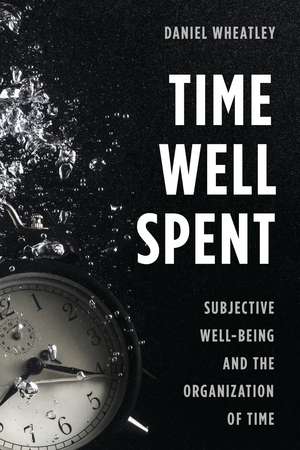
Time Well Spent: Subjective Well-Being and the Organization of Time
Autor Daniel Wheatleyen Limba Engleză Hardback – 2 mai 2017
This book aims to improve our understanding of well-being through an analysis of time-use in a post-industrial society, the UK, drawing on empirical data from large-scale surveys such as Understanding Society and smaller-scale case study evidence. It uses a plurality of theoretical perspectives to explore the relationship between our use of time and our reported levels of satisfaction, and considers the policy lessons that we can take from our organization of time.
Preț: 843.49 lei
Preț vechi: 1338.33 lei
-37%
Puncte Express: 1265
Carte tipărită la comandă
Livrare economică 25 noiembrie-09 decembrie
Livrare prin curier în România Termenul estimat este afișat lângă disponibilitate.
Transport gratuit pentru acest produs Plată online sau ramburs, în funcție de opțiunile comenzii.
Retur gratuit în 14 zile Comandă securizată și suport în română.
Specificații
ISBN-13: 9781783484256
ISBN-10: 178348425X
Pagini: 224
Ilustrații: 16 Charts, 18 Tables
Dimensiuni: 156 x 240 x 26 mm
Greutate: 0.59 kg
Editura: Bloomsbury Publishing
Colecția Rowman & Littlefield
Locul publicării:New York, United States
ISBN-10: 178348425X
Pagini: 224
Ilustrații: 16 Charts, 18 Tables
Dimensiuni: 156 x 240 x 26 mm
Greutate: 0.59 kg
Editura: Bloomsbury Publishing
Colecția Rowman & Littlefield
Locul publicării:New York, United States
V-ar putea interesa
-
 -18%Preț: 82.67 lei100.57 lei
 -
 Essays on the Political Economy of Rural AfricaRobert H. BatesPreț: 300.57 lei
 -
 Wld After OilBruce NussbaumPreț: 128.04 lei
 -
 Preț: 111.30 lei
 -
 Basic MicroeconomicsCompiled By Textbook EquityPreț: 184.26 lei
 -
 From Falling Behind to Catching UpRichard RecordPreț: 254.67 lei
 -
 Agricultural Production Economics Second EditionDavid L. DebertinPreț: 179.71 lei
 -
 Agricultural Production Economics (the Art of Production Theory)David L. DebertinPreț: 159.13 lei
 -
 Applied MicroeconomicsDavid L. DebertinPreț: 167.04 lei
 -
 Company P&l EconomicsChristopher MS William F.Preț: 66.20 lei
 -
 An Easy Introduction to EconomicsSusan M. CarlsonPreț: 126.01 lei
 -
 MicroeconomicsK. H. EricksonPreț: 75.06 lei
 -
 A Short Course in Sports EconomicsDr Brad R. HumphreysPreț: 124.96 lei
 -
 Apuntes de MicroeconomiaEmilio Arroyo RoigPreț: 119.27 lei
 -
 Economics and Finance in Business - Second EditionTafero, Arthur H.Preț: 67.53 lei
 -
 Economics and Finance - Bengali EditionTafero, Arthur H.Preț: 65.73 lei
 -
 Social EntrepreneurshipMarcel N. Kwedi-19%Preț: 430.72 lei531.76 lei
 -
 Methods of MicroeconomicsK. H. EricksonPreț: 74.66 lei
 -
 Economics for the RemnantDr Mart a. Jacob GramsPreț: 182.40 lei
 -
 The Microeconomic TheoryMR Surinder Singh PariharPreț: 49.95 lei
 -
 Edexcel Economics a Theme 3Brendan CaseyPreț: 47.60 lei
 -
 The Zanna FunctionDaniel WheatleyPreț: 88.68 lei
 -
 -20%Preț: 139.37 lei174.18 lei
 -
 Principles of MicroeconomicsSteven A. GreenlawPreț: 471.79 lei
Cuprins
1. Subjective well-being and time-use: An introduction / 2. A pluralist perspective on time-use / 3. Time-use: The historical and policy context / 4. Work-time, the quality of work and well-being / 5. The household division of labour and flexibility in paid work / 6. Care and volunteering: The (feel) good Samaritan (with Irene Hardill) / 7. Where to next? Travel-to-work and travel-for-work / 8. Leisure time: The pursuit of happiness (with Craig Bickerton) / 9. The organization of time and subjective well-being: Key findings and implications for public and organizational policy
Recenzii
Combining both new empirical evidence and a mix of different theories, this book offers a unique insight into the relationship between subjective well-being and time use. The book contributes positively to an important debate on how we might lead better and more fulfilled lives inside and outside work. Reading it is time well-spent.
This is an intelligent book dedicated to one of the most important and scarcest resources in a modern human's life: time. It provides an excellent account of different authoritative theories on time-use, as well as offers new evidence on how different allocations of time can impact our overall sense of well-being. A good companion for well-being researchers everywhere.
This book is an excellent addition to the growing social science literature on well-being. The perspective of time-use and its relation to subjective well-being provides a range of insights, and the findings presented and discussed are thought-provoking and noteworthy. I was particularly pleased to see the strong presence of themes relating to politics, policy and gender, and will be making extensive use of this book in the course I teach on politics and well-being.
(This book) explores the relationship between how time is used and well-being, using empirical measures of self-assessed well-being, and evaluates the impact of the organization of time on subjective well-being.
This is an intelligent book dedicated to one of the most important and scarcest resources in a modern human's life: time. It provides an excellent account of different authoritative theories on time-use, as well as offers new evidence on how different allocations of time can impact our overall sense of well-being. A good companion for well-being researchers everywhere.
This book is an excellent addition to the growing social science literature on well-being. The perspective of time-use and its relation to subjective well-being provides a range of insights, and the findings presented and discussed are thought-provoking and noteworthy. I was particularly pleased to see the strong presence of themes relating to politics, policy and gender, and will be making extensive use of this book in the course I teach on politics and well-being.
(This book) explores the relationship between how time is used and well-being, using empirical measures of self-assessed well-being, and evaluates the impact of the organization of time on subjective well-being.