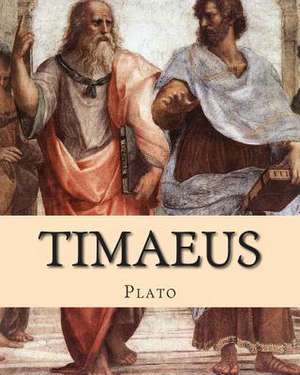
Timaeus
Autor Platoen Limba Engleză Paperback
Preț: 52.30 lei
Puncte Express: 78
Carte disponibilă
Livrare economică 05-19 noiembrie
Livrare prin curier în România Termenul estimat este afișat lângă disponibilitate.
Transport gratuit de la 400.00 lei Plată online sau ramburs, în funcție de opțiunile comenzii.
Retur gratuit în 14 zile Comandă securizată și suport în română.
Specificații
ISBN-13: 9781463519353
ISBN-10: 1463519354
Pagini: 74
Dimensiuni: 203 x 254 x 4 mm
Greutate: 0.16 kg
Editura: CreateSpace Independent Publishing Platform
ISBN-10: 1463519354
Pagini: 74
Dimensiuni: 203 x 254 x 4 mm
Greutate: 0.16 kg
Editura: CreateSpace Independent Publishing Platform
V-ar putea interesa
-
 RepublicPlatoPreț: 30.76 lei
 -
 SymposiumPlatoPreț: 27.61 lei
 -
 Timaeus and CritiasPlato-32%Preț: 62.68 lei92.03 lei
 -
 -22%Preț: 307.53 lei391.95 lei
 -
 Preț: 84.27 lei
 -
 MeditationsMarcus AureliusPreț: 34.00 lei
 -
 AristotleAristotlePreț: 193.55 lei
 -
 A History of Western PhilosophyBertrand RussellPreț: 196.21 lei
 -
 Preț: 229.26 lei
 -
 -14%Preț: 515.26 lei599.14 lei
 -
 Timaeus in ParadisePiero BoitaniPreț: 331.89 lei
 -
 Plato's Cosmology: The Timaeus of PlatoFrancis M. Cornford-16%Preț: 140.09 lei166.52 lei
 -
 The Pocket Book of PlatoMichael MoorePreț: 72.54 lei
 -
 Preț: 64.96 lei
 -
 The Dialogues of PlatoPlatoPreț: 50.06 lei
 -
 ParmenidesPlatoPreț: 43.40 lei
 -
 Preț: 58.13 lei
 -
 The Time MachineH. G. WellsPreț: 33.23 lei
 -
 UtopiaThomas MorePreț: 33.19 lei
Descriere
Descriere de la o altă ediție sau format:
Both an ideal entrée for beginning readers and a solid text for scholars, the second edition of Peter Kalkavage's acclaimed translation of Plato's Timaeus brings enhanced accessibility to a rendering well known for its faithfulness to the original text.
An extensive essay offers insights into the reading of the work, the nature of Platonic dialogue, and the cultural background of the Timaeus. Appendices on music, astronomy, and geometry provide additional guidance. A brief outline of the themes of the work, a detailed glossary, and a selected bibliography are also included.
An extensive essay offers insights into the reading of the work, the nature of Platonic dialogue, and the cultural background of the Timaeus. Appendices on music, astronomy, and geometry provide additional guidance. A brief outline of the themes of the work, a detailed glossary, and a selected bibliography are also included.
Recenzii
"Kalkavage's translation and commentary provide invaluable assistance to students of Plato's Timaeus. The translation is accurate, but readable. And Kalkavage packs a great deal of relevant historical, musical, and mathematical information into his notes."
—Catherine Zuckert, Nancy Reeves Dreux Professor of Political Science, University of Notre Dame
—Catherine Zuckert, Nancy Reeves Dreux Professor of Political Science, University of Notre Dame
Notă biografică
Plato was an ancient Greek philosopher born in Athens during the Classical period in Ancient Greece. In Athens, Plato founded the Academy, a philosophical school where he taught the philosophical doctrines that would later become known as Platonism. Plato (or Platon) was a pen name derived, apparently, from the nickname given to him by his wrestling coach - allegedly a reference to his physical broadness. According to Alexander of Miletus quoted by Diogenes of Sinope his actual name was Aristocles, son of Ariston, of the deme Collytus (Collytus being a district of Athens).Plato was an innovator of the written dialogue and dialectic forms in philosophy. He raised problems for what later became all the major areas of both theoretical philosophy and practical philosophy. His most famous contribution is the Theory of forms, which has been interpreted as advancing a solution to what is now known as the problem of universals. He is also the namesake of Platonic love and the Platonic solids.His own most decisive philosophical influences are usually thought to have been, along with Socrates, the pre-Socratics Pythagoras, Heraclitus, and Parmenides, although few of his predecessors' works remain extant and much of what we know about these figures today derives from Plato himself.[a]Along with his teacher, Socrates, and his student, Aristotle, Plato is a central figure in the history of philosophy.[b] Unlike the work of nearly all of his contemporaries, Plato's entire body of work is believed to have survived intact for over 2,400 years.[6] Although their popularity has fluctuated, Plato's works have consistently been read and studied. Through Neoplatonism Plato also greatly influenced both Christian and Islamic philosophy (through e.g. Al-Farabi). In modern times, Alfred North Whitehead famously said: "the safest general characterization of the European philosophical tradition is that it consists of a series of footnotes to Plato.