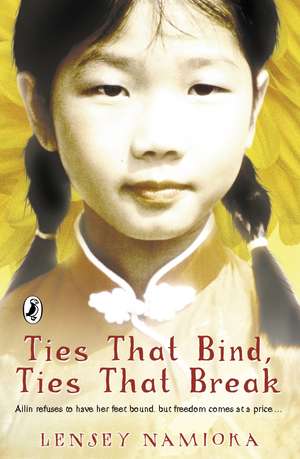
Ties That Bind, Ties That Break
Autor Lensey Namiokaen Limba Engleză Paperback – 2 oct 2003
Deși nu este un volum ilustrat, remarcăm forța vizuală a scriiturii pe care Lensey Namioka o folosește pentru a picta un portret vibrant al Chinei de la începutul secolului XX. Stilul narativ funcționează asemenea unei stampe delicate, unde fiecare detaliu al vieții cotidiene — de la jocurile cu verii până la ritualul dureros al legării picioarelor — capătă o claritate cinematografică. Putem afirma că autoarea reușește să transforme contextul istoric într-o experiență senzorială, facilitând înțelegerea unei tradiții greu de conceput pentru tinerii cititori de astăzi. Premisa este una de o intensitate remarcabilă: Ailin, a treia fiică a familiei Tao, alege libertatea de a alerga în detrimentul statutului social. În 1911, refuzul de a urma tradiția „picioarelor de lotus” nu era doar un gest de rebeliune juvenilă, ci un act care atrăgea marginalizarea totală. Ca și Bound de Donna Jo Napoli, acest roman reușește să emoționeze profund fără a fi didactic, oferind o perspectivă onestă asupra limitărilor impuse femeilor, dar și asupra curajului necesar pentru a-ți făuri propriul destin. În contextul operei sale, Ties That Bind, Ties That Break se ancorează în temele predilecte ale autoarei, precum identitatea și conflictul dintre datorie și dorința personală. Dacă în Half and Half sau April and the Dragon Lady Namioka explorează integrarea culturală și responsabilitatea față de bătrâni, aici ea merge la rădăcina transformărilor sociale. Ritmul este alert, iar tonul, deși marcat de dificultățile prin care trece Ailin, rămâne unul plin de speranță, celebrând spiritul indomabil al unei tinere care refuză să fie definită de normele rigide ale vremii sale.
Preț: 69.84 lei
Carte disponibilă
Livrare economică 31 octombrie-14 noiembrie
Livrare express 20-24 octombrie pentru 16.10 lei
Specificații
ISBN-10: 0141317159
Pagini: 160
Dimensiuni: 129 x 196 x 14 mm
Greutate: 0.13 kg
Editura: Penguin Books
Locul publicării:London, United Kingdom
V-ar putea interesa
-
 Viking at SchoolJeremy StrongPreț: 48.54 lei
 -
 It Was a Dark and Stormy NightJanet Ahlberg-28%Preț: 45.49 lei63.46 lei
 -
 The Secret Diary of Adrian Mole Aged 13 3/4Sue Townsend-26%Preț: 52.86 lei71.89 lei
 -
 George SpeaksDick King-SmithPreț: 49.06 lei
 -
 Girl UndergroundMorris GleitzmanPreț: 49.58 lei
 -
 Yang the Youngest and his Terrible EarLensey NamiokaPreț: 47.75 lei
 -
 Yang the Third and Her Impossible FamilyLensey NamiokaPreț: 40.77 lei
 -
 Half and HalfLensey NamiokaPreț: 42.90 lei
 -
 Atticus Claw Lends a PawJennifer GrayPreț: 50.64 lei
 -
 Flying the DragonNatalie Dias LorenziPreț: 54.97 lei
 -
 Eva and the Hidden DiaryJudi CurtinPreț: 63.43 lei
De ce să citești această carte
Recomandăm această carte părinților care caută lecturi cu o puternică componentă istorică și morală pentru adolescenți. Cititorul câștigă o lecție valoroasă despre integritate și curajul de a accepta consecințele propriilor alegeri. Este o fereastră deschisă spre o cultură fascinantă, oferind un context educativ despre drepturile femeilor și evoluția societății chineze, totul într-un format accesibil și captivant de doar 160 de pagini.
Despre autor
Lensey Namioka este o scriitoare de origine chineză stabilită în Statele Unite, recunoscută pentru abilitatea de a traduce complexitatea culturii asiatice pe înțelesul publicului tânăr. Născută în Beijing, ea aduce în lucrările sale o autenticitate rară, bazată pe o înțelegere profundă a istoriei și tradițiilor chineze. Prin cărți precum Ties That Bind, Ties That Break sau seria despre familia Yang, Namioka explorează teme precum onoarea, adaptarea culturală și reziliența, fiind distinsă cu numeroase premii și recenzii elogioase în publicații de prestigiu precum Publishers Weekly.
Notă biografică
Descriere
Extras
When I was a baby, my wet nurse had been a sturdy woman from the country who had lost her own baby and had milk to spare. I had a dim memory of sucking at her breast and listening to her croon lullabies. Even after I was too old to nurse, I loved to climb up on her broad lap and listen to her tell stories. I noticed that she spoke differently from the other people in our household. She was sent away when I was four, and there were times when I desperately missed her kindly face, her warm embrace, and her lilting country accent.
My parents hired an amah, or governess, to replace her. My amah spoke in a soft, ladylike manner, but she had hard eyes that never missed a single thing. I hated her constant teaching and corrections, and I tried to annoy her by talking back, using my old wet nurse's accent.
An even better way of annoying my amah was to run and hide when she called me. This was exactly what I was doing on the day when I first met my fiance. At the time I was not quite five years old, but because my amah had bound feet, I could run a lot faster and I didn't have any trouble escaping from her. I skipped through the round gates that led from one courtyard to another.
I found a fragrant sweet-olive bush to crouch behind, and stifled my giggles as I heard my amah calling, "San Xiaojie! Little Miss Three!" Soon her voice lost its usual oily smoothness and became shrill.
Then I heard another voice. "Ailin, we're having moon cakes," said Second Sister. "Grandmother is entertaining guests in her room."
Moon cakes! I loved those little, rich, round cakes filled with sweet bean paste, nuts, lotus seeds, and other good things. I poked my head out from the bush. "Here I am! I bet I could stay here for a month without being found."
Second Sister laughed, but my amah was not amused. She seized my wrist in a grip that hurt, but loosened it when I winced. I knew she would think of some way to punish me later, but not while Second Sister was watching.
"Who are Grandmother's guests?" I asked as we hurried through two gates on our way to the courtyard where my grandparents lived.
"Young Mrs. Liu and her son," said Second Sister. She stopped and looked at me. "Your collar is buttoned wrong. You're supposed to look your best, Grandmother said."
"Why do I have to look my best?" I demanded. My amah undid the top button of my collar and pushed it through its proper loop.
Second Sister smiled. "Since Eldest Sister and I are all fixed up, it's your turn now." She wet a finger and used it to wipe away a smudge on my cheek.
"I don't understand," I said. "What do you mean by being all fixed up?"
"She means that their marriages have been arranged," my amah said with a smirk. "So it's time for Little Miss Three's marriage to be arranged, too."
"Mind you, I think you're still too young," said Second Sister. "You're not quite five."
I couldn't help grinning at Second Sister, who was only thirteen but stood smoothing her hair and trying to look like a grown-up. Maybe she hoped people would mistake her for Grandmother.
"It's never too early to have your marriage settled," said my amah. "Some babies are engaged before they're even born."
I laughed. "They can't do that! What if the babies turn out to be both girls, or both boys?" I wasn't quite sure what a marriage meant, but I did know that it involved one of each kind, not two boys or two girls.
"Don't be stupid," snapped my amah. She stopped, and said more quietly, "Of course the families would cancel the engagement if both babies turned out to be of the same sex."
"Come on, we'd better hurry," said Second Sister, "or Grandmother will get mad."
Always happy to visit Grandmother, I immediately ran on ahead. Every now and then, I stopped and waited impatiently for my amah and Second Sister. They followed more slowly, swaying gently and taking small, mincing steps because of their bound feet.
At the entrance to Grandmother's room, my amah bowed and left as Second Sister and I entered and greeted Grandmother.
"Come in, come in," said Grandmother impatiently. "What took you so long?" She turned to the guests. "These two silly scamps are my granddaughters, and their only aim in life is to make my old age miserable."
I wasn't fooled by Grandmother's crusty manner. I knew she would let me get away with almost anything. Grandfather was a little more frightening, but he spent all his time in his study reading dusty books, so I didn't have to see much of him. The only grown-up who really scared me was Big Uncle, Father's eldest brother. He and Father spent a lot of time together, and Big Uncle was always criticizing little girls who were too fresh.
Grandmother wore her usual long satin tunic over trousers, and on her head she wore her black velvet headband decorated with pieces of carved jade. The guests were a lady and a boy who looked somewhat older than I was, maybe seven or eight years old. The lady was elegantly dressed in one of the new fashions that some of my cousins' wives were wearing. It consisted of a silk hip-length tunic worn over a skirt reaching to the ankles. Grandmother always said that women's wearing skirts was a scandalous custom adopted from the foreigners.
Recenzii
"Emotionally and historically illuminating."--Booklist, Starred