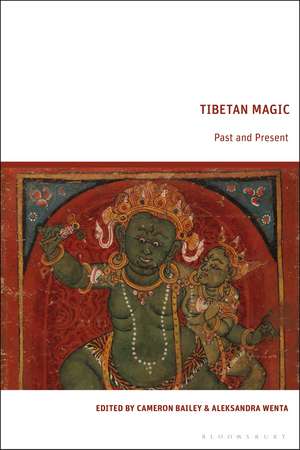
Tibetan Magic: Past and Present
Editat de Cameron Bailey, Aleksandra Wentaen Limba Engleză Hardback – 7 mar 2024
Combining the theoretical approaches of anthropology, ethnography, religious and textual studies, the book aims to shed light on experiences, practices and practitioners that have been frequently marginalized by the normative mainstream monastic Buddhist
traditions and Western Buddhist scholarship, which focuses primarily on meditation and
philosophy.
The book explores the intersection between magic/folk practices and Tantra, a complex, socio-religious phenomenon associated not only with the religious and political elites who sponsored it, but also with 'marginal' ethnic groups and social milieus, as well as with lay communities at large, who resorted to ritual agents to fulfil their worldly needs.
Preț: 552.19 lei
Preț vechi: 817.68 lei
-32%
Puncte Express: 828
Carte tipărită la comandă
Livrare economică 27 noiembrie-11 decembrie
Livrare prin curier în România Termenul estimat este afișat lângă disponibilitate.
Transport gratuit pentru acest produs Plată online sau ramburs, în funcție de opțiunile comenzii.
Retur gratuit în 14 zile Comandă securizată și suport în română.
Specificații
ISBN-13: 9781350354944
ISBN-10: 1350354945
Pagini: 266
Ilustrații: 10 bw illus
Dimensiuni: 162 x 238 x 20 mm
Greutate: 0.55 kg
Editura: Bloomsbury Publishing
Colecția Bloomsbury Academic
Locul publicării:London, United Kingdom
ISBN-10: 1350354945
Pagini: 266
Ilustrații: 10 bw illus
Dimensiuni: 162 x 238 x 20 mm
Greutate: 0.55 kg
Editura: Bloomsbury Publishing
Colecția Bloomsbury Academic
Locul publicării:London, United Kingdom
Cuprins
Introduction, Cameron M. Bailey, Dongguk University, South Korea
and Aleksandra Wenta, University of Florence, Italy
Chapter 1: The Zla gsang be'u bum: A Compendium of ritual magic and sorcery, Amanda Nichole Brown, Florida State University, USA
Chapter 2: Magical Results of the Rituals in the Tara-mula-kalpa's Continuation Tantra, Susan Landesman, American Council of Learnt Societies Fellow, USA
Chapter 3:The Vajrabhairavatantra: Materia Magica and Circulation of Tantric Magical Recipes, Aleksandra Wenta, University of Florence, Italy
Chapter 4: The Magic that Lies Within Prayer: On Patterns of Magicity and Resolute Aspirations (smon lam), Rolf Scheuermann, Heidelberg University, Germany
Chapter 5: The Yogin's Familiars: Protector Deities as Magical Guides, Cameron M. Bailey, Dongguk University, South Korea
Chapter 6: Emic perspectives on the transubstantiation of words in Tibetan-script textual amulets, Valentina Punzi, University of Tartu, Estonia
Chapter 7: The Magical Causality of Poison Casting and Cancer among Tibetan Communities of Gyalthang, Eric D. Mortensen, Guilford College, UK
Chapter 8: Is there Magic in Gcod? An Expedition into (some of) the Complexities of Sadhana-Text Enactments, Nike-Ann Schröder, Humboldt University, Germany
Chapter 9: Trainings for Sorcery, Magic, Mystic, Philosophy - for that which is called "the Great Accomplishment": Alexandra David-Neel's Written and Unwritten Tibetan Grimoires, Samuel Thévoz, University of Vienna, Austria
Afterword, Conceputalizing the 'magical' Tibet and beyond, Nicolas Sihlè, Centre for Himalayan Studies, France
Index
and Aleksandra Wenta, University of Florence, Italy
Chapter 1: The Zla gsang be'u bum: A Compendium of ritual magic and sorcery, Amanda Nichole Brown, Florida State University, USA
Chapter 2: Magical Results of the Rituals in the Tara-mula-kalpa's Continuation Tantra, Susan Landesman, American Council of Learnt Societies Fellow, USA
Chapter 3:The Vajrabhairavatantra: Materia Magica and Circulation of Tantric Magical Recipes, Aleksandra Wenta, University of Florence, Italy
Chapter 4: The Magic that Lies Within Prayer: On Patterns of Magicity and Resolute Aspirations (smon lam), Rolf Scheuermann, Heidelberg University, Germany
Chapter 5: The Yogin's Familiars: Protector Deities as Magical Guides, Cameron M. Bailey, Dongguk University, South Korea
Chapter 6: Emic perspectives on the transubstantiation of words in Tibetan-script textual amulets, Valentina Punzi, University of Tartu, Estonia
Chapter 7: The Magical Causality of Poison Casting and Cancer among Tibetan Communities of Gyalthang, Eric D. Mortensen, Guilford College, UK
Chapter 8: Is there Magic in Gcod? An Expedition into (some of) the Complexities of Sadhana-Text Enactments, Nike-Ann Schröder, Humboldt University, Germany
Chapter 9: Trainings for Sorcery, Magic, Mystic, Philosophy - for that which is called "the Great Accomplishment": Alexandra David-Neel's Written and Unwritten Tibetan Grimoires, Samuel Thévoz, University of Vienna, Austria
Afterword, Conceputalizing the 'magical' Tibet and beyond, Nicolas Sihlè, Centre for Himalayan Studies, France
Index
Recenzii
All attempts to define the "magic" concept in the book deliver fresh critical thinking on the matter regarding religion and its applicability as a universal category . The book is invaluable for exercising our confrontation and transcending stereotypes regarding "magic," "religion," and related ideas and practices.
Magic and Tibet belong together. The perception of magic has been a problem for Western scholars who have not been able to cope with it. The orphan of philosophy and religion is finally treated with respect in this book. I highly recommend it to anyone interested in Tibet and the place of magic in it!
This collection by established and emerging scholars broadens the field of the study of magic in Tibet in unique ways. Instead of delving on general discussions and theory, these essays examine key primary sources that altogether provide a coherent understanding of the practices, functions, agents, and aims of these little understood ritual secrets. No complete works have yet covered so much of the subject as does Tibetan Magic.
Magic and Tibet belong together. The perception of magic has been a problem for Western scholars who have not been able to cope with it. The orphan of philosophy and religion is finally treated with respect in this book. I highly recommend it to anyone interested in Tibet and the place of magic in it!
This collection by established and emerging scholars broadens the field of the study of magic in Tibet in unique ways. Instead of delving on general discussions and theory, these essays examine key primary sources that altogether provide a coherent understanding of the practices, functions, agents, and aims of these little understood ritual secrets. No complete works have yet covered so much of the subject as does Tibetan Magic.