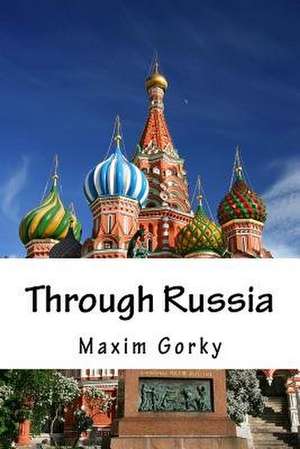
Through Russia
Autor Maxim Gorky Traducere de Charles James Hogarthen Limba Engleză Paperback
Preț: 103.30 lei
Puncte Express: 155
Carte disponibilă
Livrare economică 09-23 noiembrie
Livrare prin curier în România Termenul estimat este afișat lângă disponibilitate.
Transport gratuit de la 400.00 lei Plată online sau ramburs, în funcție de opțiunile comenzii.
Retur gratuit în 14 zile Comandă securizată și suport în română.
Specificații
ISBN-13: 9781983566219
ISBN-10: 1983566217
Pagini: 276
Dimensiuni: 152 x 229 x 15 mm
Greutate: 0.37 kg
ISBN-10: 1983566217
Pagini: 276
Dimensiuni: 152 x 229 x 15 mm
Greutate: 0.37 kg
V-ar putea interesa
-
 When You Pass Through WatersNicole SeitzPreț: 67.20 lei
 -
 ShakaraTess OnwuemePreț: 87.76 lei
 -
 I Saggi di PizzoFrancesco M MarincolaPreț: 84.06 lei
 -
 Preț: 88.57 lei
 -
 Paris, Etc.Jessie Vail AufieryPreț: 91.02 lei
 -
 Love and murderJohn BroughamPreț: 84.73 lei
 -
 Preț: 84.94 lei
 -
![Journal of a tour to the White Mountains in July, 1784 ... Printed from the original manuscript, with a prefatory note by the editor [Charles Deane]](https://i4.books-express.ro/bt/9781418193393/journal-of-a-tour-to-the-white-mountains-in-july-1784-printed-from-the-original-manuscript-with-a-prefatory-note-by-the-editor-charles-deane.jpg) Preț: 85.11 lei
Preț: 85.11 lei -
 Queen of the Black CoastRobert Ervin HowardPreț: 41.25 lei
 -
 A Witch Shall Be BornRobert Ervin HowardPreț: 53.44 lei
 -
 A Gent from Bear CreekRobert Ervin HowardPreț: 88.92 lei
 -
 The Red WindowFergus HumePreț: 92.83 lei
 -
 A Coin of Edward VIIFergus HumePreț: 71.57 lei
 -
 Quelques Nouvelles TerrifiantesGaston LeRouxPreț: 44.26 lei
 -
 Noah WebsterHorace E. ScudderPreț: 46.55 lei
 -
 The Greatest English ClassicCleland Boyd McAfeePreț: 47.35 lei
 -
 Lettres de Mon MoulinAlphonse DaudetPreț: 50.21 lei
 -
 The Curious Case of Benjamin ButtonFitzgerald Francis ScottPreț: 40.47 lei
 -
 Lord of the WorldBenson Robert HughPreț: 90.28 lei
 -
 Dawn of AllBenson Robert HughPreț: 86.19 lei
 -
 Jennie GerhardtDreiser TheodorePreț: 108.46 lei
 -
 Quo VadisSienkiewicz HenrykPreț: 159.63 lei
Notă biografică
Alexei Maximovich Peshkov (1868 - 1936), primarily known as Maxim Gorky, was a Russian and Soviet writer, a founder of the socialist realism literary method and a political activist. He was also a five-time nominee for the Nobel Prize in Literature. Around fifteen years before success as a writer, he frequently changed jobs and roamed across the Russian Empire; these experiences would later influence his writing. Gorky's most famous works were The Lower Depths (1902), Twenty-six Men and a Girl, The Song of the Stormy Petrel, My Childhood, The Mother, Summerfolk and Children of the Sun. He had an association with fellow Russian writers Leo Tolstoy and Anton Chekhov; Gorky would later mention them in his memoirs. Gorky was active with the emerging Marxist social-democratic movement. He publicly opposed the Tsarist regime, and for a time closely associated himself with Vladimir Lenin and Alexander Bogdanov's Bolshevik wing of the party. For a significant part of his life, he was exiled from Russia and later the Soviet Union. In 1932, he returned to USSR on Joseph Stalin's personal invitation and died there in June 1936.