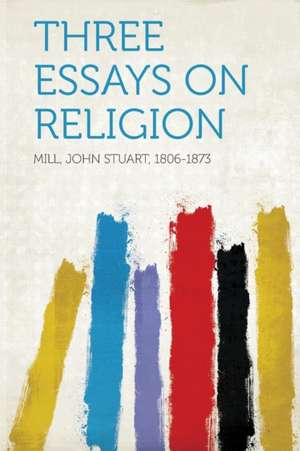
Three Essays on Religion
Autor John Stuart Millen Limba Engleză Paperback – 27 ian 2013
Preț: 141.75 lei
Puncte Express: 213
Carte tipărită la comandă
Livrare economică 03-09 iunie
Specificații
ISBN-13: 9781313429290
ISBN-10: 1313429295
Pagini: 330
Dimensiuni: 157 x 228 x 22 mm
Greutate: 0.48 kg
Editura: HardPress Publishing
ISBN-10: 1313429295
Pagini: 330
Dimensiuni: 157 x 228 x 22 mm
Greutate: 0.48 kg
Editura: HardPress Publishing
V-ar putea interesa
-
 On Liberty and the Subjection of WomenJohn Stuart Mill-27%Preț: 50.26 lei68.91 lei
 -
 -23%Preț: 277.79 lei360.03 lei
 -
 Christianity: A Very Short IntroductionLinda Woodhead-21%Preț: 53.00 lei67.50 lei
 -
 The Evolution Of God: The origins of our beliefsRobert Wright-26%Preț: 77.72 lei104.75 lei
 -
 Utilitarianism and on LibertyJohn Stuart MillPreț: 94.66 lei
 -
 Preț: 110.17 lei
 -
 The End of FaithSam Harris-23%Preț: 53.18 lei69.08 lei
 -
 On LibertyJohn Stuart Mill-12%Preț: 61.78 lei70.33 lei
 -
 Counting To GodDouglas EllPreț: 109.30 lei
 -
 Wondrous Wisdom: Everyones Guide to the Study of Authentic KabbalahMichael R Kellogg-12%Preț: 77.83 lei88.18 lei
 -
 Science and ChristianityJ B StumpPreț: 199.47 lei
 -
 Preț: 394.47 lei
 -
 -17%Preț: 277.12 lei334.75 lei
 -
 -18%Preț: 1081.04 lei1318.34 lei
 -
 Principles of Political Economy - Volume 1John Stuart MillPreț: 144.00 lei
 -
 Betrayal: The Crisis in the Catholic Church / Oscar 2016The Investigative Staff of the Boston Globe-20%Preț: 60.18 lei75.39 leiRecomandat
 -
 -23%Preț: 321.72 lei416.55 lei
 -
 Waking UpSam Harris-21%Preț: 59.45 lei74.94 lei
Recenzii
John Stuart Mill was one of the most important political and social thinkers of the nineteenth century, and his writings on human rights, feminism, the evils of slavery, and the environment are still widely read and influential today. Published after Mill’s death to avoid controversy, the three essays in this edition, Nature, Utility of Religion, and Theism, represent Mill’s considered position on religion. Mill argues that belief in a supernatural power holds us back, but that a conception of the meaning and value of being human, or Religion of Humanity, could make the world a better place. Essential in understanding Mill’s views on religion and his practical philosophy, these essays are also significant contributions to the philosophy and psychology of religion.
Appendices include Mill’s other writings on religion, his early influences, contemporary reviews, and other 19th century writings on religion and science.
“[The] essays, along with the extensive supplementary material in this volume, provide the basis for exciting and detailed analysis by student and scholar alike, the sort of comprehensive, contextual work in the history of philosophy that brings old texts into contemporary life. … The book provides the tools for exceptional scholarship and teaching regarding Mill’s views on religion, and for that we can all be grateful.” — Julie C. Van Camp, California State University (Notre Dame Philosophical Reviews)
“Mill’s Three Essays belongs on any shortlist of the towering classics of secularist thought; but it has never yet been given its due. We must therefore be cheered by its appearance in a neat and friendly volume that every one of us would want to have on our bookshelves. And the fact that the essays are supplemented in this edition by a splendid introduction from Louis Matz, and a generous selection from Mill’s other writings on religion, is yet another motive for good cheer.” — Jonathan Rée, New Humanist
“Mill thought deeply and impartially about religion, and his writings are as significant now as they were in his own day. This outstanding edition combines scholarship with accessibility. With its excellent introduction and useful appendices, it is the ideal text for students, teachers, and advanced researchers.” — Roger Crisp, St. Anne’s College, Oxford
“Lou Matz brings together the essays “Theism”, “Nature” and the “Utility of Religion” that Helen Taylor published after Mill’s death. In Mill’s essays, little of Christianity survives save its exhortation to do good. This volume also contains writings that influenced Mill (e.g., by Jeremy Bentham), discussions of religion found elsewhere in his works, and Victorian reactions to the essays. All this, together with a superb introduction! This volume would make a useful text for students and will certainly become indispensable for the scholar.” — Fred Wilson, University of Toronto
“John Stuart Mill’s Three Essays on Religion deserve closer attention than they generally receive from students of philosophy and religion. This edition will serve to stimulate interest in the essays themselves and the light they shed on Mill’s philosophy as a whole. Lou Matz has provided a substantial introduction that helpfully situates the essays in the context of Mill’s life and thought. The appendices are especially welcome since they bring together materials that are not conveniently available elsewhere, including other writings of Mill on religion and extracts from influential works of the period.” — Alan Millar, University of Stirling
“Lou Matz’s edition of Mill’s Three Essays on Religion offers significant ‘value added’ over the text of the essays themselves. Matz’s introduction is detailed and informative, yet accessible and engaging enough for students of all levels. Matz also includes passages on religion from Mill’s other works and his correspondence, reviews from contemporary readers of the Essays, and discussions of the relation between religion and science from Charles Darwin and T. H. Huxley. Thus this one volume contains all of the materials necessary for a comprehensive and contextual understanding of Mill’s views on religion.” — Dale E. Miller, Old Dominion University
Appendices include Mill’s other writings on religion, his early influences, contemporary reviews, and other 19th century writings on religion and science.
“[The] essays, along with the extensive supplementary material in this volume, provide the basis for exciting and detailed analysis by student and scholar alike, the sort of comprehensive, contextual work in the history of philosophy that brings old texts into contemporary life. … The book provides the tools for exceptional scholarship and teaching regarding Mill’s views on religion, and for that we can all be grateful.” — Julie C. Van Camp, California State University (Notre Dame Philosophical Reviews)
“Mill’s Three Essays belongs on any shortlist of the towering classics of secularist thought; but it has never yet been given its due. We must therefore be cheered by its appearance in a neat and friendly volume that every one of us would want to have on our bookshelves. And the fact that the essays are supplemented in this edition by a splendid introduction from Louis Matz, and a generous selection from Mill’s other writings on religion, is yet another motive for good cheer.” — Jonathan Rée, New Humanist
“Mill thought deeply and impartially about religion, and his writings are as significant now as they were in his own day. This outstanding edition combines scholarship with accessibility. With its excellent introduction and useful appendices, it is the ideal text for students, teachers, and advanced researchers.” — Roger Crisp, St. Anne’s College, Oxford
“Lou Matz brings together the essays “Theism”, “Nature” and the “Utility of Religion” that Helen Taylor published after Mill’s death. In Mill’s essays, little of Christianity survives save its exhortation to do good. This volume also contains writings that influenced Mill (e.g., by Jeremy Bentham), discussions of religion found elsewhere in his works, and Victorian reactions to the essays. All this, together with a superb introduction! This volume would make a useful text for students and will certainly become indispensable for the scholar.” — Fred Wilson, University of Toronto
“John Stuart Mill’s Three Essays on Religion deserve closer attention than they generally receive from students of philosophy and religion. This edition will serve to stimulate interest in the essays themselves and the light they shed on Mill’s philosophy as a whole. Lou Matz has provided a substantial introduction that helpfully situates the essays in the context of Mill’s life and thought. The appendices are especially welcome since they bring together materials that are not conveniently available elsewhere, including other writings of Mill on religion and extracts from influential works of the period.” — Alan Millar, University of Stirling
“Lou Matz’s edition of Mill’s Three Essays on Religion offers significant ‘value added’ over the text of the essays themselves. Matz’s introduction is detailed and informative, yet accessible and engaging enough for students of all levels. Matz also includes passages on religion from Mill’s other works and his correspondence, reviews from contemporary readers of the Essays, and discussions of the relation between religion and science from Charles Darwin and T. H. Huxley. Thus this one volume contains all of the materials necessary for a comprehensive and contextual understanding of Mill’s views on religion.” — Dale E. Miller, Old Dominion University
Descriere
Descriere de la o altă ediție sau format:
John Stuart Mill was one of the most important political and social thinkers of the nineteenth century, and his writings on human rights, feminism, the evils of slavery, and the environment are still widely read and influential today. Published after Mill’s death to avoid controversy, the three essays in this edition, Nature, Utility of Religion, and Theism, represent Mill’s considered position on religion. Mill argues that belief in a supernatural power holds us back, but that a conception of the meaning and value of being human, or Religion of Humanity, could make the world a better place. Essential in understanding Mill’s views on religion and his practical philosophy, these essays are also significant contributions to the philosophy and psychology of religion.
Appendices include Mill’s other writings on religion, his early influences, contemporary reviews, and other 19th century writings on religion and science.
John Stuart Mill was one of the most important political and social thinkers of the nineteenth century, and his writings on human rights, feminism, the evils of slavery, and the environment are still widely read and influential today. Published after Mill’s death to avoid controversy, the three essays in this edition, Nature, Utility of Religion, and Theism, represent Mill’s considered position on religion. Mill argues that belief in a supernatural power holds us back, but that a conception of the meaning and value of being human, or Religion of Humanity, could make the world a better place. Essential in understanding Mill’s views on religion and his practical philosophy, these essays are also significant contributions to the philosophy and psychology of religion.
Appendices include Mill’s other writings on religion, his early influences, contemporary reviews, and other 19th century writings on religion and science.
Cuprins
Acknowledgements
List of Illustrations
Introduction
John Stuart Mill:A Brief Chronology
A Note on the Text
Three Essays on Religion
List of Illustrations
Introduction
John Stuart Mill:A Brief Chronology
A Note on the Text
Three Essays on Religion
- Introductory Notice
“Nature”
“Utility of Religion”
“Theism”
- From Autobiography (1873)
- “Enlightened Infidelity” (1847)
- “Religious Sceptics” (1851)
- From Diary (1854)
- From On Liberty (1859)
- From Letter to Alexander Bain (1859)
- From Utilitarianism (1861)
- From Letter to Arthur Greene (1861)
- From Letter to Arthur Greene (1861)
- From Auguste Comte and Positivism (1865)
- From An Examination of Sir William Hamilton’s Philosophy(1865)
- From Letter to Henry Jones (1868)
- From Letter to Charles Friend (1868)
- From Letter to Richard Marshall (1868)
- From Letter to Thomas Dyke Acland (1868)
- From Jeremy Bentham, An Analysis of the Influence of Natural Religion on the Temporal Happiness of Mankind (1822)
- From James Mill,“The Church, and Its Reform,” The London Review (1835)
- From John Morley,“Mr. Mill’s Three Essays on Religion,” The Fortnightly Review (1875)
- From Charles B. Upton,“Mill’s Essays on Religion,” The Theological Review (1875)
- From Alexander Bain, John Stuart Mill:A Criticism with Personal Recollections (1882)
- From Charles Darwin, The Autobiography of Charles Darwin 1809-1882 (1887)
- From T.H. Huxley,“Agnosticism” (1889)
Textul de pe ultima copertă
In these three essays, "Nature", "The Utility of Religion", and "Theism", published between 1850 and 1870, English social and political philosopher John Stuart Mill (1806-1873) gives his most sustained analysis of religious belief. Though not prepared to abandon the idea of an overall design in nature, Mill nonetheless argues that its violence and capriciousness militate against moral ends in nature's workings. Moreover, any designer of such a world as we experience it cannot be all powerful and all good, for nature is "too clumsily made and capriciously governed". However, since humankind, by and large, cannot, it seems, be deprived of religion, Mill espouses what he calls a "religion of humanity", whose concepts of justice, morality, and altruism are based on classical models and on the New Testament Sermon on the Mount rather than on the vindictive God of the Old Testament and the world-hating doctrines of St. Paul.