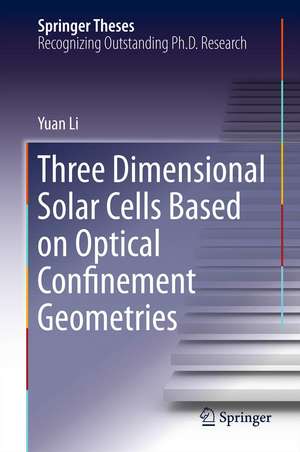
Three Dimensional Solar Cells Based on Optical Confinement Geometries: Springer Theses
Autor Yuan Lien Limba Engleză Hardback – 28 noi 2012
Additionally, this book discusses the importance of these methods in achieving the goal of high efficiency solar cells and suggests a possible application in large-scale photovoltaics business, like solar farms.
Din seria Springer Theses
- 15%
 Preț: 663.23 lei
- 15%
 Preț: 661.49 lei
- 15%
 Preț: 660.04 lei
- 18%
 Preț: 1438.89 lei
-
 Preț: 397.39 lei
- 18%
 Preț: 1150.06 lei
- 18%
 Preț: 1261.12 lei
- 15%
 Preț: 665.20 lei
-
 Preț: 404.91 lei
-
 Preț: 401.44 lei
- 18%
 Preț: 1151.50 lei
-
 Preț: 410.46 lei
- 18%
 Preț: 1034.72 lei
- 18%
 Preț: 977.51 lei
- 18%
 Preț: 1144.10 lei
- 15%
 Preț: 663.23 lei
- 18%
 Preț: 1031.60 lei
- 15%
 Preț: 638.81 lei
- 18%
 Preț: 978.49 lei
-
 Preț: 398.83 lei
- 15%
 Preț: 667.93 lei
-
 Preț: 399.72 lei
- 15%
 Preț: 658.80 lei
- 15%
 Preț: 663.97 lei
- 15%
 Preț: 664.46 lei
- 18%
 Preț: 1263.02 lei
- 15%
 Preț: 663.48 lei
- 18%
 Preț: 1035.90 lei
- 18%
 Preț: 1273.75 lei
- 18%
 Preț: 1152.69 lei
- 15%
 Preț: 661.99 lei
- 18%
 Preț: 1152.90 lei
- 18%
 Preț: 1264.69 lei
- 18%
 Preț: 1038.03 lei
- 18%
 Preț: 1036.63 lei
- 18%
 Preț: 1156.95 lei
- 18%
 Preț: 1036.70 lei
- 18%
 Preț: 979.42 lei
- 15%
 Preț: 642.59 lei
- 15%
 Preț: 665.96 lei
- 18%
 Preț: 976.57 lei
- 18%
 Preț: 1443.18 lei
-
 Preț: 401.44 lei
-
 Preț: 399.14 lei
- 18%
 Preț: 1034.98 lei
- 18%
 Preț: 1148.15 lei
- 15%
 Preț: 658.33 lei
- 15%
 Preț: 662.51 lei
- 15%
 Preț: 659.03 lei
- 15%
 Preț: 659.78 lei
Preț: 663.45 lei
Preț vechi: 780.53 lei
-15%
Carte tipărită la comandă
Livrare economică 02-16 decembrie
Specificații
ISBN-10: 1461456983
Pagini: 184
Ilustrații: XXX, 154 p.
Dimensiuni: 160 x 241 x 15 mm
Greutate: 0.4 kg
Ediția:2013
Editura: Springer
Colecția Springer Theses
Seria Springer Theses
Locul publicării:New York, NY, United States
V-ar putea interesa
-
 -23%Preț: 1318.79 lei1712.72 lei
-
 Concepts in Organic ElectronicsStephen R. Forrest-9%Preț: 352.46 lei386.06 lei
-
 Optical Properties of SolidsMark FoxPreț: 383.52 lei
-
 -11%Preț: 668.13 lei750.70 lei
-
 -32%Preț: 514.32 lei751.70 lei
-
 Quantum & Nano Technologies for PhotovoltaicsLoucas Tsakalakos-9%Preț: 670.37 lei736.67 lei
-
 -34%Preț: 149.68 lei227.27 lei
-
 Third Generation Solar CellsAgata Zdyb-14%Preț: 728.25 lei846.80 lei
-
 Fundamentals of Photonics, Third Edition, 2V SetBahaa E. A. Saleh-23%Preț: 1219.19 lei1583.36 lei
-
 Photovoltaic Solar EnergyWilfried van Sark-23%Preț: 683.27 lei887.37 lei
-
 AI First, Human AlwaysSandy CarterPreț: 132.84 lei
-
 Advanced Concepts in PhotovoltaicsArthur J Nozik-14%Preț: 1374.24 lei1597.94 lei
-
 -36%Preț: 185.48 lei290.78 lei
-
 Preț: 411.30 lei
-
 -14%Preț: 789.17 lei917.64 lei
-
 -23%Preț: 722.31 lei938.06 lei
-
 Composites-Based Perovskite Solar CellsYoon-Bong Hahn-23%Preț: 812.16 lei1054.76 lei
-
 Anti-reflection and Light Trapping in c-Si Solar CellsChetan Singh Solanki-15%Preț: 666.71 lei784.36 lei
-
 Advances in Photonics Integrated Circuits, LASER and ApplicationsVarun Raghunathan-18%Preț: 1601.51 lei1953.06 lei
Public țintă
ResearchCuprins
Notă biografică
Dr. Yuan Li studied Geoenvironmental Engineering at the Institute of Rock and Soil Mechanics, Chinese Academy of Sciences (CAS) and Cardiff University, where he spent five years (2018–2023) conducting cross-disciplinary research on bio-electro-chemico-thermo-hydro-mechanical behaviours of contaminated soils and geo-wastes. He is currently a distinguished postdoctoral fellow at the Hong Kong Polytechnic University, Hong Kong, developing functional nanomaterials derived from geo-wastes with eco-benefits and applying them to geopolymer-stabilised infrastructures. He will serve as a research associate at the University of Cambridge from April 2025 to September 2025, and as a Marie Curie Fellow at Imperial College London from October 2025, where he will continue these studies. His research interests focus on (1) analysis of soil-pollutant interactions and interactions between soil particles and functional nanomaterials; (2) novel thermal and thermochemical methods to address soil contamination; (3) microstructure analysis and assessment of geopolymers, thermally treated wastes, and waste-based nanomaterials with environmental benefits for sustainable infrastructures; and (4) sustainability assessment based on life cycle analysis and carbon budget for waste-based cementitious materials. He has received various research funds and awards, including the Horizon Europe Marie Sk¿odowska-Curie Actions Fellowship, the Distinguished Postdoctoral Fellowship, and the Special Prize of Presidential Scholarship from CAS.
Textul de pe ultima copertă
Additionally, this book discusses the importance of these methods in achieving the goal of high efficiency solar cells and suggests a potential application in large-scale photovoltaics businesses, like solar farms.