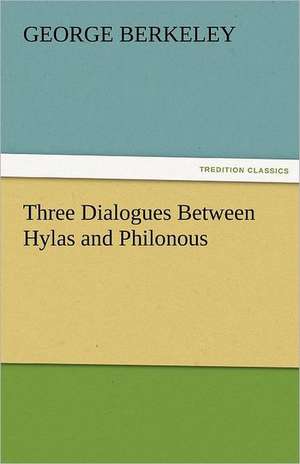
Three Dialogues Between Hylas and Philonous
Autor George Berkeleyen Limba Engleză Paperback – 25 noi 2011
Preț: 127.82 lei
Puncte Express: 192
Carte tipărită la comandă
Livrare economică 16-30 iunie
Specificații
ISBN-13: 9783842456747
ISBN-10: 3842456743
Pagini: 112
Dimensiuni: 133 x 203 x 9 mm
Greutate: 0.15 kg
Editura: TREDITION CLASSICS
ISBN-10: 3842456743
Pagini: 112
Dimensiuni: 133 x 203 x 9 mm
Greutate: 0.15 kg
Editura: TREDITION CLASSICS
V-ar putea interesa
Descriere
Descriere de la o altă ediție sau format:
The Oxford Philosophical Texts series consists of authoritative teaching editions of canonical texts in the history of philosophy from the ancient world down to modern times. Each volume provides a clear, well laid out text together with a comprehensive introduction by a leading specialist, giving the student detailed critical guidance on the intellectual context of the work and the structure and philosophical importance of the main arguments. Endnotes are supplied which provide further commentary on the arguments and explain unfamiliar references and terminology, and a full bibliography and index are also included. The series aims to build up a definitive corpus of key texts in the Western philosophical tradition, which will form a reliable and enduring resource for students and teachers alike. The Three Dialogues between Hylas and Philonous (1713) were designed as a vivid and accessible presentation of the remarkable picture of reality that Berkeley had first presented three years earlier, in his Principles of Human Knowledge. His striking claim there, as here, was that physical things consist of nothing but ideas in minds. Berkeley uses this thesis as the ground for a new argument for the existence of God, and the dialogue form enables him to raise and respond to many of the natural objections to his position. The text printed in this volume is that of the 1734 edition of the Dialogues, generally agreed to represent Berkeley's mature thought. It is supplemented by a comprehensive introduction which looks in detail at the structure and main arguments of the work and the relationship between the Dialogues and the Principles, and also discusses Berkeley's life, influences, and general philosophy. In addition the volume includes an analysis of the text, a glossary, detailed endnotes, and a full bibliography with guidance on further reading. Published alongside the Principles (also edited by Jonathan Dancy), this new edition of Berkeley's most engaging text provides the student with a thorough introduction to the central ideas of one of the worlds greatest philosophers.
The Oxford Philosophical Texts series consists of authoritative teaching editions of canonical texts in the history of philosophy from the ancient world down to modern times. Each volume provides a clear, well laid out text together with a comprehensive introduction by a leading specialist, giving the student detailed critical guidance on the intellectual context of the work and the structure and philosophical importance of the main arguments. Endnotes are supplied which provide further commentary on the arguments and explain unfamiliar references and terminology, and a full bibliography and index are also included. The series aims to build up a definitive corpus of key texts in the Western philosophical tradition, which will form a reliable and enduring resource for students and teachers alike. The Three Dialogues between Hylas and Philonous (1713) were designed as a vivid and accessible presentation of the remarkable picture of reality that Berkeley had first presented three years earlier, in his Principles of Human Knowledge. His striking claim there, as here, was that physical things consist of nothing but ideas in minds. Berkeley uses this thesis as the ground for a new argument for the existence of God, and the dialogue form enables him to raise and respond to many of the natural objections to his position. The text printed in this volume is that of the 1734 edition of the Dialogues, generally agreed to represent Berkeley's mature thought. It is supplemented by a comprehensive introduction which looks in detail at the structure and main arguments of the work and the relationship between the Dialogues and the Principles, and also discusses Berkeley's life, influences, and general philosophy. In addition the volume includes an analysis of the text, a glossary, detailed endnotes, and a full bibliography with guidance on further reading. Published alongside the Principles (also edited by Jonathan Dancy), this new edition of Berkeley's most engaging text provides the student with a thorough introduction to the central ideas of one of the worlds greatest philosophers.
Recenzii
This is a new critical edition of Berkeley’s 1734 (third edition, first 1713) Three Dialogues, a text that is deservedly one of the most challenging and beloved classics of modern philosophy. The heart of the work is the dispute between materialism and idealism, two fundamentally opposed positions that are embodied by Hylas and Philonous, the characters in this philosophical drama. The book is packed with brilliant arguments and counter-arguments of an extraordinarily sophisticated nature. Amid all this philosophical swordplay one would think that there could be scant room for the characters to develop any sort of personality. Yet in Berkeley’s hands, and with his literary gifts, the interlocutors are both vivid and funny.
The dialogue deals with some of the most important perennial problems of philosophy, including: the materialism-idealism dispute, skepticism in rationalist and empiricist epistemology, the conflict over apriorism and aposteriorism, rationalism versus empiricism, the existence and nature of God, the philosophy of science, philosophy of mathematics, abstract general ideas, the role of perception in human knowledge, and the metaphysics of causation.
This edition combines a usefully annotated version of Berkeley’s complete original text with a substantial critical introduction, a chronology of events in Berkeley’s life and career, and supplementary annotated appendices of original sources from thinkers relevant to Berkeley’s work.
“Among the most welcome and distinctive features of this new edition are the editor’s substantial and informative introduction, and also a helpful set of appendices, including passages from Locke that define Berkeley’s main target, a substantial correspondence with Samuel Johnson, and a set of interpretations and convergences in other eighteenth-century writings. Highly recommended for use in upper-level courses.” — Ernest Sosa, Board of Governors Professor, Rutgers University
“A very welcome addition to Berkeley studies is Dale Jacquette’s new edition of Berkeley’s Three Dialogues. Professor Jacquette’s introduction and annotations are extremely helpful, as is his inclusion of Berkeley’s letters to his American correspondent Samuel Johnson. … This book would be quite useful for general courses in Early Modern Philosophy, more advanced courses in Empiricism, and certainly for one devoted just to Berkeley.” — Richard Brook, Professor Emeritus, Bloomsburg University
The dialogue deals with some of the most important perennial problems of philosophy, including: the materialism-idealism dispute, skepticism in rationalist and empiricist epistemology, the conflict over apriorism and aposteriorism, rationalism versus empiricism, the existence and nature of God, the philosophy of science, philosophy of mathematics, abstract general ideas, the role of perception in human knowledge, and the metaphysics of causation.
This edition combines a usefully annotated version of Berkeley’s complete original text with a substantial critical introduction, a chronology of events in Berkeley’s life and career, and supplementary annotated appendices of original sources from thinkers relevant to Berkeley’s work.
“Among the most welcome and distinctive features of this new edition are the editor’s substantial and informative introduction, and also a helpful set of appendices, including passages from Locke that define Berkeley’s main target, a substantial correspondence with Samuel Johnson, and a set of interpretations and convergences in other eighteenth-century writings. Highly recommended for use in upper-level courses.” — Ernest Sosa, Board of Governors Professor, Rutgers University
“A very welcome addition to Berkeley studies is Dale Jacquette’s new edition of Berkeley’s Three Dialogues. Professor Jacquette’s introduction and annotations are extremely helpful, as is his inclusion of Berkeley’s letters to his American correspondent Samuel Johnson. … This book would be quite useful for general courses in Early Modern Philosophy, more advanced courses in Empiricism, and certainly for one devoted just to Berkeley.” — Richard Brook, Professor Emeritus, Bloomsburg University
Cuprins
Introduction
1. Why Study the Dialogues?
2. Perception, Action, and the World
2.1 Ideas vs Things
2.2. Berkeley’s Concern with Skepticism
2.3 The Move to Phenominalism
2.4 Phenomenalism and Common Sense
3. Berkeley’s Alternatives
3.1 Discontinuous Realism
3.2 Continuous Realism
3.3 Unsupported Phenomenalism
3.4 Theistic Phenomenalism
3.5 Interpreting Berkeley
4. Berkeley’s Life and Work
5. A Note on the Text
Selected Bibliography
The Dialogues
Preface
The First Dialogue
The Second Dialogue The Third Dialogue
1. Why Study the Dialogues?
2. Perception, Action, and the World
2.1 Ideas vs Things
2.2. Berkeley’s Concern with Skepticism
2.3 The Move to Phenominalism
2.4 Phenomenalism and Common Sense
3. Berkeley’s Alternatives
3.1 Discontinuous Realism
3.2 Continuous Realism
3.3 Unsupported Phenomenalism
3.4 Theistic Phenomenalism
3.5 Interpreting Berkeley
4. Berkeley’s Life and Work
5. A Note on the Text
Selected Bibliography
The Dialogues
Preface
The First Dialogue
The Second Dialogue The Third Dialogue
Notă biografică
David Hilbert is a professor of Philosophy at the University of Illinois at Chicago. John Perry is professor emeritus in Philosophy at Stanford.