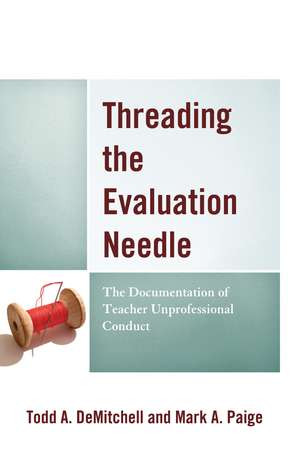
Threading the Evaluation Needle: The Documentation of Teacher Unprofessional Conduct
Autor Todd A. DeMitchell, Mark A. Paigeen Limba Engleză Paperback – 10 dec 2019
Effective supervision and evaluation requires that the school leader possess the knowledge of effective instruction, exhibit skills in documentation of professional conduct, and embrace a professional approach with the will to place and keep students at the center of school policy and practice decisions. Supervising and evaluating teachers is a difficult, but essential work. Research shows that time and expertise are necessary to effectively supervise and to build a case for adverse employment decisions, when necessary.
Threading the Evaluation Needle: The Documentation of Teacher Unprofessional Conduct addresses the legal and professional knowledge that structures discipline and dismissal in the public schools. The authors, based on their educational, legal, and research experience, provide templates for various types of documentation necessary to effectively build a case for discipline. This book seeks to give principals the tools and knowledge to institute in good faith a fair and accurate documentation system.
Preț: 175.46 lei
Preț vechi: 236.59 lei
-26%
Puncte Express: 263
Carte tipărită la comandă
Livrare economică 07-21 decembrie
Livrare prin curier în România Termenul estimat este afișat lângă disponibilitate.
Transport gratuit de la 400.00 lei Plată online sau ramburs, în funcție de opțiunile comenzii.
Retur gratuit în 14 zile Comandă securizată și suport în română.
Specificații
ISBN-13: 9781475854053
ISBN-10: 1475854056
Pagini: 120
Ilustrații: 1 Table
Dimensiuni: 154 x 222 x 9 mm
Greutate: 0.16 kg
Editura: Bloomsbury Publishing
Colecția Rowman & Littlefield
Locul publicării:New York, United States
ISBN-10: 1475854056
Pagini: 120
Ilustrații: 1 Table
Dimensiuni: 154 x 222 x 9 mm
Greutate: 0.16 kg
Editura: Bloomsbury Publishing
Colecția Rowman & Littlefield
Locul publicării:New York, United States
Cuprins
Preface: Who Shall Teach Our Children?
Chapter 1: Evaluation and the Documentation Challenge
Chapter 2: The Evaluation of Teachers
Chapter 3: The Principal as Evaluator
Chapter 4: Legal Frameworks: Infusing the Evaluation with Fairness
Chapter 5: The Five Fatal "Eyes" of Unprofessional Conduct
Chapter 6: Files, Memos, and Documentation
Chapter 7: Conclusion and the Ten Commandments of Documentation
Appendix A - InTASC Model Core Teaching Standards and Learning
Progressions for Teachers
Appendix B - Personnel Evaluation Standards
Appendix C - Examples of Causes and Evidence for Dismissal/Discipline
Appendix D - The Bologna Sandwich Technique
Appendix E - Negligent Hiring: Did We Hire the Wrong Person?
Appendix F: Table of Cases
About the Authors
Chapter 1: Evaluation and the Documentation Challenge
Chapter 2: The Evaluation of Teachers
Chapter 3: The Principal as Evaluator
Chapter 4: Legal Frameworks: Infusing the Evaluation with Fairness
Chapter 5: The Five Fatal "Eyes" of Unprofessional Conduct
Chapter 6: Files, Memos, and Documentation
Chapter 7: Conclusion and the Ten Commandments of Documentation
Appendix A - InTASC Model Core Teaching Standards and Learning
Progressions for Teachers
Appendix B - Personnel Evaluation Standards
Appendix C - Examples of Causes and Evidence for Dismissal/Discipline
Appendix D - The Bologna Sandwich Technique
Appendix E - Negligent Hiring: Did We Hire the Wrong Person?
Appendix F: Table of Cases
About the Authors
Recenzii
This book would make an excellent gift for an aspiring superintendent or someone who has landed in her or his first superintendency. "Threading the Evaluation Needle" emphasizes the principle that supervision of school staff requires the school leader to prioritize instructional supervision while ensuring accountability processes used by the school leader are led with integrity.
DeMitchell and Paige have clearly and concisely captured the school administrators' obstacles to authentic educator accountability and more importantly offer practical solutions to the daunting evaluation process. As a veteran high school principal, the supporting case law, the Ten Commandments and tool-box documents provide valuable, ready to implement strategies for my own practice. The substantial attention to the effective evaluation of the mediocre teacher and the induced exit strategy are welcome and necessary contributions to educator evaluation literature.
Threading the Evaluation Needle should be required reading for any educational leadership and licensure program. The authors are credible practitioners informing practice with significant field experience from both the legal and administrative realms. Naming the principal as the legal leader of the school is a crucial element to the climate of courage that the authors weave into the fabric of how evaluation is embedded into the values and norms of our schools.
Tenants of this book serve as an earnest reminder of the ethical responsibility, we as school leaders bear, to nurture our relationships with the educators with whom we supervise and evaluate. We must enter into our dialogues with both kindness and diligence, seeking to understand the ways in which we can provide clear and explicit feedback with our main intention being helping to hone and improve their craft for the betterment of students.
DeMitchell and Paige send a clear message to all school leaders that it is imperative we be fair and ethical in how we provide feedback to educators and that these processes not be leveraged for the sole purpose of termination. The Tool Box and cases provided offer model products and guidance for school leaders helping them refine practices to include ongoing and effective documentation of concerns and/or praise through the evaluation process.
A most noteworthy message, embedded throughout, is the fact that the expectations school leaders establish though the evaluation process sets the standard for how the school community may interpret that leader's level of integrity, as well as establish the overall tone of the school culture.
A great reminder, for new and seasoned leaders alike, that the evaluation process is about two parties willingness to enter into a relationship, grounded in mutual respect, where they feel safe, and perhaps a bit vulnerable, to discuss what's working and what isn't and how to close that gap for the betterment of students.
DeMitchell and Paige have clearly and concisely captured the school administrators' obstacles to authentic educator accountability and more importantly offer practical solutions to the daunting evaluation process. As a veteran high school principal, the supporting case law, the Ten Commandments and tool-box documents provide valuable, ready to implement strategies for my own practice. The substantial attention to the effective evaluation of the mediocre teacher and the induced exit strategy are welcome and necessary contributions to educator evaluation literature.
Threading the Evaluation Needle should be required reading for any educational leadership and licensure program. The authors are credible practitioners informing practice with significant field experience from both the legal and administrative realms. Naming the principal as the legal leader of the school is a crucial element to the climate of courage that the authors weave into the fabric of how evaluation is embedded into the values and norms of our schools.
Tenants of this book serve as an earnest reminder of the ethical responsibility, we as school leaders bear, to nurture our relationships with the educators with whom we supervise and evaluate. We must enter into our dialogues with both kindness and diligence, seeking to understand the ways in which we can provide clear and explicit feedback with our main intention being helping to hone and improve their craft for the betterment of students.
DeMitchell and Paige send a clear message to all school leaders that it is imperative we be fair and ethical in how we provide feedback to educators and that these processes not be leveraged for the sole purpose of termination. The Tool Box and cases provided offer model products and guidance for school leaders helping them refine practices to include ongoing and effective documentation of concerns and/or praise through the evaluation process.
A most noteworthy message, embedded throughout, is the fact that the expectations school leaders establish though the evaluation process sets the standard for how the school community may interpret that leader's level of integrity, as well as establish the overall tone of the school culture.
A great reminder, for new and seasoned leaders alike, that the evaluation process is about two parties willingness to enter into a relationship, grounded in mutual respect, where they feel safe, and perhaps a bit vulnerable, to discuss what's working and what isn't and how to close that gap for the betterment of students.