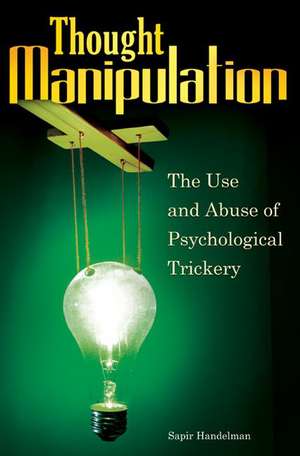
Thought Manipulation: The Use and Abuse of Psychological Trickery
Autor Sapir Handelmanen Limba Engleză Hardback – 23 iul 2009
From politics to sales, education, romance, and parenthood, everyone plays-wittingly or not-the roles of manipulator or manipulated. Thought Manipulation: The Use and Abuse of Psychological Trickery offers a thorough understanding of the art of manipulation, leading readers on a fascinating journey into the gray areas of ethics, politics, leadership, advertising, psychotherapy, and intimate relationships.
The book explains how manipulation works, exploring morally questionable tricks, such as temptation, distraction, and misdirection and introducing manipulative strategies, both simple and sophisticated. At the same time, the author allows that manipulation is not always a bad thing as any effective change in decision-making and human behavior cannot be achieved without employing it to at least a certain degree. Manipulation operates in an infinite variety of guises and situations. Sapir Handelman explains how we can resist such effects, with a focus on ethics and freedom of choice.
Preț: 392.35 lei
Preț vechi: 620.70 lei
-37%
Puncte Express: 589
Carte tipărită la comandă
Livrare economică 07-21 decembrie
Livrare prin curier în România Termenul estimat este afișat lângă disponibilitate.
Transport gratuit de la 400.00 lei Plată online sau ramburs, în funcție de opțiunile comenzii.
Retur gratuit în 14 zile Comandă securizată și suport în română.
Specificații
ISBN-13: 9780313355325
ISBN-10: 0313355320
Pagini: 180
Dimensiuni: 156 x 235 x 20 mm
Greutate: 0.42 kg
Ediția:New.
Editura: Bloomsbury Publishing
Colecția Praeger
Locul publicării:New York, United States
ISBN-10: 0313355320
Pagini: 180
Dimensiuni: 156 x 235 x 20 mm
Greutate: 0.42 kg
Ediția:New.
Editura: Bloomsbury Publishing
Colecția Praeger
Locul publicării:New York, United States
V-ar putea interesa
-
 You Are Doing a Freaking Great Job.: And Other Reminders of Your AwesomenessWorkman Publishing-23%Preț: 50.70 lei65.63 lei
 -
 -23%Preț: 94.75 lei123.41 lei
 -
 Until the Brighter TomorrowValerie Irick RainfordPreț: 69.12 lei
 -
 The Motivation ManifestoBrendon Burchard-18%Preț: 95.08 lei115.38 lei
 -
 -30%Preț: 64.79 lei92.61 lei
 -
 Mudras for Modern LifeSwami SaradanandaPreț: 109.52 lei
 -
 Just Get On With It!Ali CampbellPreț: 94.07 lei
 -
 Preț: 101.11 lei
 -
 -26%Preț: 68.13 lei92.57 lei
 -
 This Book Will Make You Feel BeautifulJessamy HibberdPreț: 76.99 lei
 -
 The Little Book of ConfidenceTiddy RowanPreț: 72.76 lei
Recenzii
Where are the boundaries between manipulation, weakness, and free choice? Handelman, a fellow in peace and conflict resolution research at the University of Missouri, proposes that the phenomenon of manipulation can be used as a constructive tool, and outlines manipulative strategies used in politics, leadership, advertising, psychotherapy, and intimate relationships. To begin, the concept of manipulation is explained, and the challenges it presents to the open society are explored, with discussion of the characteristics and ethics of manipulation. Specific types of manipulation are then described, focusing on those that are designed to limit freedom of choice, in chapters on manipulation in advertising, politics, and leadership. The third part of the book looks at manipulations that are geared toward helping us discover new options and horizons, such as the manipulation found in therapy.