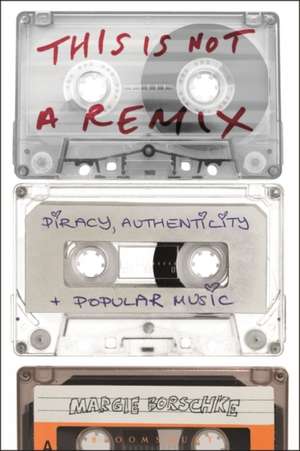
This is Not a Remix: Piracy, Authenticity and Popular Music
Autor Margie Borschkeen Limba Engleză Paperback – 10 aug 2017
Borschke examines the innovations that have sprung from the use of recording formats in grassroots music scenes, from the vinyl, tape and acetate that early disco DJs used to create remixes to the mp3 blogs and vinyl revivalists of the 21st century. This is Not A Remix challenges claims that 'remix culture' is a substantially new set of innovations and highlights the continuities and contradictions of the Internet era.
Through an historical focus on copy as a property and practice, This Is Not a Remix focuses on questions about the materiality of media, its use and the aesthetic dimensions of reproduction and circulation in digital networks. Through a close look at sometimes illicit forms of composition-including remixes, edits, mashup, bootlegs and playlists-Borschke ponders how and why ideals of authenticity persist in networked cultures where copies and copying are ubiquitous and seemingly at odds with romantic constructions of authorship. By teasing out unspoken assumptions about media and culture, this book offers fresh perspectives on the cultural politics of intellectual property in the digital era and poses questions about the promises, possibilities and challenges of network visibility and mobility.
Preț: 178.70 lei
Preț vechi: 238.67 lei
-25%
Puncte Express: 268
Carte disponibilă
Livrare economică 11-25 noiembrie
Livrare prin curier în România Termenul estimat este afișat lângă disponibilitate.
Transport gratuit de la 400.00 lei Plată online sau ramburs, în funcție de opțiunile comenzii.
Retur gratuit în 14 zile Comandă securizată și suport în română.
Specificații
ISBN-13: 9781501318924
ISBN-10: 1501318926
Pagini: 192
Dimensiuni: 150 x 224 x 16 mm
Greutate: 0.32 kg
Editura: Bloomsbury Publishing
Colecția Bloomsbury Academic
Locul publicării:New York, United States
ISBN-10: 1501318926
Pagini: 192
Dimensiuni: 150 x 224 x 16 mm
Greutate: 0.32 kg
Editura: Bloomsbury Publishing
Colecția Bloomsbury Academic
Locul publicării:New York, United States
V-ar putea interesa
-
 Elvis Has Left the BuildingDylan Jones-19%Preț: 58.56 lei72.11 lei
 -
 Nico, Songs They Never Play on the RadioJames Young-27%Preț: 78.44 lei107.19 lei
 -
 The Official Spinal Tap CompanionKarl French-26%Preț: 89.01 lei120.70 lei
 -
 -23%Preț: 56.83 lei74.15 lei
 -
 Top of the PopsPatrick HumphriesPreț: 217.50 lei
 -
 Torment Saint: The Life of Elliott SmithWilliam Todd Schultz-35%Preț: 69.91 lei107.94 lei
 -
 The Art of SongwritingAndrew West-20%Preț: 175.61 lei218.24 lei
 -
 Let's Play Ukulele (mit 2 CDs)Daniel SchusterbauerPreț: 202.21 lei
 -
 Global ReggaeCarolyn CooperPreț: 289.07 lei
Cuprins
1 This is not a remix
1.1 Introduction
1.2 Critical approach
2 Copy, a brief history
2.1 The ghost in the digital machine
2.2 The trouble with media history
2.3 "Again, back": Repetition and music's materiality
3 The rhetoric of remix
3.1 Remix as trope
3.2 The extended remix: In the press
3.3 The extended remix: Scholarly use
3.4 Lawrence Lessig's "Remix Culture"
3.5 Remix as resistance
3.6 Why the history of remix matters
4 Disco edits: Analog antecedents and network bias
4.1 What a difference a record makes
4.2 Interrupting the rhetoric of remix
4.3 Disco edits, a technical distinction
4.4 Hang the DJ
4.5 Walter Gibbons, the break, and the edits that made disco
4.6 Let your body talk
4.7 Are samples copies?
4.8 Parasites, pirates, and permission
4.9 Digital revival and an analog persistence
4.10 Credit to the edit
5 The New Romantics
5.1 Piracy's long history
5.2 MP3 blogs as social media
5.3 Material media: MP3 blogs as artifacts and practices
5.4 Provenance as metadata
5.5 Rethinking participation and the folk aesthetic
5.6 Countercultures and anticommercialism
5.7 Networking authenticity
5.8 Analog antecedents: Harry Smith's mystical collection
5.9 Copies, networks, and a poetics of encounter
6 Copies and the aesthetics of circulation
1.1 Introduction
1.2 Critical approach
2 Copy, a brief history
2.1 The ghost in the digital machine
2.2 The trouble with media history
2.3 "Again, back": Repetition and music's materiality
3 The rhetoric of remix
3.1 Remix as trope
3.2 The extended remix: In the press
3.3 The extended remix: Scholarly use
3.4 Lawrence Lessig's "Remix Culture"
3.5 Remix as resistance
3.6 Why the history of remix matters
4 Disco edits: Analog antecedents and network bias
4.1 What a difference a record makes
4.2 Interrupting the rhetoric of remix
4.3 Disco edits, a technical distinction
4.4 Hang the DJ
4.5 Walter Gibbons, the break, and the edits that made disco
4.6 Let your body talk
4.7 Are samples copies?
4.8 Parasites, pirates, and permission
4.9 Digital revival and an analog persistence
4.10 Credit to the edit
5 The New Romantics
5.1 Piracy's long history
5.2 MP3 blogs as social media
5.3 Material media: MP3 blogs as artifacts and practices
5.4 Provenance as metadata
5.5 Rethinking participation and the folk aesthetic
5.6 Countercultures and anticommercialism
5.7 Networking authenticity
5.8 Analog antecedents: Harry Smith's mystical collection
5.9 Copies, networks, and a poetics of encounter
6 Copies and the aesthetics of circulation
Recenzii
This Is Not a Remix will be useful not only for scholars of popular music but for any of those interested in music in their personal lives . Borschke's book indicates that there is much to be said about the long-standing genealogy of collective engagement with music that can literally be heard in our songs, mashups, and playlists.
This Is Not a Remix does raise some big issues and calls into question accepted wisdom regarding romantic notions of the current participatory recorded music scene.
Borschke's analysis of copying and remixing as it relates to popular music is fascinating and original, and the value of this book extends to those with an interest in media studies, intellectual property, and copyright.
This book contributes to the immediate topic of multiformats and provides an insightful and densely detailed exploration and analysis of the notion of copy ... this publication is valuable to our understanding of the complexities and nuances of living in a digital culture.
Offers interesting in-depth studies into DJ culture, mp3 blogs and the history of vinyl ... [and] provides useful insights into the nature of the copy in relation to remix. It is a fascinating read that provides much food for thought ... a valuable addition to the growing remix canon.
The most enjoyable section of This Is Not A Remix concerns the invention of the disco edit, particularly the specifics of legendary New York DJ Walter Gibbons's process of splicing together extended drum breaks in his makeshift home studio, then pressing the mix on acetate for use in clubs.
Margie Borschke's book offers an exciting new framework for thinking about digital copying of media, shifting the discussion from the now well known territory of intellectual property rights to the rich and complex history of the aesthetics of copying in both analog and digital media.
This inspiring and well-researched study really puts the disco in discourse, reminding of the long history of practices of copy that pertain to contemporary forms of cultural (re)production. Borschke's book makes a great contribution to critical studies of culture and also media archaeological research and is a warmly recommended for students and colleagues in music, sound and media studies.
This Is Not a Remix does raise some big issues and calls into question accepted wisdom regarding romantic notions of the current participatory recorded music scene.
Borschke's analysis of copying and remixing as it relates to popular music is fascinating and original, and the value of this book extends to those with an interest in media studies, intellectual property, and copyright.
This book contributes to the immediate topic of multiformats and provides an insightful and densely detailed exploration and analysis of the notion of copy ... this publication is valuable to our understanding of the complexities and nuances of living in a digital culture.
Offers interesting in-depth studies into DJ culture, mp3 blogs and the history of vinyl ... [and] provides useful insights into the nature of the copy in relation to remix. It is a fascinating read that provides much food for thought ... a valuable addition to the growing remix canon.
The most enjoyable section of This Is Not A Remix concerns the invention of the disco edit, particularly the specifics of legendary New York DJ Walter Gibbons's process of splicing together extended drum breaks in his makeshift home studio, then pressing the mix on acetate for use in clubs.
Margie Borschke's book offers an exciting new framework for thinking about digital copying of media, shifting the discussion from the now well known territory of intellectual property rights to the rich and complex history of the aesthetics of copying in both analog and digital media.
This inspiring and well-researched study really puts the disco in discourse, reminding of the long history of practices of copy that pertain to contemporary forms of cultural (re)production. Borschke's book makes a great contribution to critical studies of culture and also media archaeological research and is a warmly recommended for students and colleagues in music, sound and media studies.