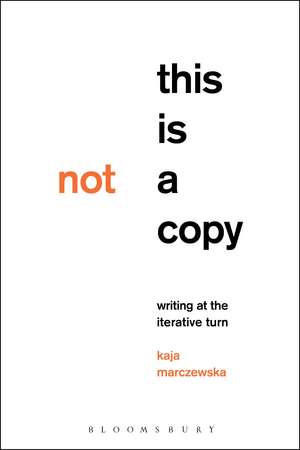
This Is Not a Copy: Writing at the Iterative Turn
Autor Dr. Kaja Marczewskaen Limba Engleză Paperback – 22 aug 2019
Developing the new concept of the Iterative Turn, This Is Not a Copy identifies and theorizes the turn toward ubiquitous iteration as a condition of text-based creative practices as they emerge in response to contemporary technologies. Conceiving of writing as iterative invites us to address a set of new, critical questions about contemporary culture. Combining discussion of literature, experimental and electronic writing, mainstream and independent publishing with debates in 20th- and 21st-century art, contemporary media culture, transforming technologies and copyright laws, This Is Not a Copy offers a timely and urgently needed argument, introducing a unique new perspective on practices that permeate our contemporary culture.
Preț: 251.02 lei
Puncte Express: 377
Carte tipărită la comandă
Livrare economică 27 noiembrie-11 decembrie
Livrare prin curier în România Termenul estimat este afișat lângă disponibilitate.
Transport gratuit de la 400.00 lei Plată online sau ramburs, în funcție de opțiunile comenzii.
Retur gratuit în 14 zile Comandă securizată și suport în română.
Specificații
ISBN-13: 9781501357336
ISBN-10: 1501357336
Pagini: 320
Ilustrații: 21 bw illus
Dimensiuni: 152 x 229 x 22 mm
Greutate: 0.42 kg
Editura: Bloomsbury Publishing
Colecția Bloomsbury Academic
Locul publicării:New York, United States
ISBN-10: 1501357336
Pagini: 320
Ilustrații: 21 bw illus
Dimensiuni: 152 x 229 x 22 mm
Greutate: 0.42 kg
Editura: Bloomsbury Publishing
Colecția Bloomsbury Academic
Locul publicării:New York, United States
Cuprins
Figures
Acknowledgements
Reprint Credits
"Plagiarizing Well Is Hard To Do": An Introduction
Chapter 1: The Iterative Turn
Chapter 2: Erasure
Chapter 3: Transcription
Chapter 4: Code
Bibliography
Notes
Index
Acknowledgements
Reprint Credits
"Plagiarizing Well Is Hard To Do": An Introduction
Chapter 1: The Iterative Turn
Chapter 2: Erasure
Chapter 3: Transcription
Chapter 4: Code
Bibliography
Notes
Index
Recenzii
It should be reiterated: this original and creative account of the 'unoriginal genius' behind 'uncreative writing' is not merely another contribution to the critical literature on conceptual, code-based, and partially-erased poetry. Rather, This Is Not A Copy rethinks the very concepts of copying and authorship themselves. We live now in a world where iteration is the fundamental mode of engaging culture. Rather than start from problems (whether ethical, legal, or aesthetic), Marczewska thus starts with a solution. More than an reckoning of the recent past, this book is a way forward.
Focusing on various forms of iteration (including erasure, transcription, curation, assemblage, and digital coding) Kaja Marczewska's outstanding study should prove to be the gold standard for teachers and students who are interested in exploring how contemporary poets and artists have engaged with an avant-garde tradition of conceptualism to rethink traditional Romantic (Lockean) ideas of creativity and authorship, and to ask tough questions about how transformative a text must be (or should need to be) to avoid copyright infringement. Thorough, informed, soundly interpreted, and it is hard to imagine a book more up-to-date or concerning a movement that is more of-the-moment.
In This Is Not a Copy, Kaja Marczewska demarcates with great intelligence and careful scholarship the history of an aesthetic shift, the Iterative Turn that affords us an understanding of an expanded form of writing demanding an alternative skill set and including copying as an act of writing in and of itself. Marczewska breaks down for us three experimental approaches to writing that dominate the contemporary avant-garde poetic scene: erasure, transcription and coding. She links these to earlier avant-garde moments and suggests that the iteration is not just defined at the level of material reproduction but in terms of repeating existing artistic procedures as well. Both are made in direct response to a technologically driven society of postproduction where information is constantly being selected and reframed to generate new meanings in order to disrupt the existing order of things. Iterative writing is presented as a complex system of creative practice and critical thought. This book is essential for readers with 'aesthetic attitude' who think about the limits of literature and the creative potential of writing in the digital age.
Focusing on various forms of iteration (including erasure, transcription, curation, assemblage, and digital coding) Kaja Marczewska's outstanding study should prove to be the gold standard for teachers and students who are interested in exploring how contemporary poets and artists have engaged with an avant-garde tradition of conceptualism to rethink traditional Romantic (Lockean) ideas of creativity and authorship, and to ask tough questions about how transformative a text must be (or should need to be) to avoid copyright infringement. Thorough, informed, soundly interpreted, and it is hard to imagine a book more up-to-date or concerning a movement that is more of-the-moment.
In This Is Not a Copy, Kaja Marczewska demarcates with great intelligence and careful scholarship the history of an aesthetic shift, the Iterative Turn that affords us an understanding of an expanded form of writing demanding an alternative skill set and including copying as an act of writing in and of itself. Marczewska breaks down for us three experimental approaches to writing that dominate the contemporary avant-garde poetic scene: erasure, transcription and coding. She links these to earlier avant-garde moments and suggests that the iteration is not just defined at the level of material reproduction but in terms of repeating existing artistic procedures as well. Both are made in direct response to a technologically driven society of postproduction where information is constantly being selected and reframed to generate new meanings in order to disrupt the existing order of things. Iterative writing is presented as a complex system of creative practice and critical thought. This book is essential for readers with 'aesthetic attitude' who think about the limits of literature and the creative potential of writing in the digital age.