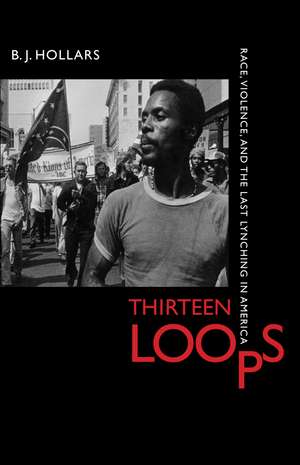
Thirteen Loops: Race, Violence, and the Last Lynching in America
Autor B. J. Hollarsen Limba Engleză Hardback – 6 sep 2011
Thirteen Loops: Race, Violence, and the Last Lynching in America recounts the story of three innocent victims, all of whom suffered violent deaths through no fault of their own: Vaudine Maddox in 1933 in Tuscaloosa, Sergeant Gene Ballard in 1979 in Birmingham, and Michael Donald in 1981 in Mobile.
The death of Vaudine Maddox—and the lynchings that followed—serves as a cautionary tale about the violence that occurred in the same region nearly fifty-years later, highlighting the cowardice, ignorance, and happenstance that sustained a culture of racial intolerance far into the future.Nearly half a century later, after a black bank robber was acquitted for the murder of police Sergeant Gene Ballard, two Klansmen took it upon themselves to exact revenge on an innocent victim--nineteen-year-old African American Michael Donald. Donald's murder--deemed the last lynching in America--reignited the race debate in America and culminated in a courtroom drama in which the United Klans of America were at long last put on trial.
While tracing the relationships among these murders, B. J. Hollars's research led him deep into the heart of Alabama’s racial, political, and legal landscapes. A work of literary journalism, Thirteen Loops draws upon rarely examined primary sources, court documents, newspaper reports, and first-hand accounts in an effort to unravel the twisted tale of a pair of interconnected murders that forever altered United States' race relations.
The death of Vaudine Maddox—and the lynchings that followed—serves as a cautionary tale about the violence that occurred in the same region nearly fifty-years later, highlighting the cowardice, ignorance, and happenstance that sustained a culture of racial intolerance far into the future.Nearly half a century later, after a black bank robber was acquitted for the murder of police Sergeant Gene Ballard, two Klansmen took it upon themselves to exact revenge on an innocent victim--nineteen-year-old African American Michael Donald. Donald's murder--deemed the last lynching in America--reignited the race debate in America and culminated in a courtroom drama in which the United Klans of America were at long last put on trial.
While tracing the relationships among these murders, B. J. Hollars's research led him deep into the heart of Alabama’s racial, political, and legal landscapes. A work of literary journalism, Thirteen Loops draws upon rarely examined primary sources, court documents, newspaper reports, and first-hand accounts in an effort to unravel the twisted tale of a pair of interconnected murders that forever altered United States' race relations.
Preț: 201.56 lei
Nou
Puncte Express: 302
Preț estimativ în valută:
35.67€ • 41.82$ • 31.32£
35.67€ • 41.82$ • 31.32£
Carte indisponibilă temporar
Doresc să fiu notificat când acest titlu va fi disponibil:
Se trimite...
Preluare comenzi: 021 569.72.76
Specificații
ISBN-13: 9780817317539
ISBN-10: 0817317538
Pagini: 264
Ilustrații: 16 illustrations
Dimensiuni: 140 x 216 x 23 mm
Greutate: 0.51 kg
Ediția:First Edition, First Edition
Editura: University Of Alabama Press
Colecția University Alabama Press
ISBN-10: 0817317538
Pagini: 264
Ilustrații: 16 illustrations
Dimensiuni: 140 x 216 x 23 mm
Greutate: 0.51 kg
Ediția:First Edition, First Edition
Editura: University Of Alabama Press
Colecția University Alabama Press
Notă biografică
B.J. Hollars is the editor of You Must Be This Tall To Ride: Contemporary Writers Take You Inside The Story. He received his M.F.A in Creative Writing from The University of Alabama and has published in North American Review, Ninth Letter, and The Southeast Review, among others. He is an assistant professor of creative writing at the University of Wisconsin-Eau Claire.
Recenzii
"Through newspaper accounts and copious interviews, Hollars has wrought a highly stylized . . . account of the murder [of Michael Donald] and its aftermath, with discussions of two other homicides. . . . However, the substantive central narrative justifies the effort of following these twists and turns. Hollars compares Donald's legacy to those of Emmett Till, Rosa Parks, James Meredith, and Martin Luther King Jr. Though this might be a stretch, Donald's life and death are certainly worth remembering."
--Publishers Weekly
"Thirteen Loops offers a compelling narrative, an interesting analysis of three not necessarily related events. It is readable and imaginatively put together, and well worth the attention of anyone interested in the history of lynching in the U.S. South."
—The Journal of African American History
--Publishers Weekly
"Thirteen Loops offers a compelling narrative, an interesting analysis of three not necessarily related events. It is readable and imaginatively put together, and well worth the attention of anyone interested in the history of lynching in the U.S. South."
—The Journal of African American History
“Hollars puts a creative spin on his analysis of three lynching cases in the American South . . . With meticulous detailing, the author describes the three cases, individually and, in concluding updates, how they coalesce. . . . Hollars’ text is scholarly and comprehensive but delivered in a fresh, far-from-dry journalistic style. . . . The author is also quite astute at drawing meaningful comparisons. He discusses Donald’s lynching in 1981 alongside the murder of gay man Matthew Shepard in 1998, each established as a 'hate crime' and further solidifying the terminology in police work and legislation alike. A creatively written, edifying work of historical significance and a boon for those interested in Southern race relations.”—Kirkus Reviews
"Thirteen Loops [is] a cogent and valuable history, documented extensively in a lengthy bibliography; it is an important academic document. It is more than that, though. It is written in story form, conversationally, as though recounted by a friend, and this form makes it a very personal experience to read. It makes Thirteen Loops one of those rare books that is impossible to put down, that is transformative, that will remain forever in memory."--Haydens Ferry Review
Descriere
A vivid and troubling portrait of violence, lynching, and race relations over a fifty-year period in the state of Alabama.