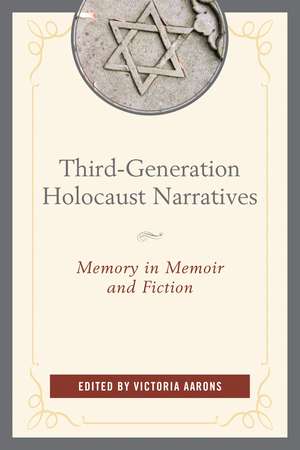
Third-Generation Holocaust Narratives: Memory in Memoir and Fiction: Lexington Books
Editat de Victoria Aarons Contribuţii de Alan Astro, Alan Berger, Malena Chinski, Erika Dreifus, Jessica Lang, Paule Lévy, Avinoam Patt, Henri Raczymow, Gary Weissmanen Limba Engleză Paperback – 23 mar 2018
Din seria Lexington Books
- 32%
 Preț: 729.63 lei
 - 59%
 Preț: 427.24 lei
 - 35%
 Preț: 574.44 lei
 - 22%
 Preț: 341.76 lei
 - 31%
 Preț: 437.25 lei
 - 28%
 Preț: 352.50 lei
 - 23%
 Preț: 321.53 lei
 - 23%
 Preț: 333.36 lei
 - 23%
 Preț: 327.54 lei
 - 35%
 Preț: 593.04 lei
 - 33%
 Preț: 358.06 lei
 - 26%
 Preț: 363.28 lei
 - 24%
 Preț: 374.46 lei
 - 22%
 Preț: 330.56 lei
 - 28%
 Preț: 346.74 lei
 - 24%
 Preț: 308.07 lei
 - 23%
 Preț: 321.63 lei
 - 27%
 Preț: 263.04 lei
 - 24%
 Preț: 369.89 lei
 - 25%
 Preț: 884.44 lei
 - 36%
 Preț: 730.77 lei
 - 29%
 Preț: 345.71 lei
 - 33%
 Preț: 556.03 lei
 - 33%
 Preț: 428.79 lei
 - 34%
 Preț: 616.07 lei
 - 29%
 Preț: 342.12 lei
 - 26%
 Preț: 362.85 lei
 - 22%
 Preț: 338.89 lei
 - 28%
 Preț: 356.18 lei
 - 23%
 Preț: 321.63 lei
 - 28%
 Preț: 346.74 lei
 - 22%
 Preț: 340.40 lei
 - 29%
 Preț: 345.71 lei
 - 22%
 Preț: 329.89 lei
 - 37%
 Preț: 660.07 lei
 - 27%
 Preț: 355.41 lei
 - 32%
 Preț: 727.58 lei
 - 24%
 Preț: 313.51 lei
 - 28%
 Preț: 614.62 lei
 - 24%
 Preț: 309.62 lei
 - 34%
 Preț: 630.22 lei
 - 34%
 Preț: 575.26 lei
 - 34%
 Preț: 607.70 lei
 - 33%
 Preț: 639.19 lei
 - 33%
 Preț: 642.37 lei
 - 33%
 Preț: 640.95 lei
 - 25%
 Preț: 369.74 lei
Preț: 341.33 lei
Preț vechi: 434.21 lei
-21%
Puncte Express: 512
Carte tipărită la comandă
Livrare economică 08-22 decembrie
Livrare prin curier în România Termenul estimat este afișat lângă disponibilitate.
Transport gratuit de la 400.00 lei Plată online sau ramburs, în funcție de opțiunile comenzii.
Retur gratuit în 14 zile Comandă securizată și suport în română.
Specificații
ISBN-13: 9781498517188
ISBN-10: 1498517188
Pagini: 234
Ilustrații: 7 b/w photos;
Dimensiuni: 152 x 231 x 19 mm
Greutate: 0.39 kg
Editura: Bloomsbury Publishing
Colecția Lexington Books
Seria Lexington Books
Locul publicării:New York, United States
ISBN-10: 1498517188
Pagini: 234
Ilustrații: 7 b/w photos;
Dimensiuni: 152 x 231 x 19 mm
Greutate: 0.39 kg
Editura: Bloomsbury Publishing
Colecția Lexington Books
Seria Lexington Books
Locul publicării:New York, United States
Cuprins
1. A Special Kind of Kinship: On Being a '3G' Writer, Erika Dreifus
2. Memory's Afterimage: Post-Holocaust Writing and the Third Generation, Victoria Aarons
3. A Visible Bridge: Contemporary Jewish Fiction and the Return to the Shoah, Avinoam Patt
4. Story-telling, Photography, and Mourning in Daniel Mendelsohn's The Lost, Paule Lévy
5. Life After Death: A Third Generation Journey in Jérémie Dres' We Won't See Auschwitz, Alan Berger
6. The "generation without grandparents": Witnesses and Companions to an Unfinished Search, Malena Chinski
7. Avatars of Third-Generation Holocaust Narrative in French and Spanish, Alan Astro
8. Measure for Measure: Narrative and Numbers in Holocaust Textual Memorials, Jessica Lang
9. Against Generational Thinking in Holocaust Studies, Gary Weissman
10. Simon and Mania, Henri Raczymow, translated by Alan Astro
Preface: Henri Raczymow, Writer of the Second-and-a-Half Generation in France, Alan Astro
2. Memory's Afterimage: Post-Holocaust Writing and the Third Generation, Victoria Aarons
3. A Visible Bridge: Contemporary Jewish Fiction and the Return to the Shoah, Avinoam Patt
4. Story-telling, Photography, and Mourning in Daniel Mendelsohn's The Lost, Paule Lévy
5. Life After Death: A Third Generation Journey in Jérémie Dres' We Won't See Auschwitz, Alan Berger
6. The "generation without grandparents": Witnesses and Companions to an Unfinished Search, Malena Chinski
7. Avatars of Third-Generation Holocaust Narrative in French and Spanish, Alan Astro
8. Measure for Measure: Narrative and Numbers in Holocaust Textual Memorials, Jessica Lang
9. Against Generational Thinking in Holocaust Studies, Gary Weissman
10. Simon and Mania, Henri Raczymow, translated by Alan Astro
Preface: Henri Raczymow, Writer of the Second-and-a-Half Generation in France, Alan Astro
Recenzii
This collection considers works written by grandchildren, great nieces and nephews, and other relatives about family members who lived during the Hitler years. The term third generation raises some issues. In speaking about the literature of the Holocaust, "the literature of the first generation" meant the testimony of those who lived through the horrors of the Third Reich, those who either survived the death camps (Primo Levi, Ellie Wiesel, Imre Kertesz, et al.) or lived in hiding in the ghettos or as partisan fighters. It did not include those who lived safely through the Nazi years in protected areas or foreign countries. When critics and scholars begin to use terms such as 3G literature and introduce expressions such as 1.5G, 2G, 2.5G, and 3G, one senses that 3.5G and 4G loom in the future; lost is the emphasis on the quality of the story, novel, memoir, biography, film, or research being produced. Generational criticism privileges familial relationships. At its worse, it exploits the experiences of others. Important in this regard is critique of how writers far removed from the Holocaust preserve memory and provide witness to a past they never experienced. The best of these essays do that well, and this book is valuable for doing that service. Summing Up: Recommended. Graduate students, researchers, faculty.
A valuable, searching collection of Third Generation views of the Holocaust, views still proximate to that event and yet increasingly distanced from it. The accounts selectively presented here are both reflective and provide intimate detail, and Aarons' skill in editing brings out with great clarity the effect of time's passage on memory, art, and trauma in the aftermath of the Holocaust.
Victoria Aarons once again firmly establishes that the post-Holocaust universe is her domain. With great sensitivity, editorial skill and insight, she has unearthed the generational consequences of a crime that was beyond description, and yet so many writers were compelled to do that very thing.
In this important and visionary new book on third-generation Holocaust narratives, Victoria Aarons assembles a sturdy architectonic of memory's afterimage. Through a "visible bridge"-the continued outpouring of exceptionally well-written and international memoirs and fiction on the Holocaust-the essays affirm that memory is a structure that leaves third-generation survivors, and those coming later, with no alibi against witnessing. In her remarkably lucid introduction, Aarons reminds us that while some of us witness, all of us are companions on a (still) unfinished search.
A valuable, searching collection of Third Generation views of the Holocaust, views still proximate to that event and yet increasingly distanced from it. The accounts selectively presented here are both reflective and provide intimate detail, and Aarons' skill in editing brings out with great clarity the effect of time's passage on memory, art, and trauma in the aftermath of the Holocaust.
Victoria Aarons once again firmly establishes that the post-Holocaust universe is her domain. With great sensitivity, editorial skill and insight, she has unearthed the generational consequences of a crime that was beyond description, and yet so many writers were compelled to do that very thing.
In this important and visionary new book on third-generation Holocaust narratives, Victoria Aarons assembles a sturdy architectonic of memory's afterimage. Through a "visible bridge"-the continued outpouring of exceptionally well-written and international memoirs and fiction on the Holocaust-the essays affirm that memory is a structure that leaves third-generation survivors, and those coming later, with no alibi against witnessing. In her remarkably lucid introduction, Aarons reminds us that while some of us witness, all of us are companions on a (still) unfinished search.