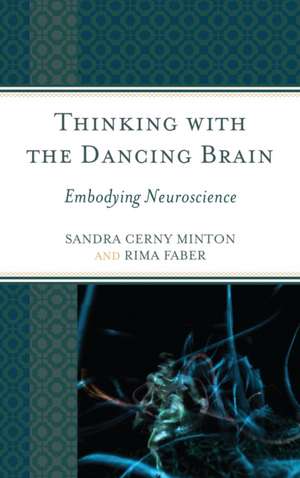
Thinking with the Dancing Brain: Embodying Neuroscience
Autor Sandra C. Minton, Rima Faberen Limba Engleză Paperback – 21 sep 2016
Chapters address observation, engagement, critical thought, emotion, memory, imagery and imagination, learning, problem solving, and 21st century skills. Finer components are explored through neurological networks, classroom pedagogy, dance, and movement experiences that provide:
Description of the thought processes, their components, and their neurological functional needs.The neurological physiology that has been discovered in the cognitive process.How brain function can be applied to the educational classroom.Applications of the neurological research to dance education, the choreographic process, and dance performance.Movement explorations for readers to experience the thought processes through dance with neurological knowledge in mind.
Preț: 255.41 lei
Preț vechi: 334.15 lei
-24%
Puncte Express: 383
Carte tipărită la comandă
Livrare economică 09-23 decembrie
Livrare prin curier în România Termenul estimat este afișat lângă disponibilitate.
Transport gratuit de la 400.00 lei Plată online sau ramburs, în funcție de opțiunile comenzii.
Retur gratuit în 14 zile Comandă securizată și suport în română.
Specificații
ISBN-13: 9781475812510
ISBN-10: 1475812515
Pagini: 200
Dimensiuni: 148 x 228 x 16 mm
Greutate: 0.3 kg
Editura: Bloomsbury Publishing
Colecția Rowman & Littlefield
Locul publicării:New York, United States
ISBN-10: 1475812515
Pagini: 200
Dimensiuni: 148 x 228 x 16 mm
Greutate: 0.3 kg
Editura: Bloomsbury Publishing
Colecția Rowman & Littlefield
Locul publicării:New York, United States
V-ar putea interesa
-
 Doorway to EcstasySherry BrierPreț: 115.53 lei
 -
 Performing Arts and Therapeutic ImplicationsTanvi Bajaj-15%Preț: 462.55 lei544.18 lei
 -
 Preț: 494.95 lei
 -
 Le vieux de la montagne, ou Les arabes du Liban, mélodrame en trois actes, en proseJean-Guillaume-Antoine CuvelierPreț: 89.99 lei
 -
 Preț: 75.14 lei
 -
 L'Enfant Prodigue, Ballet-Pantomime En Trois ActesPierre Gabriel GardelPreț: 89.42 lei
 -
 Preț: 105.22 lei
 -
 L'Épée de Jeanne d'Arc, Ou Les Cinq Demoiselles, À-Propos Burlesque Et Grivois, En Un ActeAlexandre-Marie MaréchallePreț: 79.76 lei
 -
 Preț: 104.83 lei
 -
 Preț: 214.86 lei
 -
 Les 12188 kilomètres de Tête de linotteSans AuteurPreț: 104.83 lei
 -
 Les Absences de Monsieur, Comédie-Vaudeville En 1 ActeNarcisse FournierPreț: 82.68 lei
 -
 Preț: 135.52 lei
 -
 Les Acteurs À l'Épreuve, Vaudeville Épisodique En 1 ActeCharles-Augustin SewrinPreț: 81.67 lei
 -
 Les Acteurs À l'Essai, Comédie-Vaudeville Épisodique En 1 ActeCharles DupeutyPreț: 82.11 lei
 -
 Preț: 96.90 lei
 -
 Les Affaires Étrangères: Pièce En Un ActeJules LévyPreț: 82.51 lei
 -
 Preț: 89.20 lei
 -
 Les ailes de l'amour, comédie en un acte, en vers et en vaudevilles, mêlée d'airs nouveauxLouis-Abel Beffroy De ReignyPreț: 104.65 lei
 -
 Preț: 89.59 lei
 -
 Les Amants désespérés ou la Comtesse d'Olinval. Tragedie bourgeoise en cinq actesJean-François-Dieudonne MaucomblePreț: 104.43 lei
 -
 Un Peintre Bernayen: Michel Hubert-Descours, 1707-1775Adolphe-Andre PoréePreț: 81.88 lei
 -
 Preț: 82.51 lei
 -
 Preț: 89.20 lei
Cuprins
Foreword: Robert G. Shulman
Preface
Acknowledgments
1. Groundwork for Thinking in Dance
2. Observation
3. Engagement
4. High Level Thinking Skills
5. Emotion
6. Memory
7. Imagination and Imagery
8. Learning
9. Problem Solving
10. 21st Century Skills
Glossary
Index
Preface
Acknowledgments
1. Groundwork for Thinking in Dance
2. Observation
3. Engagement
4. High Level Thinking Skills
5. Emotion
6. Memory
7. Imagination and Imagery
8. Learning
9. Problem Solving
10. 21st Century Skills
Glossary
Index
Recenzii
Thinking with the Dancing Brain is a must read book for educators, artists, and scientists. This gem is revolutionary in its structure. Current brain research and valuable educational theories are interspersed in every chapter with simple movement explorations that make the research understandable and the theories memorable. The book proves once and for all that the body and brain work as one unit and that thought cannot take place without movement.
Thinking with the Dancing Brain should be part of every dance educator's library, especially if they want to move forward in the 21st century with keener content and pedagogical skills. The authors have done an excellent job exploring the interdependence of brain function and critical thinking, how the interplay impacts learning and teaching dance, and its embodiment in movement. Each chapter ends with an application section in which students experience the effect. Remarkably, the book unifies the Cartesian duality between body and mind, physicality and thought.
Thinking with the Dancing Brain is a wonderfully written text that genuinely brings the nature of brain and body together in dance and learning. Soundly grounded in neuroscience, the book carefully walks the reader through the research on the brain and its contributions to the beauty of dance and how dance improves brain functioning and learning. The embedded exercises help the reader reach a new awareness of the intricate interaction between the brain and body that helps make dance such an emotional and rewarding form of communication and how dance can improve learning and memory.
The movement explorations are a functional and practical way to bring the didactic portion of the book to life. They benefit the kinesthetic learner, thus incorporating every learning style. As someone who specializes in movement, and teaching it to a wide patient population, these explorations were extremely useful.
Thinking with the Dancing Brain brings decades of experience together to teach us about the science of movement, brain integration and the opportunity to more completely understand the applications of movement in education. The work invites dance educators, artists, therapists and others to the practice of observation and awareness. As our students' needs are increasing and becoming more complex, we need more tools to access all learners. Minton and Faber continue to feed our community with insight and wisdom and to promote conversation and inquiry into how dance and movement help us to understand human interaction, expression, communication and function.
Thinking with the Dancing Brain should be part of every dance educator's library, especially if they want to move forward in the 21st century with keener content and pedagogical skills. The authors have done an excellent job exploring the interdependence of brain function and critical thinking, how the interplay impacts learning and teaching dance, and its embodiment in movement. Each chapter ends with an application section in which students experience the effect. Remarkably, the book unifies the Cartesian duality between body and mind, physicality and thought.
Thinking with the Dancing Brain is a wonderfully written text that genuinely brings the nature of brain and body together in dance and learning. Soundly grounded in neuroscience, the book carefully walks the reader through the research on the brain and its contributions to the beauty of dance and how dance improves brain functioning and learning. The embedded exercises help the reader reach a new awareness of the intricate interaction between the brain and body that helps make dance such an emotional and rewarding form of communication and how dance can improve learning and memory.
The movement explorations are a functional and practical way to bring the didactic portion of the book to life. They benefit the kinesthetic learner, thus incorporating every learning style. As someone who specializes in movement, and teaching it to a wide patient population, these explorations were extremely useful.
Thinking with the Dancing Brain brings decades of experience together to teach us about the science of movement, brain integration and the opportunity to more completely understand the applications of movement in education. The work invites dance educators, artists, therapists and others to the practice of observation and awareness. As our students' needs are increasing and becoming more complex, we need more tools to access all learners. Minton and Faber continue to feed our community with insight and wisdom and to promote conversation and inquiry into how dance and movement help us to understand human interaction, expression, communication and function.