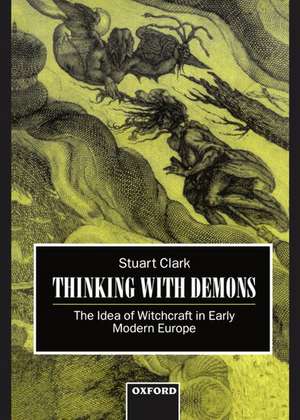
Thinking with Demons: The Idea of Witchcraft in Early Modern Europe
Autor Stuart Clarken Limba Engleză Hardback – 30 ian 1997
Preț: 788.16 lei
Preț vechi: 1157.44 lei
-32%
Puncte Express: 1182
Carte tipărită la comandă
Livrare economică 04-09 decembrie
Livrare prin curier în România Termenul estimat este afișat lângă disponibilitate.
Transport gratuit pentru acest produs Plată online sau ramburs, în funcție de opțiunile comenzii.
Retur gratuit în 14 zile Comandă securizată și suport în română.
Specificații
ISBN-13: 9780198200017
ISBN-10: 0198200013
Pagini: 844
Ilustrații: 2 halftones
Dimensiuni: 162 x 243 x 48 mm
Greutate: 1.32 kg
Editura: OUP OXFORD
Colecția OUP Oxford
Locul publicării:Oxford, United Kingdom
ISBN-10: 0198200013
Pagini: 844
Ilustrații: 2 halftones
Dimensiuni: 162 x 243 x 48 mm
Greutate: 1.32 kg
Editura: OUP OXFORD
Colecția OUP Oxford
Locul publicării:Oxford, United Kingdom
V-ar putea interesa
-
 Early Modern European Witchcraft: Centres and PeripheriesBengt Ankarloo-29%Preț: 555.85 lei787.72 lei
 -
 Witchcraft: A Very Short IntroductionMalcolm GaskillPreț: 57.46 lei
 -
 -22%Preț: 392.36 lei502.59 lei
 -
 Healing Dramas: Divination and Magic in Modern Puerto RicoRaquel RombergPreț: 232.09 lei
 -
 Europe's Inner DemonsNorman Cohn-18%Preț: 88.22 lei108.19 lei
 -
 Witches and WitchcraftProfessor David Nash-39%Preț: 41.79 lei68.73 lei
 -
 WitchLisa ListerPreț: 78.31 lei
 -
 Clark, S: The Unknown UniverseStuart Clark-29%Preț: 82.15 lei115.14 lei
 -
 Preț: 71.04 lei
Recenzii
This massive and rich book is brimming with suggestions for future researchers. Clark's bibliography is itself a contribution to witchcraft scholarship. Thinking with Demons will become a classic.
This is intellectual history at its best. Clark reads and understands the demonological writings between the late fifteenth and early eighteenth centuries on their own terms
Clarke is showing something of a break with the historiographical trends which have prevailed in witchcraft studies over the last twenty years.
This is a subtle exposition, informed but not distorted by an awareness of linguistic theory. J.A. Sharpe, Renaissance Studies Vol.14, No.3.
a formidable intellectual achievement ... it is doubtful if any current witchcraft scholar could equal the breadth of Clark's acquaintance with both works of demonology and more recent publications. He displays deep erudition with a light touch: the book, for all its length and the profundity of its scholarship, is a pleasure to read.
rich and exciting exposition of a belief system.
Anybody who still believes that witchcraft was a marginal or unimportant aspect of European history should spend a weekend reading this book. They will emerge from the exercise with a clearer notion of what first rate intellectual history is like.
deeply considered and weighty arguments based on dauntingly wide reading.
this is an ambitious and thematically broad book which constitutes a formidable intellectual achivement.
Thinking with Demons, which offers a lot more than the basics, will intimidate many undergraduates, but will provide them with conclusive proof that witchcraft was not just a matter of village squabbles. It will also remind their teachers of the sheer complexity and pervasiveness of demonological thought.
This book offers a distillation of ... research, within a cogently constructed and copiously documented overall argument ... This is a book for the specialist ... Mastering such a vast body of material as early modern demonology is a huge enterprise, and Dr Clark has performed a most valuable service by his heroic struggle to make its structures and thought-patterns comprehensible.
a tour de force
It is a major accumulation of information about western European writings on witchcraft ... It will be a text consulted and cited by many subsequent scholars on witchcraft.
' ... an important book ... in every sense a magisterial work of a historian of consummate skill. Carefully researched and documented, supported by a mountainous bibliography, this is a book that should be carefully read, and re-read, by every historian of the early modern period.'
This is a massive work. It covers far more ground than its title indicates...It is good, in these days of soundbites, "dumbing-down" and widespread intellectual sloth, to come upon such a monument of scholarship. The time, determination and care that must have gone into creating it are most impressive--and so is the result. The hopes and fears, doubts and certainties of the early modern intelligentsia come powerfully alive. Anyone who wishes to enter imaginatively into that mental world might well start by reading this remarkable book.
of all the books on the subject which have recently appeared, this is perhaps the most remarkable, raising our understanding of ideas about witchcraft to a new level of sophistication. It is based on massive research in teh learned literature of demonology in the period.../ ... Clark's erudition is combined with intense methodological sophistication.../ ... there is no doubt that IThinking With DemonsI will force us to reconsider the place of witchcraft in early modern ideas, and thus to think more deeply about the nature of those ideas in themselves./ Michael Hunter, Birkbeck College, London, Eighteenth Century Life, vol 22, no 2, May 1998.
Important and provocative. A magisterial survey of European demonological thought from the fifteenth to the eighteenth centuries. Clark's mastery of the sources, his effective use of linguistic theory, and the originality of his interpretations make the reading of this massive, complex, and skilfully constructed book an immensely rewarding experience, one that easily repays the time and effort that one must invest in it. The most comprehensive and thorough study of early modern witchcraft beliefs in any language.
This is intellectual history at its best. Clark reads and understands the demonological writings between the late fifteenth and early eighteenth centuries on their own terms
Clarke is showing something of a break with the historiographical trends which have prevailed in witchcraft studies over the last twenty years.
This is a subtle exposition, informed but not distorted by an awareness of linguistic theory. J.A. Sharpe, Renaissance Studies Vol.14, No.3.
a formidable intellectual achievement ... it is doubtful if any current witchcraft scholar could equal the breadth of Clark's acquaintance with both works of demonology and more recent publications. He displays deep erudition with a light touch: the book, for all its length and the profundity of its scholarship, is a pleasure to read.
rich and exciting exposition of a belief system.
Anybody who still believes that witchcraft was a marginal or unimportant aspect of European history should spend a weekend reading this book. They will emerge from the exercise with a clearer notion of what first rate intellectual history is like.
deeply considered and weighty arguments based on dauntingly wide reading.
this is an ambitious and thematically broad book which constitutes a formidable intellectual achivement.
Thinking with Demons, which offers a lot more than the basics, will intimidate many undergraduates, but will provide them with conclusive proof that witchcraft was not just a matter of village squabbles. It will also remind their teachers of the sheer complexity and pervasiveness of demonological thought.
This book offers a distillation of ... research, within a cogently constructed and copiously documented overall argument ... This is a book for the specialist ... Mastering such a vast body of material as early modern demonology is a huge enterprise, and Dr Clark has performed a most valuable service by his heroic struggle to make its structures and thought-patterns comprehensible.
a tour de force
It is a major accumulation of information about western European writings on witchcraft ... It will be a text consulted and cited by many subsequent scholars on witchcraft.
' ... an important book ... in every sense a magisterial work of a historian of consummate skill. Carefully researched and documented, supported by a mountainous bibliography, this is a book that should be carefully read, and re-read, by every historian of the early modern period.'
This is a massive work. It covers far more ground than its title indicates...It is good, in these days of soundbites, "dumbing-down" and widespread intellectual sloth, to come upon such a monument of scholarship. The time, determination and care that must have gone into creating it are most impressive--and so is the result. The hopes and fears, doubts and certainties of the early modern intelligentsia come powerfully alive. Anyone who wishes to enter imaginatively into that mental world might well start by reading this remarkable book.
of all the books on the subject which have recently appeared, this is perhaps the most remarkable, raising our understanding of ideas about witchcraft to a new level of sophistication. It is based on massive research in teh learned literature of demonology in the period.../ ... Clark's erudition is combined with intense methodological sophistication.../ ... there is no doubt that IThinking With DemonsI will force us to reconsider the place of witchcraft in early modern ideas, and thus to think more deeply about the nature of those ideas in themselves./ Michael Hunter, Birkbeck College, London, Eighteenth Century Life, vol 22, no 2, May 1998.
Important and provocative. A magisterial survey of European demonological thought from the fifteenth to the eighteenth centuries. Clark's mastery of the sources, his effective use of linguistic theory, and the originality of his interpretations make the reading of this massive, complex, and skilfully constructed book an immensely rewarding experience, one that easily repays the time and effort that one must invest in it. The most comprehensive and thorough study of early modern witchcraft beliefs in any language.