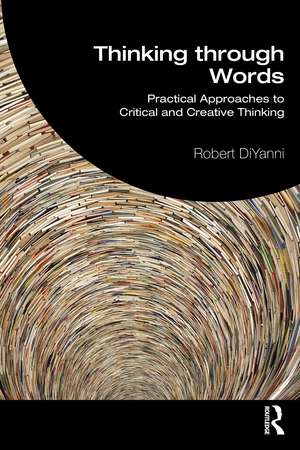
Thinking through Words: Practical Approaches to Critical and Creative Thinking
Autor Robert DiYannien Limba Engleză Paperback – 21 apr 2026
This compelling guide is an indispensable companion to Reading Literature and Writing that Matters. Part I offers a clear and concise overview of essential aspects of critical thinking and understanding, including what knowledge is, how we acquire it, and how we can use it productively. Part II explores argument and persuasion, including essential elements of argumentation and how to construct effective arguments. Part III introduces types of logical fallacies, along with cognitive biases and various blocks to thinking—and how to overcome them. Part IV describes practical thinking tools and techniques to develop readers’ creative thinking skills. It also features a host of exercises and questions throughout.
The result is a more confident, capable thinker equipped to meet challenges with clarity and innovation. Whether you're navigating complex decisions, solving persistent problems, or analyzing texts, this book is the essential guide to honing your critical thinking skills.
Preț: 249.11 lei
Puncte Express: 374
Carte disponibilă
Livrare economică 26 octombrie-09 noiembrie
Livrare express 10-16 octombrie pentru 28.45 lei
Livrare prin curier în România Termenul estimat este afișat lângă disponibilitate.
Transport gratuit de la 400.00 lei Plată online sau ramburs, în funcție de opțiunile comenzii.
Retur gratuit în 14 zile Comandă securizată și suport în română.
Specificații
ISBN-13: 9781041172239
ISBN-10: 1041172230
Pagini: 230
Dimensiuni: 156 x 234 mm
Greutate: 0.33 kg
Ediția:1
Editura: Taylor & Francis
Colecția Routledge
Locul publicării:Oxford, United Kingdom
ISBN-10: 1041172230
Pagini: 230
Dimensiuni: 156 x 234 mm
Greutate: 0.33 kg
Ediția:1
Editura: Taylor & Francis
Colecția Routledge
Locul publicării:Oxford, United Kingdom
Public țintă
Undergraduate Advanced and Undergraduate CoreNotă biografică
Robert DiYanni is Professor of Humanities at New York University, USA, where he serves on the faculties of the School of Professional Studies and the Stern School of Business, following a decade in the College of Arts and Science. His publications include The Pearson Guide to Critical and Creative Thinking (2014), Critical and Creative Thinking: A Brief Guide for Teachers (2015), and Critical Reading Across the Curriculum (with Anton Borst; 2017).
Cuprins
Preface
Acknowledgments
Part I: Critical Thinking and Understanding
1. Why We Need Critical Thinking
2. How We Acquire Knowledge
3. Decisive Thinking: Making Good Decisions
Part II: Argument and Persuasion
4. Argument Basics: Claims and Evidence / Assumptions and Implications
5. Key Aspects of Argument: Causality and Correlation / Authority and Analogy
6. Rhetoric: Its Dangers and Its Uses
Part III: Obstacles to Productive Thinking
7. Inductive Thinking Fallacies
8. Cognitive Biases and Thinking Blocks
Part IV: Pathways to Creative Thinking
9. Some Lateral Thinking Tools
10. Creative Thinking Strategies and Techniques
Part V: Thinking with Some Master Thinkers
11. Jean-Paul Sartre and Simone de Beauvoir
12. Mahatma Gandhi and Rabindranath Tagore
13. Susanne K. Langer and Jerome S. Bruner
14. Richard Feynman and Daniel Kahneman
Appendix A: Varieties of Future Thinking
Appendix B: Thinking About Artificial Intelligence
References
Index
Acknowledgments
Part I: Critical Thinking and Understanding
1. Why We Need Critical Thinking
2. How We Acquire Knowledge
3. Decisive Thinking: Making Good Decisions
Part II: Argument and Persuasion
4. Argument Basics: Claims and Evidence / Assumptions and Implications
5. Key Aspects of Argument: Causality and Correlation / Authority and Analogy
6. Rhetoric: Its Dangers and Its Uses
Part III: Obstacles to Productive Thinking
7. Inductive Thinking Fallacies
8. Cognitive Biases and Thinking Blocks
Part IV: Pathways to Creative Thinking
9. Some Lateral Thinking Tools
10. Creative Thinking Strategies and Techniques
Part V: Thinking with Some Master Thinkers
11. Jean-Paul Sartre and Simone de Beauvoir
12. Mahatma Gandhi and Rabindranath Tagore
13. Susanne K. Langer and Jerome S. Bruner
14. Richard Feynman and Daniel Kahneman
Appendix A: Varieties of Future Thinking
Appendix B: Thinking About Artificial Intelligence
References
Index
Descriere
This book reveals the essential elements of critical and creative thinking that drive achievement in academic, professional, and personal spheres. Moving seamlessly from the foundations of critical understanding to the art of persuasion, Robert DiYanni expertly guides readers past common obstacles toward a more complete intellectual toolkit.