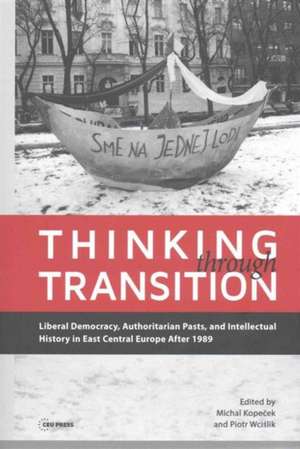
Thinking Through Transition
Editat de Michal Kopecek, Piotr Wcisliken Limba Engleză Hardback – oct 2015
Preț: 990.49 lei
Preț vechi: 1088.44 lei
-9% Nou
Puncte Express: 1486
Preț estimativ în valută:
175.27€ • 205.53$ • 153.92£
175.27€ • 205.53$ • 153.92£
Carte disponibilă
Livrare economică 24 ianuarie-07 februarie
Preluare comenzi: 021 569.72.76
Specificații
ISBN-13: 9789633860854
ISBN-10: 9633860857
Pagini: 608
Dimensiuni: 157 x 235 x 37 mm
Greutate: 1.02 kg
Editura: Amsterdam University Press
ISBN-10: 9633860857
Pagini: 608
Dimensiuni: 157 x 235 x 37 mm
Greutate: 1.02 kg
Editura: Amsterdam University Press
V-ar putea interesa
-
 The Sewing Circles of HeratChristina LambPreț: 110.62 lei
 -
 Forgotten Voices Of The Second World WarMax Arthur-29%Preț: 83.37 lei117.01 lei
 -
 -19%Preț: 61.72 lei76.45 lei
 -
 Preț: 107.48 lei
 -
 Another Day of LifeRyszard Kapuscinski-29%Preț: 52.96 lei74.19 lei
 -
 The FixerJoe Sacco-20%Preț: 94.42 lei117.58 lei
 -
 After Heaven – Spirituality in America Since the 1950sRobert WuthnowPreț: 244.07 lei
 -
 Preț: 271.08 lei
 -
 The American Era: Power and Strategy for the 21st CenturyRobert J. LieberPreț: 216.05 lei
 -
 Satchmo Blows Up the World – Jazz Ambassadors Play the Cold WarPenny M Von EschenPreț: 236.76 lei
 -
 Inside the Kremlin's Cold WarConstantine PleshakovPreț: 240.37 lei
 -
 An Ordinary Man: The True Story Behind Hotel RwandaPaul Rusesabagina-29%Preț: 71.89 lei101.42 lei
 -
 First They Killed My FatherLoung Ung-21%Preț: 65.16 lei82.10 lei
 -
 Conspiracy to MurderLinda MelvernPreț: 200.65 lei
 -
 Hot Books in the Cold WarAlfred A Reisch-9%Preț: 990.41 lei1088.36 lei
Descriere
"It is not easy for historians to apply their methods to a period that does not yet have a clear end" is the first sentence in this book, revealing the challenge that a new generation of scholars took at writing an intellectual history of post-communist East Central Europe.