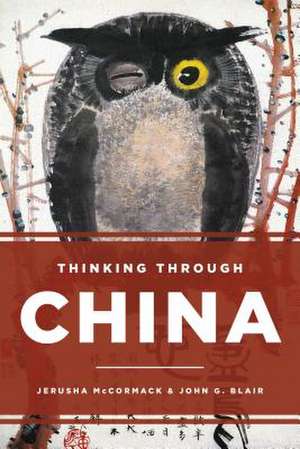
Thinking through China
Autor Jerusha McCormack, John G. Blairen Limba Engleză Paperback – aug 2015
This intensive bridging work allows those without deep knowledge of China to understand the very different perspectives to be gained by looking at the world through Chinese eyes. As each of the ten words maps out new territory, the premises of a very dissimilar - but equally coherent - world view gradually emerge. Creating a cultural cartography through both text and image, the authors provide readers with a vivid sense of what is uniquely Chinese about China.
Preț: 274.13 lei
Preț vechi: 356.25 lei
-23%
Puncte Express: 411
Carte tipărită la comandă
Livrare economică 02-16 decembrie
Livrare prin curier în România Termenul estimat este afișat lângă disponibilitate.
Transport gratuit de la 400.00 lei Plată online sau ramburs, în funcție de opțiunile comenzii.
Retur gratuit în 14 zile Comandă securizată și suport în română.
Specificații
ISBN-13: 9781442247925
ISBN-10: 1442247924
Pagini: 328
Ilustrații: 15 b/w illustrations; 27 b/w photos; 1 map; 6 textboxes
Dimensiuni: 150 x 226 x 22 mm
Greutate: 0.5 kg
Editura: Bloomsbury Publishing
Colecția Rowman & Littlefield
Locul publicării:New York, United States
ISBN-10: 1442247924
Pagini: 328
Ilustrații: 15 b/w illustrations; 27 b/w photos; 1 map; 6 textboxes
Dimensiuni: 150 x 226 x 22 mm
Greutate: 0.5 kg
Editura: Bloomsbury Publishing
Colecția Rowman & Littlefield
Locul publicării:New York, United States
V-ar putea interesa
-
 The Search for Modern China 3eJonathan D. Spence-15%Preț: 448.73 lei527.92 lei
 -
 Zen at WarBrian Daizen Victoria-20%Preț: 317.38 lei397.48 lei
 -
 Preț: 246.84 lei
 -
 To Build an Afghan NationVictor H Wells-27%Preț: 1605.40 lei2187.00 lei
 -
 Writing Revolution: The Voices from Tunis to DamascusMatthew Cassel-20%Preț: 139.58 lei175.40 lei
 -
 -31%Preț: 84.43 lei123.07 lei
 -
 A Short History of ChinaGordon Kerr-21%Preț: 71.24 lei90.08 lei
 -
 China or JapanClaude Meyer-22%Preț: 193.61 lei248.36 lei
 -
 Beggar's ChickenUlrich BaerPreț: 117.52 lei
Cuprins
Introduction: Entering a Chinese World
To the Reader
Part I: What Makes China Chinese? Ten Key Words
Chapter 1: Binding Families: Xiào?
Chapter 2: Selves Located Through Others: Miànzi??
Chapter 3: The People Network: Guanxi ??
Chapter 4: Where's My Mind? Xin?
Chapter 5: The Energy Unifying the World: Qi?
Chapter 6: Chameleon Reality: Yì?
Chapter 7: Realizing a Way: Dào ?
Chapter 8: Thinking in Harmony: Hé ?
Chapter 9: The Lurking Threat of Chaos: Luàn ?
Chapter 10: Strategizing Life: Cèlüè ??
Part II: Western Questions, Chinese Responses
Chapter 11: Question One: Christianity?
Chapter 12: Question Two: Human Rights?
Chapter 13: Question Three: Democracy?
Chapter 14: Question Four: China Ruling the World?
Part III: Rethinking the West
Appendix: Glossing the Ten Chinese Characters
Acknowledgments
List of Works Cited
Index
About the Authors
To the Reader
Part I: What Makes China Chinese? Ten Key Words
Chapter 1: Binding Families: Xiào?
Chapter 2: Selves Located Through Others: Miànzi??
Chapter 3: The People Network: Guanxi ??
Chapter 4: Where's My Mind? Xin?
Chapter 5: The Energy Unifying the World: Qi?
Chapter 6: Chameleon Reality: Yì?
Chapter 7: Realizing a Way: Dào ?
Chapter 8: Thinking in Harmony: Hé ?
Chapter 9: The Lurking Threat of Chaos: Luàn ?
Chapter 10: Strategizing Life: Cèlüè ??
Part II: Western Questions, Chinese Responses
Chapter 11: Question One: Christianity?
Chapter 12: Question Two: Human Rights?
Chapter 13: Question Three: Democracy?
Chapter 14: Question Four: China Ruling the World?
Part III: Rethinking the West
Appendix: Glossing the Ten Chinese Characters
Acknowledgments
List of Works Cited
Index
About the Authors
Recenzii
This book is by two senior scholars of American and English literature and civilization who have spent over a decade teaching graduate students in Beijing and have supplemented their personal experiences with extensive reading in secondary studies on contemporary China in English. In part I, the heart of their book (ten chapters), they discuss ten words offered as keys to Chinese thinking today and yesteryear, accompanied by well-chosen examples. Emphasizing continuities in time and space within China and the West and concentrating on the differences between these two traditions, the authors are more sensitive to Western than to Chinese exceptions to their thoughtful and thought-provoking generalizations. Part II consists of four chapters, on Christianity, human rights, democracy, and Chinese views on China's place in the world. In the short, concluding Part III, 'Rethinking the West,' the authors urge readers to reconsider their own thinking. In sum, this is a welcome book-very 21st century-reflecting how attitudes have changed both within and beyond China and useful for considering the present situation.
You get two fascinating books for the price of one in Thinking through China: A window for viewing many key dimensions of contemporary Chinese culture, and a mirror for viewing our own.
Thinking through China is an enjoyable and informative introduction to key thought patterns in Chinese civilization. The work is filled with illuminating examples of cultural differences that should be of particular interest to Western readers who seek to learn more about what makes China tick.
In Thinking through China, Jerusha McCormack and John Blair draw upon their decades-long sojourn in a Chinese world to invite their readers to think with them through the most enduring values and customs of an antique China-a China whose rise in our own historical moment is changing the world. This capacious tour de force takes us down a portal to the other side of the looking glass to make penetrating comparisons between profoundly different ways of thinking and living and our own thick cultural assumptions, requiring of us nothing less than to struggle with imagination to break through the limits of our own common sense. Indeed, 'we will know differently when we know more.'
As someone who works with teachers through the National Consortium for Teaching About Asia, I can say that this is a fabulous resource. McCormack and Blair have spent years refining their ideas about the essential values underlying Chinese culture. Their goal has been to instruct Western students to better understand Chinese culture and its accompanying behaviors. Equally important has been their interest in teaching Chinese students to understand Western culture and the behavior of people from Western countries....Thinking through China is much more sophisticated, accessible, and valuable than most other books dealing with this topic.
A Top 10 list of philosophers to help us make sense of the coronavirus crisis. #1: Lao Tzu. Covid-19 was first reported in China, so why not start there philosophically. Lao Tzu represents an ancient school of thought that promotes equanimity, embraces paradox and - in common with several other Asian faiths - emphasises life's cyclical nature. Read: Thinking Through China by Jerusha McCormack and John G. Blair, an accessible introduction to Chinese philosophy and culture.
You get two fascinating books for the price of one in Thinking through China: A window for viewing many key dimensions of contemporary Chinese culture, and a mirror for viewing our own.
Thinking through China is an enjoyable and informative introduction to key thought patterns in Chinese civilization. The work is filled with illuminating examples of cultural differences that should be of particular interest to Western readers who seek to learn more about what makes China tick.
In Thinking through China, Jerusha McCormack and John Blair draw upon their decades-long sojourn in a Chinese world to invite their readers to think with them through the most enduring values and customs of an antique China-a China whose rise in our own historical moment is changing the world. This capacious tour de force takes us down a portal to the other side of the looking glass to make penetrating comparisons between profoundly different ways of thinking and living and our own thick cultural assumptions, requiring of us nothing less than to struggle with imagination to break through the limits of our own common sense. Indeed, 'we will know differently when we know more.'
As someone who works with teachers through the National Consortium for Teaching About Asia, I can say that this is a fabulous resource. McCormack and Blair have spent years refining their ideas about the essential values underlying Chinese culture. Their goal has been to instruct Western students to better understand Chinese culture and its accompanying behaviors. Equally important has been their interest in teaching Chinese students to understand Western culture and the behavior of people from Western countries....Thinking through China is much more sophisticated, accessible, and valuable than most other books dealing with this topic.
A Top 10 list of philosophers to help us make sense of the coronavirus crisis. #1: Lao Tzu. Covid-19 was first reported in China, so why not start there philosophically. Lao Tzu represents an ancient school of thought that promotes equanimity, embraces paradox and - in common with several other Asian faiths - emphasises life's cyclical nature. Read: Thinking Through China by Jerusha McCormack and John G. Blair, an accessible introduction to Chinese philosophy and culture.