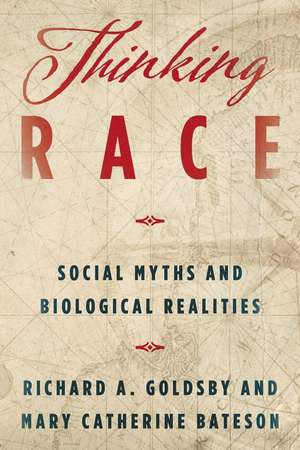
Thinking Race: Social Myths and Biological Realities
Autor Richard A. Goldsby, Mary Catherine Batesonen Limba Engleză Hardback – 9 sep 2019
Adresat studenților din științele sociale, cercetătorilor în antropologie și practicienilor din domeniul politicilor publice, Thinking Race propune o clarificare necesară a distincției dintre biologia umană și „rasă” ca invenție socială. Observăm în această lucrare o sinteză rară între rigoarea imunologiei și perspectiva nuanțată a antropologiei culturale, autorii Richard A. Goldsby și Mary Catherine Bateson unindu-și expertiza pentru a demonta miturile care stau la baza rasismului sistemic.
Textul este organizat progresiv, debutând cu analiza migrațiilor și a diversității genetice, pentru ca apoi să exploreze aplicații critice în medicină și evaluarea abilităților umane. Găsim în capitolele centrale o examinare curajoasă a unor subiecte sensibile, precum relația dintre rasă și IQ sau disparitățile din accesul la educație. Spre deosebire de How Real Is Race?, care se concentrează masiv pe deconstrucția antropologică a mitului biologic, Thinking Race adoptă o abordare mai interdisciplinară, integrând date despre sănătate și justiție penală pentru a propune soluții concrete de remodelare a societății.
Această ediție publicată de Bloomsbury Publishing sub amprenta Rowman & Littlefield se distinge prin capacitatea de a menține un ton analitic în fața unor teme de actualitate precum acțiunea afirmativă sau reparațiile pentru sclavie. Ritmul este susținut de exemple elocvente, iar structura logică ghidează cititorul de la înțelegerea diferențelor biologice reale către recunoașterea drepturilor umane egale ca fundament pentru o societate rezilientă.
Preț: 257.72 lei
Preț vechi: 335.61 lei
-23%
Carte disponibilă
Livrare economică 09-23 noiembrie
Specificații
ISBN-10: 1538105012
Pagini: 160
Dimensiuni: 154 x 232 x 18 mm
Greutate: 0.4 kg
Editura: Bloomsbury Publishing
Colecția Rowman & Littlefield
Locul publicării:New York, United States
V-ar putea interesa
-
 Composing a Further LifeMary Catherine BatesonPreț: 117.25 lei
 -
 The Tinkerer′s Accomplice – How Design Emerges From Life ItselfJ. Scott TurnerPreț: 240.71 lei
 -
 Play: An Interdisciplinary SynthesisFelicia McMahon-33%Preț: 387.29 lei579.48 lei
 -
 Composing a LifeMary Catherine BatesonPreț: 98.37 lei
 -
 Biology for NonbiologistsFrank R. Spellman-18%Preț: 334.30 lei407.87 lei
 -
 Preț: 276.85 lei
 -
 The Blood and Its Third ElementAntoine BechampPreț: 116.77 lei
 -
 The Handbook of NatureFrank R. Spellman-21%Preț: 560.57 lei708.71 lei
 -
 Structural continuity in poetryMary Catherine Bateson-23%Preț: 881.63 lei1144.98 lei
 -
 Wo Engel zögernGregory BatesonPreț: 155.91 lei
 -
 Biologie des cellules souches humainesAri MassoudiPreț: 348.93 lei
 -
 Entomologie médico-légale: recherche et expertisesDamien CHARABIDZE-19%Preț: 433.51 lei535.20 lei
 -
 Preț: 438.88 lei
 -
 Effets de la sécheresse sur le riz (Oryza sp.)Fofana Mamadou-19%Preț: 440.54 lei543.88 lei
 -
 Mécanisme d'Action de la CotinineOmar Riah-19%Preț: 428.36 lei528.84 lei
 -
 Rôle de la sulfhydryl oxidase QSOX dans le système nerveux centralGeorges Mairet-Coello-19%Preț: 489.89 lei604.79 lei
 -
 -19%Preț: 522.53 lei645.10 lei
 -
 Preț: 439.83 lei
 -
 Preț: 361.50 lei
 -
 -23%Preț: 719.30 lei934.15 lei
 -
 Modulation de la réponse immunitaire par des glycolipides parasitairesFrançoise Debierre-GrockiegoPreț: 260.16 lei
 -
 Preț: 361.66 lei
 -
 Preț: 391.46 lei
 -
 Immunité et athéroscléroseGiuseppina CaligiuriPreț: 472.21 lei
 -
 Contrôler l'infection par LeishmaniaPhilippe Holzmuller-23%Preț: 719.57 lei934.50 lei
De ce să citești această carte
Pentru studenții și specialiștii care doresc să înțeleagă mecanismele din spatele inegalităților sistemice, această carte oferă instrumentele teoretice necesare pentru a separa faptele biologice de prejudecățile sociale. Cititorul câștigă o perspectivă integrată asupra modului în care sănătatea, educația și justiția sunt afectate de percepții rasiale eronate, primind în final un set de direcții pentru politici sociale echitabile.
Despre autor
Mary Catherine Bateson a fost profesor emerit de antropologie la Universitatea George Mason, continuând moștenirea părinților săi, Margaret Mead și Gregory Bateson, cu un accent deosebit pe lingvistică. Richard A. Goldsby este profesor emerit la Amherst College și cercetător la MIT, specializat în imunologie și biologie experimentală. Colaborarea lor, începută cu lucrări despre criza SIDA, reflectă o abordare multidisciplinară unică, îmbinând științele naturii cu cele umaniste pentru a explora complexitatea identității umane și a provocărilor sociale contemporane.
Descriere
Cuprins
Acknowledgments
1 Generations of Migration
2 The Notion and Nature of Race
3 Human Diversity
4 Race and Medicine
5 Race and Ability
6 Seeking Solutions
Suggested Readings for Thinking Race
Index
Recenzii
Is race a social construction or a biological reality? In this brave and necessary book, Richard Goldsby and Mary Catherine Bateson provide a persuasive response: it is both. Using a wealth of genetic and cultural evidence, Goldsby and Bateson shed light on a question too often dominated by heat, and they explore the implications of their answer for medicine, social policy, and politics.
This scholarly, but completely accessible and entertaining, treatise examines what we term "race" providing food for serious thought on several levels. The authors bring expertise from their respective areas of scholarship to bear on this complex topical issue. Their discussion of the intricacies involved, not readily resolved by current DNA analyses or dissection of cultural issues, gives new and thoughtful insight. Having defined race in a reasonable way next are enumerated consequences of racial discrimination along with some suggestions to balance inequity. An open-minded reading of this treatment may require rethinking of common stereotypes and abandoning racist attitudes.
This wise book by a distinguished biologist and an acclaimed anthropologist forthrightly, clearly, and concisely summarizes the objective evidence that there are races and racial differences: readers will find some surprising. The authors' take bears on many 'hot-button' issues and provides compelling and reasoned insight into how society and culture, not biology, determines racial inequality. Thinking Race is a must read.
If we are ever to move beyond the racial divisiveness that continues to plaque our nation, we must have courageous conversations about race. Goldsby and Bateson have written an important and engaging book that can enlighten these conversations in the interest of social justice. By explaining the biology of race, and how race is largely socially constructed, the authors help us accept human differences among us at the same time that we understand the power of human unity.
The authors draw upon a wide spectrum of sources and methods in crafting a compelling argument that distinguishes and illustrates the complexities between race as a biological concept and race as a social construct.