
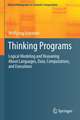
Thinking Programs: Texts & Monographs in Symbolic Computation
Autor Wolfgang Schreineren Limba Engleză Hardback – 30 aug 2025
| Toate formatele și edițiile | Preț | Express |
|---|---|---|
| Paperback (1) | 470.56 lei 6-8 săpt. | |
| Springer International Publishing – 24 oct 2022 | 470.56 lei 6-8 săpt. | |
| Hardback (2) | 476.56 lei 6-8 săpt. | |
| Springer – 30 aug 2025 | 476.56 lei 6-8 săpt. | |
| Springer International Publishing – 23 oct 2021 | 639.70 lei 6-8 săpt. |
Din seria Texts & Monographs in Symbolic Computation
-
 Preț: 378.58 lei
 - 20%
 Preț: 617.52 lei
 - 15%
 Preț: 615.97 lei
 - 20%
 Preț: 322.43 lei
 - 20%
 Preț: 619.58 lei
 - 15%
 Preț: 615.35 lei
 - 20%
 Preț: 893.64 lei
 - 15%
 Preț: 451.86 lei
 - 49%
 Preț: 504.69 lei
 - 15%
 Preț: 631.55 lei
 - 20%
 Preț: 335.61 lei
 - 20%
 Preț: 330.36 lei
 - 20%
 Preț: 330.48 lei
 - 15%
 Preț: 675.09 lei
 - 20%
 Preț: 1403.13 lei
 - 20%
 Preț: 630.91 lei
 - 18%
 Preț: 862.04 lei
 - 18%
 Preț: 972.17 lei
 - 15%
 Preț: 470.56 lei
 - 20%
 Preț: 1113.69 lei
 - 20%
 Preț: 489.35 lei
Preț: 476.56 lei
Preț vechi: 560.65 lei
-15%
Puncte Express: 715
Preț estimativ în valută:
84.21€ • 97.60$ • 73.43£
84.21€ • 97.60$ • 73.43£
Carte tipărită la comandă
Livrare economică 15-29 mai
Specificații
ISBN-13: 9783031997044
ISBN-10: 3031997042
Pagini: 664
Dimensiuni: 160 x 241 x 41 mm
Greutate: 1.1 kg
Ediția:Second Edition 2026
Editura: Springer
Seria Texts & Monographs in Symbolic Computation
ISBN-10: 3031997042
Pagini: 664
Dimensiuni: 160 x 241 x 41 mm
Greutate: 1.1 kg
Ediția:Second Edition 2026
Editura: Springer
Seria Texts & Monographs in Symbolic Computation
Cuprins
Part I The Foundations.- Syntax and Semantics.- The Language of Logic.- The Art of Reasoning.- Building Models.- Recursion.- Part II The Higher Planes.- Abstract Data Types.- Programming Languages.- Computer Programs.- Concurrent Systems.- References.- Index.
Notă biografică
Wolfgang Schreiner is an associate professor at the Research Institute for Symbolic Computation (RISC) of the Johannes Kepler University Linz, Austria. He is working in formal methods of computer science (with previous research in parallel computing and functional programming), and has produced various software packages related to formal semantics, specification, and verification, in particular the RISC ProofNavigator, the RISC ProgramExplorer, and the RISC Algorithm Language (RISCAL). Formerly he directed a degree programme on Computer-based Learning at the Upper Austria University of Applied Sciences in Hagenberg.
Textul de pe ultima copertă
This book describes some basic principles that allow developers of computer programs (computer scientists, software engineers, programmers) to clearly think about the artifacts they deal with in their daily work: data types, programming languages, programs written in these languages that compute from given inputs wanted outputs, and programs that describe continuously executing systems. The core message is that clear thinking about programs can be expressed in a single universal language, the formal language of logic. Apart from its universal elegance and expressiveness, this “logical” approach to the formal modeling of and reasoning about computer programs has another advantage: due to advances in computational logic (automated theorem proving, satisfiability solving, model checking), nowadays much of this process can be supported by software. This book therefore accompanies its theoretical elaborations by practical demonstrations of various systems and tools thatare based on respectively make use of the presented logical underpinnings.
Caracteristici
Theoretical constructions are illustrated by numerous examples that provide the reader with an intuitive understanding of the underlying ideas Each theoretical chapter concludes with the demonstration of some software that shows to the reader the practical applicability of the presented theory The book is accompanied by a web site that contains the source code of the demonstrations and examples for further self-study