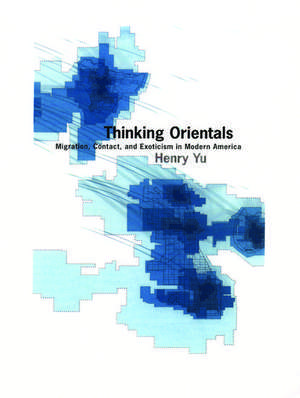
Thinking Orientals: Migration, Contact, and Exoticism in Modern America
Autor Henry Yuen Limba Engleză Hardback – mar 2001
Preț: 679.11 lei
Preț vechi: 984.63 lei
-31%
Puncte Express: 1019
Carte tipărită la comandă
Livrare economică 26 noiembrie-01 decembrie
Livrare prin curier în România Termenul estimat este afișat lângă disponibilitate.
Transport gratuit pentru acest produs Plată online sau ramburs, în funcție de opțiunile comenzii.
Retur gratuit în 14 zile Comandă securizată și suport în română.
Specificații
ISBN-13: 9780195116601
ISBN-10: 0195116607
Pagini: 288
Ilustrații: 7 halftones, 2 maps
Dimensiuni: 152 x 229 x 19 mm
Greutate: 0.58 kg
Editura: Oxford University Press
Colecția OUP USA
Locul publicării:New York, United States
ISBN-10: 0195116607
Pagini: 288
Ilustrații: 7 halftones, 2 maps
Dimensiuni: 152 x 229 x 19 mm
Greutate: 0.58 kg
Editura: Oxford University Press
Colecția OUP USA
Locul publicării:New York, United States
V-ar putea interesa
-
 -28%Preț: 368.33 lei512.23 lei
 -
 The Founding Fathers ReconsideredR. B. Bernstein-23%Preț: 147.23 lei190.46 lei
 -
 -11%Preț: 242.09 lei273.04 lei
 -
 Barack Obama: A Pocket Biography of Our 44th PresidentSteven J Niven-22%Preț: 53.85 lei68.72 lei
 -
 Maple Leaf Empire: Canada, Britain, and Two World WarsJonathan F. VancePreț: 268.15 lei
 -
 Fairness and Freedom: A History of Two Open Societies: New Zealand and the United StatesDavid Hackett Fischer-10%Preț: 263.77 lei294.49 lei
 -
 Beliefs and Superstitions of the Pennsylvania GermansEdwin Miller FogelPreț: 246.66 lei
 -
 The Forgotten ManAmity ShlaesPreț: 139.95 lei
 -
 Choctaw Crime and Punishment, 1884-1907Mihesuah DevonPreț: 272.41 lei
 -
 Dodge City: The Early Years, 1872-1886Wm B. ShillingbergPreț: 392.03 lei
 -
 Preț: 149.88 lei
 -
 The Rebel and the RoseWesley MillettPreț: 114.77 lei
 -
 Narratives of the French & Indian WarRobert EastburnPreț: 123.52 lei
 -
 Woodrow Wilson: USABrian Morton-18%Preț: 77.39 lei94.52 lei
 -
 Living in Two WorldsCharles EastmanPreț: 161.01 lei
Notă biografică
Henry Yu is Assistant Professor of History at the University of California, Los Angeles.
Recenzii
A tour de force. Henry Yu takes us on a dazzling journey through twentieth-century social science and identity politics. There is something new and provocative on every page, from Yu's deep analysis of the construction of the "oriental" in Chicago School sociology to his finely-drawn biographical vignettes of famous intellectuals and little known immigrants. Thinking Orientals will find a place on a short shelf of absolutely indispensable books on the changing concept of race in American history.
In this masterful and densely textured book, Henry Yu explores how American social scientists at the University of Chicago grappled with the 'Oriental problem' during the first half of the twentieth century. Offering rich insights on how theories of race and culture in American intellectual life were constructed, Thinking Orientals exposes the limitations of binary racial theories and offers us sophisticated ways of thinking about the complexity of contemporary race relations. This is an important book. It is one of the best intellectual histories of the concept of race I have read.
Elegantly written, keenly argued. Page after page, Thinking Orientals is aglitter with insights which will be important, not only for specialists in Asian American studies, but for anyone interested in the workings of 'race' on the American scene. Henry Yu brilliantly illuminates the mutual engagement of the social and the intellectual worlds-the power of ideas to disfigure the social landscape, and of existing social and institutional structures persistently to hem our thinking.
Thinking Orientals is a brilliant synthesis of ethnic studies and intellectual history. Henry Yu's wonderfully cogent interpretation of the creation, racialization, and replication of the scholarly study of American 'Orientals' should be required reading for all scholars and students seeking to understand the intimate connections between race, culture, knowledge, and power in modern American history.
Stylish, rigorous, dramatic, and unpredictable, this book makes enormous contributions to American Studies, to Asian American Studies, to the sociology of race, and to cultural studies. More than almost any other recent work, it shows what is gained for intellectual history by taking a broadly cultural approach. Yu surely places social science within a broader and highly unequal world and situates the creativity of a fascinating group of intellectuals of color within sharp constraints.
Dominating stereotypes have humble origins as explanations. This is a revealing history on how we in the United States have come to think the way we do on 'Orientals,' assimilation, and whiteness.
In this masterful and densely textured book, Henry Yu explores how American social scientists at the University of Chicago grappled with the 'Oriental problem' during the first half of the twentieth century. Offering rich insights on how theories of race and culture in American intellectual life were constructed, Thinking Orientals exposes the limitations of binary racial theories and offers us sophisticated ways of thinking about the complexity of contemporary race relations. This is an important book. It is one of the best intellectual histories of the concept of race I have read.
Elegantly written, keenly argued. Page after page, Thinking Orientals is aglitter with insights which will be important, not only for specialists in Asian American studies, but for anyone interested in the workings of 'race' on the American scene. Henry Yu brilliantly illuminates the mutual engagement of the social and the intellectual worlds-the power of ideas to disfigure the social landscape, and of existing social and institutional structures persistently to hem our thinking.
Thinking Orientals is a brilliant synthesis of ethnic studies and intellectual history. Henry Yu's wonderfully cogent interpretation of the creation, racialization, and replication of the scholarly study of American 'Orientals' should be required reading for all scholars and students seeking to understand the intimate connections between race, culture, knowledge, and power in modern American history.
Stylish, rigorous, dramatic, and unpredictable, this book makes enormous contributions to American Studies, to Asian American Studies, to the sociology of race, and to cultural studies. More than almost any other recent work, it shows what is gained for intellectual history by taking a broadly cultural approach. Yu surely places social science within a broader and highly unequal world and situates the creativity of a fascinating group of intellectuals of color within sharp constraints.
Dominating stereotypes have humble origins as explanations. This is a revealing history on how we in the United States have come to think the way we do on 'Orientals,' assimilation, and whiteness.