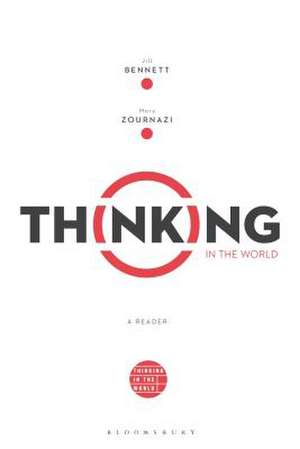
Thinking in the World: A Reader: Thinking in the World
Editat de Jill Bennett, Mary Zournazien Limba Engleză Paperback – 26 dec 2019
Thinking in the World showcases some of the most compelling arguments for a philosophy in action. Including wholly original, never-before-released material from Michel Serres, Alphonso Lingis, and Mieke Bal, the different chapters in this book constitute dialogues and approachable essays, as well as impassioned arguments for a particular way of approaching thinking in the world.

Preț: 197.31 lei
Preț vechi: 242.96 lei
-19%
Puncte Express: 296
Carte disponibilă
Livrare economică 09-23 noiembrie
Livrare prin curier în România Termenul estimat este afișat lângă disponibilitate.
Transport gratuit de la 400.00 lei Plată online sau ramburs, în funcție de opțiunile comenzii.
Retur gratuit în 14 zile Comandă securizată și suport în română.
Specificații
ISBN-13: 9781350069220
ISBN-10: 1350069221
Pagini: 368
Dimensiuni: 154 x 232 x 22 mm
Greutate: 0.54 kg
Editura: Bloomsbury Publishing
Colecția Bloomsbury Academic
Seria Thinking in the World
Locul publicării:London, United Kingdom
ISBN-10: 1350069221
Pagini: 368
Dimensiuni: 154 x 232 x 22 mm
Greutate: 0.54 kg
Editura: Bloomsbury Publishing
Colecția Bloomsbury Academic
Seria Thinking in the World
Locul publicării:London, United Kingdom
Cuprins
List of Illustrations
Introduction. Thinking in the world
Jill Bennett (University of New South Wales, Australia) and Mary Zournazi (University of New South Wales, Australia)
Part 1. Thinking worlds
Chapter 1. Revolutions in thinking
Michel Serres (Stanford University, USA) and Mary Zournazi
Chapter 2. The thinking that is in the world
Alphonso Lingis (Pennsylvania State University, USA)
Part II. Senses of place
Chapter 3. A phenomenology of thinking in place
Edward Casey (SUNY, Stony Book, USA) and Jeff Malpas (University of Tasmania, Australia)
Chapter 4. Attunement as architectural meaning
Alberto Perez-Gomez (McGill University, Canada)
Part III. Extended minds and bodies
Chapter 5. Embodying thought in skilful action
John Sutton (Macquarie University, Australia), Doris McIlwain (Macquarie University, Australia), Wayne Christensen (University of Warwick, UK) and Andrew Geeves (Independent Scholar, Australia)
Chapter 6. What does the stick do for the blind?
Lambros Malafouris (University of Oxford, UK)
Part IV. Technologies
Chapter 7. The distributed-centered subject
Hélène Mialet (York University, Canada)
Chapter 8. Dancing with the nonhuman
Petra Gemeinboeck (University of New South Wales, Australia)
Part V. Creativity
Chapter 9. Thinking in film
Mieke Bal (Emeritus Professor, University of Amsterdam, the Netherlands)
Chapter 10. Thinking through the cello
Tim Ingold (University of Aberdeen, UK)
Chapter 11. Aesthetic intelligence
Jill Bennett and Lynn Froggett (University of Central Lancashire, UK)
Part VI. Spectrums of experience
Chapter 12. Reading Leslie Marmon Silko's Ceremony with autist Jamie Burke, or remembering the sensorimotor future
Ralph James Savarese (Grinnell College, USA)
Chapter 13. The philosophical role of illness
Havi Carel (University of Bristol, UK)
Part VII. Economies, ecologies, politics
Chapter 14. Thinking love and politics in the world
Michael Hardt (Duke University, USA) and Mary Zournazi
Chapter 15. Thinking with interdependence: from economy/environment to ecological livelihoods
Ethan Miller (Bates College, Maine, USA) and J.K. Gibson-Graham (Western Sydney University, Australia)
Introduction. Thinking in the world
Jill Bennett (University of New South Wales, Australia) and Mary Zournazi (University of New South Wales, Australia)
Part 1. Thinking worlds
Chapter 1. Revolutions in thinking
Michel Serres (Stanford University, USA) and Mary Zournazi
Chapter 2. The thinking that is in the world
Alphonso Lingis (Pennsylvania State University, USA)
Part II. Senses of place
Chapter 3. A phenomenology of thinking in place
Edward Casey (SUNY, Stony Book, USA) and Jeff Malpas (University of Tasmania, Australia)
Chapter 4. Attunement as architectural meaning
Alberto Perez-Gomez (McGill University, Canada)
Part III. Extended minds and bodies
Chapter 5. Embodying thought in skilful action
John Sutton (Macquarie University, Australia), Doris McIlwain (Macquarie University, Australia), Wayne Christensen (University of Warwick, UK) and Andrew Geeves (Independent Scholar, Australia)
Chapter 6. What does the stick do for the blind?
Lambros Malafouris (University of Oxford, UK)
Part IV. Technologies
Chapter 7. The distributed-centered subject
Hélène Mialet (York University, Canada)
Chapter 8. Dancing with the nonhuman
Petra Gemeinboeck (University of New South Wales, Australia)
Part V. Creativity
Chapter 9. Thinking in film
Mieke Bal (Emeritus Professor, University of Amsterdam, the Netherlands)
Chapter 10. Thinking through the cello
Tim Ingold (University of Aberdeen, UK)
Chapter 11. Aesthetic intelligence
Jill Bennett and Lynn Froggett (University of Central Lancashire, UK)
Part VI. Spectrums of experience
Chapter 12. Reading Leslie Marmon Silko's Ceremony with autist Jamie Burke, or remembering the sensorimotor future
Ralph James Savarese (Grinnell College, USA)
Chapter 13. The philosophical role of illness
Havi Carel (University of Bristol, UK)
Part VII. Economies, ecologies, politics
Chapter 14. Thinking love and politics in the world
Michael Hardt (Duke University, USA) and Mary Zournazi
Chapter 15. Thinking with interdependence: from economy/environment to ecological livelihoods
Ethan Miller (Bates College, Maine, USA) and J.K. Gibson-Graham (Western Sydney University, Australia)
Recenzii
This volume is a remarkable collection of essays for its creative approach to the topic of thinking. The various essays effectively demonstrate the ways in which thinking does not merely take place in the brain but is embodied in our material and practical engagement with the world.
Here is a book to help us understand the ways we and the world are mutually obliged. A book leading us toward the ecological sensibility that we must learn quickly from the lively world that, for the moment, continues to host us.
Attuned to contemporary technologies that open new ways to engage mind-world relationships, this outstanding collection of critical and innovative phenomenological analyses provides a rich set of exciting interventions that respond in original ways to (both senses of) the question that Heidegger famously formulated: "What is Called Thinking?" / "What Calls for Thinking?"
Here is a book to help us understand the ways we and the world are mutually obliged. A book leading us toward the ecological sensibility that we must learn quickly from the lively world that, for the moment, continues to host us.
Attuned to contemporary technologies that open new ways to engage mind-world relationships, this outstanding collection of critical and innovative phenomenological analyses provides a rich set of exciting interventions that respond in original ways to (both senses of) the question that Heidegger famously formulated: "What is Called Thinking?" / "What Calls for Thinking?"